For the past several months, I have been commenting on the findings of the World Bank’s “Diagnosing Corruption in Ethiopia”, a 448-page report covering eight sectors (health, education, rural water supply, justice, construction, land, telecommunications and mining). In this my sixth commentary, I focus on “corruption in the justice sector”. The other five commentaries are available at my blog site.
Talking about corruption in the Ethiopian “justice sector” is like talking about truth in Orwell’s 1984 Ministry of Truth (“Minitrue”). The purpose of Minitrue is to create and maintain the illusion that the Party is absolute, all knowing, all-powerful and infallible. The purpose of the Ministry of Justice in Ethiopia is to create the illusion that the ruling regime under the command and control of the Tigrean People’s Liberation Front (TPLF) masquerading as the Ethiopian People’s Democratic Front (EPDRF) is absolute, all knowing, all-powerful and infallible.
I have long caricatured the “justice sector” of the TPLF/EPDRF as a kangaroo justice system founded on a sham, corrupt and whimsical legal process. What passes off as a “justice system” in Ethiopia is little more than a marketplace where “justice” is bought and sold in a monopoly controlled by one man supported by a few nameless, faceless and clueless men who skulk in the shadows of power. It is a justice system in which universal principles of law and justice are disregarded, subverted, perverted and mocked. It is a system where the poor, the marginalized, the audacious journalists, dissidents, opposition and civic society leaders are legally lynched despite the criticism and bootless cries of the international community. It is a system in which regime leaders, their families, friends and cronies are above the law and spell justice “JUST US”.
My first critique of the TPLF/EPDRF “justice system” appeared in 2006 when I wrote a 32-page analysis titled, “Keystone Cops, Prosecutors and Judges in a Police State.” It was written in the first year of what has become my long day’s journey into the dark night of advocacy against human rights violations in Ethiopia and Africa. The piece was intended to be a critical analysis of the trial of the so-called Kality defendants consisting of some 130 or so major opposition leaders, human rights advocates, civic society activists, journalists and others in the aftermath of the 2005 election. I tried to demonstrate that the show trial of those defendants was little more than a third-rate theatrical production staged to dupe the international community. I also tried to show how a dysfunctional and bankrupt judicial system was used to destroy political opposition and dissent. I described the “judicial proceedings” of the Kality defendants as “an elaborate hoax, a make-believe tribunal complete with hand-picked judges, trumped up charges, witless prosecutors, no procedures and predetermined outcomes set up to produce only one thing: a monumental miscarriage of justice.”
A glossy “diagnosis” of corruption in the Ethiopian justice sector
The WB’s “diagnosis” of corruption in “Ethiopia’s justice sector” is based on “interviews of 60 individuals” including “federal judges and prosecutors”, police, private attorneys, etc. in the capital and at another location. No ordinary citizens were included in the interview panel or the smaller focus groups. The study is intended to “explore the incidence of corruption in Ethiopia’s justice sector (including not only the courts but also several other organizations).” The “justice sector” includes, among others, “courts, police, prosecutors, administrative agencies with quasi-judicial powers, and public and private attorneys, prisons, and those in the executive and legislative branches responsible for enacting the laws and regulations governing their operations”.
The report begins with unusual disclaimers and apologia. The author proclaims that “this report begins from an agnostic standpoint—attempting only to document reality in Ethiopia’s justice sector and to compare it… with the situation elsewhere in African and other countries…” It is not clear what she means by “an agnostic standpoint”, but her analysis is frontloaded with servilely apologetic language manifestly intended not to offend or appear to point an accusatory finger at the ruling regime in Ethiopia. The report appears to have been written with some trepidation; perhaps the author was afraid of a backlash (tongue-lash) from the regime. The author timorously tiptoes around well-established and notorious facts about corruption in the regime’s justice sector. In light of the many disclaimers, reservations and contingencies in the report, it is obvious that the author does not want to call a spade a spade, so she calls the spade a bucket. But corruption by any disclaimer is still corruption; and Ethiopia’s justice sectors reeks of corruption.
The author claims an examination of “corruption in the justice sector is important because it undermines the peaceful resolution of conflicts, the control of corruption in other sectors, the strengthening of the normative framework underlying private and public actions (the rule of law), and the creation of a predictable environment for public and private transactions.” According to the study, corruption in the Ethiopian justice sector “takes one of two forms: (a) political interference with the independent actions of courts or other sector agencies, or (b) payment or solicitation of bribes or other considerations to alter a decision or action.” The study claims the “most common form of corruption involves bribes solicited by or offered to police to ignore a criminal offense, not make an arrest, or not bring witnesses or suspects to court (which can cause a provisional adjournment of the case). Traffic police are the worst offenders.” Another “common form of corruption” involves “payment of court staff to misplace case files or evidence” (a practice that has nearly disappeared because of new judicial policies on archive management introduced under a Canadian International Development Agency program”.
The author provides a catalogue of corrupt practices which she claims are disputed by various respondents in her study but include “(a) sales of judgments or other judicial actions in civil disputes; (b) lawyers’ solicitation of “bribes” that never reached the bench; (c) prosecutors’ misuse of their own powers, in response to bribes or political directives, to advance or paralyze a case; and (d) the corrupt actions of various officials entrusted with enforcement of judgments, especially in civil cases.” She attributes the divergence in viewpoints to a “likely gap between perceptions and reality [which] are partly a function of the persistent lack of transparency in personnel policies.”
What is remarkable about the WB “justice sector” study is the fact that the author, by focusing on the “most common form of corruption” (i.e. petty police, particularly traffic police, corruption), fails to critically probe grand corruption involving party officials and regime leaders and their cronies who routinely subvert the justice system through political interference and pressure to protect their political and economic interests. She circumvents serious inquiry into grand corruption in the “justice sector” by providing catalogues of “potential forms of criminal and civil corruption” and “corruption risks”. She appears averse to investigating high-level corruption that occurs in the process of judicial appointment of handpicked party loyalists and hacks, laws written to aid certain elites in society, or in the debasement and corruption of the integrity and independence of the judiciary. She ignores the type of justice corruption that occurs in “state capture” where economic elites develop cozy relationships with political and judicial officials through whom they obtain favorable judicial decisions to advance their own advantage. For instance, on the issue of political interference in the judicial process, the author demonstrates her “agnosticism” by reporting that “the one who came closest eventually admitted that ‘there was some [political interference], but it was very rare.’” Other responses ranged from ‘a moderate amount’ (limited to the bad apples) to the extreme of holding that ‘every civil judgment is sold.’”
Curiously, the author points an accusatory finger at petty corruption as the “most common form of corruption” distracting attention from the systemic and structural corruption in the justice sector. The importance of petty corruption must not be understated because of the serious impact it has on the lives and livelihoods of ordinary citizens interacting with police, prosecutorial and other petty judicial officials. There is ample anecdotal evidence of petty corruption in which ordinary Ethiopian citizens and businesspersons are “shaken down” by traffic cops or minor functionaries in the judicial or state bureaucracy seeking small bribes. However, though petty corruption may be easier to detect, the real focus should be on grand corruption which is systemic, structural and difficult to detect and nearly impossible to punish. Structural and systemic corruption in the legal institutions, rules, and norms and those who are practitioners in the system create, maintain and sustain a culture of corruption in the justice sector, which the author appears to overlook.
Justice corruption is primarily a systemic failure of judicial institutions, lack of political will and capacity to manage judicial resources, maintain integrity of institutions. The author makes abstract references to the usual catalogue of corruption variables but does not seek to gather data to illuminate the scope, breadth and gravity of the problem of political interference and lack of accountability in the justice system. Grand corruption in the justice sector stems from the fact that political officials have wide authority over judicial officials (from appointment to management of judicial functions); and political officials have little accountability and incentive to maintain the integrity of the justice sector. There are few functional formal systems of control in the relationship between the judicial and political processes in Ethiopia. If there ever were control systems, they have been broken for a long time making it nearly impossible to administer fairly the laws while maintaining accountability in the form of a robust reporting system and transparency in the form of robust management practices. Such institutional decay has promoted the growth of a culture of corruption in the justice sector and continues to undermine not only the broad adjudicatory role of justice sector institutions but also public confidence in the integrity of the justice system itself.
Justice sector in a police state?
Justice in a dictatorship is to justice as military music is to music. No reasonable person would consider martial law (military rule) to produce justice. By definition dictatorship — a form of government in which absolute power is concentrated in the hands of a dictator or a small clique — is the quintessential definition of injustice. Any form of government that operates in flagrant disregard of the rule of law is inherently corrupt.
I have on previous occasions tried to expose such corruption in Ethiopia’s “justice sector” with anecdotal evidence of arbitrary administration of justice or denial of fair trial to those accused of “terrorism”, “treason” and even “corruption”, opposition leaders, human rights advocates, journalists, etc. In the kinder and gentler police state that Ethiopia has become, any petty “law enforcement” official of the regime has the power to arrest and jail an innocent citizen. As I argued in my February 2012 commentary, “The Prototype African Police State”, a local police chief in Addis Ababa felt so arrogantly secure in his arbitrary powers that he threatened to arrest a Voice of America reporter stationed in Washington, D.C. simply because that reporter asked him for his full name during a telephone interview. “I don’t care if you live in Washington or in Heaven. I don’t give a damn! But I will arrest you and take you. You should know that!!”, barked the impudent police chief Zemedkun. If a flaky policeman can exercise such absolute power, is it unreasonable to imagine those at the apex of power have the power to do anything they want with impunity. The regime in Ethiopia is the petri dish of corruption and living proof that power corrupts and an absolute power corrupts absolutely.
In my view, denial of due process (fair trial) is the highest form of corruption imaginable in the “justice sector” because it results in the arbitrary deprivation of a person’s life, liberty and property. Could anyone (other than those politically connected) really expect to get a fair trial in the regime’s kangaroo courts or fair treatment in the pre-trial process?
The systemic corruption in the “justice sector” is that the law of the land is ignored, disregarded and perverted at the whim and fancy of those in power. For instance, the presumption of innocence (Eth. Const. Art. 20(3)) is openly flouted. The late leader of the regime used to routinely and publicly talk about the guilt of opposition leaders, journalists and others standing trial without so much of an awareness of the suspects’ right to a presumption of innocence or appreciation of the risk of prejudicial pretrial publicity emanating from such inflammatory statements which are prohibited under the Constitution and other international human rights regimes (e.g. Article 11 of the Universal Declaration of Human Rights, Article 14(2) of the International Covenant on Civil and Political Rights (ICCPR) and Article 7(b) of the African Charter on Human and People’s Rights (ACHPR)). In 2011, the late leader of the regime proclaimed the guilt of freelance Swedish journalists Johan Persson and Martin Schibbye on charges of “terrorism” while they were being tried and he was visiting Norway. He emphatically declared the duo “are, at the very least, messenger boys of a terrorist organization. They are not journalists.” Persson and Schibbye were “convicted” and sentenced to long prison terms.
Show trials by publicity and demonization are another hallmark of the regime’s justice system. Following the 2005 election, the late leader of the regime publicly declared that “The CUD (Kinijit) opposition leaders are engaged in insurrection — that is an act of treason under Ethiopian law. They will be charged and they will appear in court.” They were charged, appeared in “court” and were convicted. In December 2008, the late leader railroaded Birtukan Midekssa, the first female political party leader in Ethiopian history, without so much as a hearing let alone a trial. He sent her straight from the street into solitary confinement and later declared: “There will never be an agreement with anybody to release Birtukan. Ever. Full stop. That’s a dead issue.” In making this statement, the late leader proclaimed to the world that he is the law and the ultimate source of justice in Ethiopia. His words trump the country’s Constitution!
In 2009, one of the top leaders of the regime labeled 40 defendants awaiting trial as “desperadoes” who planned to “assassinate high ranking government officials and destroying telecommunication services and electricity utilities and create conducive conditions for large scale chaos and havoc.” They were all “convicted” and given long prison sentences.
Violations of the constitutional rights of those accused of crimes by the regime are rampant. Article 20 (2) provides, “Any person in custody or a convicted prisoner shall have the right to communicate with and be visited by spouse(s), close relatives and friends, medical attendants, religious and legal counselors.” Internationally celebrated Ethiopian journalists including Reeyot Alemu, Woubshet Taye and many others were denied access to legal counsel for months. Ethiopian Muslim activists who demanded an end to religious interference were jailed on “terrorism” charges were also denied access to counsel. They were mistreated and abused in pretrial detention. Scores of journalists, opposition members and activists arrested and prosecuted (persecuted) under the so-called anti-terrorism proclamation were also denied counsel and speedy trials and have languished in prison for long periods. Suspects are interrogated without the presence of counsel and coerced confessions extracted. Yet, Article 19 (5) provides, “Everyone shall have the right not to be forced to make any confessions or admissions of any evidence that may be brought against him during the trial.”
Article 19 (1) provides, “Anyone arrested on criminal charges shall have the right to be informed promptly and in detail… the nature and cause of the charge against him… Article 20 (2) provides, “Everyone charged with an offence shall be adequately informed in writing of the charges brought against him. Recently, the regime arrested members of its officialdom and their cronies on suspicion of corruption and kept the suspects in detention for months without informing them “promptly and in detail the charges against them”. Although the regime’s “top anti-corruption official” claimed that the corruption “suspects have been under surveillance for two years”, on their first court appearance, the prosecutors requested a 14-day continuance to gather more evidence! There is no judicial system in the world where suspects are arrested of committing crimes after being investigated for 2 years and then the prosecution asks for endless continuances to gather additional evidence.
Injustice impersonating justice
The 2012 U.S. State Department Human Rights report concluded, “The law provides for an independent judiciary. Although the civil courts operated with a large degree of independence, the criminal courts remained weak, overburdened, and subject to political influence.” The WB could have done a much better job of “diagnosing corruption” in Ethiopia’s “justice sector”. Candidly speaking, any deficiency in the report should not reflect exclusively on the World Bank or its consultants but on Ethiopians, particularly the Ethiopian intelligentsia, who do not seem find it worth their time or effort to read, challenge and supplement such reports. It seems few, very few, Ethiopian scholars and analysts take the time and effort to locate, study and critically analyze such important studies done by international institutions and other private research institutions.
I doubt the WB justice sector study will be of much value to policy makers, scholars or the casual reader. Having said that, the burden is on Ethiopian scholars in Ethiopia and abroad to work collaboratively and carefully document corruption in Ethiopia’s justice and other sectors. No study of Ethiopia’s justice sector is worthy of the title if it does not rigorously evaluate the factors that are at the core of corruption in the “justice sector” – absence of the rule of law, lack of independence of the judiciary, absence of due process, lack of impartiality and neutrality in the judicial process, the culture of corruption and impunity and the lack of accountability, transparency and confidence in the legal system. Such a study is the principal responsibility of Ethiopians, not the World Bank or its consultants. On the other hand, when the sword of justice is beaten into a sledgehammer of injustice, it is the supreme duty of ordinary citizens to expose it!
Professor Alemayehu G. Mariam teaches political science at California State University, San Bernardino and is a practicing defense lawyer.
Previous commentaries by the author are available at:
http://open.salon.com/blog/almariam/
www.huffingtonpost.com/alemayehu-g-mariam/
Amharic translations of recent commentaries by the author may be found at:
Meles Zenawi when he was alive and his apostles today (“Melesistas”) keep playing us in the Diaspora like a cheap fiddle. They make us screech, shriek, scream and shout by simply showing their mugs in our cities. How do they do it? Every now and then, the Melesistas suit up a few of their bumbling and bungling zombies from central casting and unleash them into the Ethiopian Diaspora to “sell bonds” for the “Grand Meles Dam” to be built over the Blue Nile. Anytime these zombies show up to panhandle chump change from their supporters, a welcoming committee of defiant and patriotic Ethiopian activists show up to chase them out of town like campers at a national park chasing coyotes scrounging at the trash bin. For the past several weeks, Diaspora activists have been routing these imposters across European and American cities; but incredibly, these brazen con artists show up in the next city like snake oil salesmen at a carnival. That really piqued my curiosity. Why do these scammers show up in city after city knowing that they will be confronted and chased out by young patriotic Ethiopians? Are they really fundraising by “selling bonds” in the Diaspora or are they using “fundraising” as a cover for something altogether different? Ummm!!!
First, the irrefutable facts about the Meles Dam hogwash. As I demonstrated in my March 11 commentary, “Rumors of Water War on the Nile?”, the Meles Dam on the Blue Nile (Abay River) was the exquisite figment of Meles’ imagination, and now the phantasmic idol of worship for his discombobulated apostles. Anyone who bothers to study the facts of this so-called dam project will readily conclude that it is pie in the sky. It is “self-funded” because the multilateral lending institutions and private investors who normally bankroll such major infrastructure projects wouldn’t touch it with a ten foot pole standing a mile away. They have determined it is a white elephant. Egypt has also used its leverage to block funding sources. Egypt has contingency military plans to undam the dam if it ever comes on line.
The fact of the matter is that it is impossible for the bumbling regime in Ethiopia, which sustains itself through international panhandling, to raise the USD$6-10bn needed from the people of the second poorest country in the world. The regime does not even have sufficient foreign reserves to cover the cost of imports for three months. Its foreign debt exceeds USD$12bn; and despite windbagging about an 11 percent annual growth, the “fifth fastest growing economy in the world”, yada, yada, unemployment, inflation, mismanagement and corruption have put on life support an economy addicted to international handouts. The idea that nickels and dimes collected from Ethiopians in the country by staging “musical concerts, a lottery and an SMS campaign” and a buck or two from Diaspora Ethiopians could build such a project is simply nutty. Because the dam builders live in a fool’s paradise, they think Diaspora Ethiopians are all “fools and idiots” who will buy fantasy dam bonds. (Just as an aside, those who are buying Meles Dam junk bonds should first consider buying the Brooklyn Bridge in New York City.) Anyway, the Diaspora “bond sales” effort has been a total failure. The regime recently announced that it had collected $43,160 from its latest bond sales in San Diego, CA. Yeah! Right!
For domestic public relations purposes, the Melesistas’ strategic objective in pushing the Meles Dam hoax is to create patriotic fervor and galvanize the entire population around an object of national pride while deifying Meles and generating political support for themselves to prolong their lease on political power. The Meles Dam would at once be a hydrological temple to worship “Meles the Great Leader and Visionary” and a symbolic object of national unity that could rally massive support for the regime. The Melesistas have convinced themselves that by talking about the Meles Dam 24/7, 365 days, they can convince the people that the dam is actually under construction. They blather about building the “largest dam in Africa” and Ethiopia becoming a middle income country and a formidable regional economic power in just a few years. They talk about their “visionary leader” and how they will blindly follow his vision to the end of the rainbow where they will collect their pot of gold in the form of Meles Dam bonds. They march on chanting their mantra: “We will follow Meles’ vision without doubt or question.”
They must really think the people are “fools and idiots” (to borrow a phrase from Susan Rice) to be fooled by their silly dog and pony show and talk of pie in the sky. The Ethiopian people may not know about a “pie in the sky”, but they certainly know about the “cow they have in the sky whose milk they never see.” But careful analysis shows the Melesistas have pulled this one right out of Joseph Goebbel’s bag of tricks: “If you tell a lie big enough and keep repeating it, people will eventually come to believe it. The lie can be maintained only for such time as the State can shield the people from the political, economic and/or military consequences of the lie. It thus becomes vitally important for the State to use all of its powers to repress dissent, for the truth is the mortal enemy of the lie, and thus by extension, the truth is the greatest enemy of the State.” Isn’t this exactly what the Melesistas are doing in Ethiopia now – repeat the dam lie, development lie and repress dissent and persecute journalist who tell the truth?
The Melesistas think they are so smart that they can hoodwink not only Ethiopians in the country but also those in the Diaspora. They put on a dam “bond selling” show to convince Diasporans that the Meles Dam is real and that it is the panacea to Ethiopia’s economic woes. “Buy dam bonds! Ethiopia will be rafting on a river of milk and honey once the Blue Nile is dammed.” But only a damned fool would believe that. According to the World Bank, Ethiopia’s “power sector alone would require $3.3 billion per year to develop” in the next decade. Currently, power tariffs are so underpriced that they range between “$0.04-0.08 per kilowatt-hour” and are “low by regional standards and recover only 46 percent of the costs of the utility.” For every dollar they spend supplying power, they lose 54 cents! In other words, these guys hawking the Meles Dam junk bonds and promising billions in profits are losing their shirts on the power they are selling right now! Why would anyone trust and buy dam bonds from those who can’t even make a damn profit from existing dams? Why would anyone buy dam junk bonds when the outlook for the energy sector in Ethiopia is so damn bleak? The Melesistas fantasize that they can pay off bondholders by selling power from the dam to the Sudan, Egypt and the Arabian peninsula. Why the hell would Egypt or the Sudan buy power from a dam that damns them by effectively reducing their water supply for agriculture and their own production of power?
The real aim of the Meles Dam is not the construction of a dam over the Blue Nile but to use the specter of the construction of a gargantuan dam on the Nile to inspire fear, loathing and dread of an imminent regional water war. Simply stated, the dam idea is an extortion scheme to scam the international community and downstream countries for more aid and loans as a price for continued regional stability, avoidance of conflict and maintenance of the status quo. Suffice it to say, one has to be a damned “fool and an idiot” to believe the Meles Dam will ever be built or buy Meles Dam junk bonds and expect a return. (Buying the Brooklyn Bridge is a much better investment.)
Shadowboxing Smoke and Mirrors
So, why do the Melsistas send zombies into the Diaspora on a fool’s errand? They know they will be shamed and disgraced and chased out of every American and European city like stray dogs at a bazaar. They know they will be lucky to squeeze a few hundred dollars at a Diaspora “bond selling” event. Do they do it because they are professional beggars and panhandlers?
There is a deceptively simple method to their madness. They send their zombies in the Diaspora to make us shadowbox smoke and mirrors. They are playing a simple but clever psychological game.
The Melesistas are getting hammered everyday by bad publicity. Hardly a day passes without some report by an international human rights, press or research organization documenting their monumental crimes against humanity. Just in the past few months, there have been numerous reports and press releases by Human Rights Watch, the Committee to Protect Journalists and a host of newspaper and television outlets, including Al Jazeera and CNN, on massive human rights violations, land grabs, ethnic cleansing, suppression of religious freedom and other issues in Ethiopia. Recently, the World Bank made public a 448-page corruption report on Ethiopia. A couple of weeks ago, the U.S. State Department released its annual Human Rights Report on Ethiopia documenting the regime’s “arbitrary killings, torture, beating, abuse, and mistreatment of detainees by security forces, harsh and life-threatening prison conditions, arbitrary arrests and detentions, detention without charge and lengthy pretrial detention, illegal searches, “villagization” (pillagization) program, restrictions on freedom of assembly, association, and movement, interference in religious affairs…” This past week, they got clobbered in the international press for a kangaroo appellate court affirmance of the 18-year sentences of the internationally-acclaimed journalist Eskinder Nega and dynamic opposition leader Andualem Aragie.
The Melesistas have become international pariahs and desperately want to change the topic from Eskinder Nega, Reeyot Alemu, Woubshet Taye, Andualem Aragie…, corruption, ethnic cleansing, land giveaways, suppression of religious freedom and interference in religious affairs and critical human rights reports. They want to take control of the international public relations agenda. They want to shed off their international image as corrupt thugs who trample on human rights and steal elections. They want to reinvent themselves as anti-poverty warriors and statesmen of economic development. They want to be seen as the new “new breed of African leaders” toiling indefatigably to eradicate poverty and promote economic development and democracy.
In a Machiavellian maneuver, they have, to some extent, succeeded in getting Diaspora Ethiopians, particularly the activists, to promote their “dam development” agenda for them in America, Europe and elsewhere. Every time Diaspora activists confront the zombie junk bond dealers and brokers, they are seen talking (but saying nothing) about development, growth, infrastructure projects and how the Meles Dam will transform Ethiopia into an economic powerhouse. (They never mention the massive foreign debt, the USD$12bn that has left the country illegally since 2001, the massive youth unemployment, accelerating population growth, etc.). They always sheath their bloody hands in the glove of development talk. When activists protest and confront these zombies, they appear to be anti-development obstructionist agitators. That’s is the exquisite trick of the Melesistas. They want the world to see Diaspora Ethiopians as a bunch of rowdy, wild, disorderly, loudmouthed, raucous, uncivil and intolerant bunch who will not even allow civil discussions of “development”. They aim to create and nurture the image of a few combative “Diaspora extremists” and an overwhelming number of silent (as a church mouse) regime supporters who are afraid to come forward (or attend their “bond selling” events) and show their support for fear of attack by the “extremists.” In the mix are the hapless Diasporans who have to go back and forth to Ethiopia to secure their property and business interests. Those guys are toast; either they pay protection money (buy dam bonds) or get jacked up on some trumped up charge and lose their properties or worse.
The Melesistas’ strategy to counter bad publicity and capture the domestic and international public relations commanding heights is based on three principles: Distract, distract and distract some more. Distract Ethiopians inside the country from critical political, social and economic issues by bombarding them with inane development propaganda. State television (which is watched by virtually no one in the country) is filled with ceaseless barrages of nauseating and mind numbing amateur development propaganda. It is vintage police state propaganda aimed at convincing a largely illiterate population that famine is plenty, decline is development, poverty is wealth, dictatorship is democracy and the man who destroyed the country is its savior.
The second strategy is to distract Diaspora Ethiopians from vigorously pursuing an agenda that promotes democracy freedom and human rights. They unleash a few smooth-talking empty suits with empty heads and let them wander from one city to another in the U.S. and Europe just to get Ethiopian activists emotionally worked up about a fantasy dam and lose their focus on issues of human rights violations, abuse of political prisoners, ethnic cleansing, suppression of religious freedoms, and myriad economic problems. Some Diaspora activists react vigorously whenever they see these hapless empty suits at “bond selling” events believing they are confronting the master criminals. Therein lies the trick. The Melesistas are so clever that they have succeeded in making some of us believe that the puppets are actually the puppet masters. We need to be aware that the empty suits they send into the Diaspora to sell the dam bonds are just schmucks and buffoons who do what they are told; or “zombies” as the great African musician Fela Kuti would have called them (“Zombie go… zombie stop…zombie turn…zombie think…” ) They are bait and are offered as scapegoats to the Diaspora. By chasing the puppets out of town, some of us feel we have chased out the puppet masters. But the puppet masters laugh at us because our victory is the victory of the shadow boxer who knocked out the shadow.
The third strategy of the Melesistas is to distract donors and human rights organizations from criticizing them on their atrocious human rights record. They want to justify and convince them that the masses of ordinary Ethiopians are interested in the politics of the belly and not the politics of the ballot. Meles declared, “My view is that there is no direct relationship between economic growth and democracy historically or theoretically.” They want to convince donors and human rights organizations that the masses do not care about human rights or democracy; they are concerned only about filling their bellies. To them, the masses of poor, illiterate, hungry and sick Ethiopians are too dumb and too damn needy to appreciate “political democracy.”
Legacy of the great manipulator
Manipulation of the Diaspora is one of the chief legacies of Meles. Wikileaks cablegrams portray Meles as a slick, scheming, crafty and cunning hombre. He could have achieved greatness but undid himself because he was unable to tame his voracious appetite for extreme vindictiveness and revenge and could not bridle his bottomless capacity for maliciousness, viciousness and obduracy. Those who claim to know Meles say he knew his opposition better than the opposition knew itself. Distraction, diversion, misdirection, hoodwinking, chicanery, paralogy and sophistry were the hallmarks of Meles’ strategy. The cunning dictator was able to shroud his corrupt empire for two decades by pursuing a propaganda policy of mass distraction and by staging one farcical political theatre after another. As I have long maintained, Meles’ “attitude was that he can outwit, outthink, outsmart, outplay, outfox and outmaneuver boatloads of Ph.Ds., M.Ds., J.Ds. Ed.Ds or whatever alphabet soup of degrees exist out there any day of the week. He seemed to think that like the opposition leaders, Ethiopian intellectuals are dysfunctional, shiftless and inconsequential, and will never be able to pose a real challenge to his power.” In a rare moment of candor responding to a journalist’s question about Diaspora Ethiopians protesting his overseas visits, Meles confessed, “We may be at fault in some way. I am sorry. That maybe we didn’t communicate well enough to those Ethiopians living abroad what is happening, what we are doing here.” Meles’ apostles keep making the same mistake. Like shepherd, like sheep! Like Meles, like Melesistas!
Criminal violations in selling unregistered securities in the U.S.
There have been questions raised about the legality of the sale of Meles Dam bonds as “securities” in the U.S. Under federal and most state laws, a “security” is broadly defined and includes stocks, bonds, debt and equity securities, notes, investment contracts, etc. Unless exempted, all securities must be registered with the Securities and Exchange Commission (SEC) and/or relevant state agencies prior to selling or offering for sale to the public. A security which does not have an effective registration statement on file with the SEC and/or the relevant state agency is considered an unregistered security. Buying or selling unregistered securities is a crime under federal and state laws. The SEC can prosecute issuers and sellers of unregistered securities under section 20(b) of the Securities Act of 1933 (which regulates original issuers) and seek injunctions if the Securities Act has been violated, or if a violation is imminent. Section 8A also allows the SEC to issue orders to issuers of unregistered securities to cease and desist and seek civil penalties under Section 20(d) if an issuer violated the Securities Act, an SEC rule, or a cease-and-desist order.
Like most states, California Corporations Code sections 25110-25118 set strict guidelines for any securities sold in that state. Any person or entity who willfully sells or transports unregistered securities through interstate commerce or buys such securities could face serious criminal liabilities under California Corporations Code section 25540, subd. (a) with penalties of incarceration for up to three years and a fine up to $1 million. California prosecutors, like their federal counterparts, could also seek injunctive relief and civil penalties.
There are a few limited exemptions to the registration requirement. One of them is an exemption “for certain foreign government securities brokers or dealers”. Pursuant to 17 CFR 401.9, “A government securities broker or dealer (excluding a branch or agency of a foreign bank) that is a non-U.S. resident shall be exempt from the provisions of sections 15C(a), (b), and (d) of the Act (15 U.S.C. 78o–5(a), (b) and (d)) and the regulations of this subchapter provided it complies with the provisions of 17 CFR 240.15a–6…” In other words, the bond “brokers and dealers” sent to the U.S. to sell the Meles Dam bonds must meet the multifarious requirements of federal securities law and other regulatory requirements including full disclosure, proof of maintenance of required books and records relating to the bond issues and written consent to service of process for any civil action arising from disputes in bond related transactions. It is highly unlikely that the “brokers and dealers” selling the Meles Dam bonds in the United States qualify under 17 CFR 240.15a–6 and 15 U.S.C. 78o–5(a).
Fight the Power, not the smoke and image in the mirror
Diaspora activists should keep their eyes on the prize, not on the smoke and mirrors of the Melesista Road Show, Carnival and Circus.
Ethiopian Americans are fortunate to live under a Constitution that guarantees our right to free expression and peaceful protest. As citizens, it is our moral duty to exercise our constitutional rights. We have recently seen Americans using their right to protest by launching the “Occupy” protest movement. Historically, the civil rights movement relied on sit-ins, sit downs, teach-ins, rallies and marches as a form of direct nonviolent action to bring about change. Nonviolent mass protests eventually led to passage of the Civil Rights Act of 1964 which ended racial segregation, and the Voting Rights Act of 1965 which removed barriers to voting. The anti-war and free speech movements relied on non-violent protests to defend expressive freedoms and end the war in Vietnam. Nonviolent protests were also used in the anti-Apartheid movement in the U.S. resulting in boycotts, divestments in corporations and spurring legislative and diplomatic action which hastened the end of Apartheid.
The main point is that Diaspora Ethiopians should be laser-focused on the prize and make sure that democracy will in the end triumph over dictatorship in Ethiopia; human rights are vindicated and human rights abusers are held accountable and any government in Ethiopia shall fear the people and the people shall never fear their government. We should not be distracted by empty suits with empty heads lurking in and out of town to scrounge up chicken feed. We should not be angry at programmed zombies at “bond selling” events because they are just wretched flunkies and bootlickers, who given the opportunity will make a beeline to the immigration office to file for political asylum. We should not mistake the puppets for the puppet masters. We should not confuse shadow for reality.
We should be aware not only when we are being abused but also used. We should never let them make us do their dirty jobs because they can cleverly manipulate our psychological disposition to righteous indignation. We should never react because that allows them to take control of our emotions and reactions. We should always act and never react. Most importantly, we should engage in proactive activism instead of reactive activism. When we are proactive, we plan things out carefully and strategically. Nonviolent protest is a highly disciplined effort. Dr. Martin L. King, Jr. taught, “In any nonviolent campaign there are four basic steps: collection of the facts to determine whether injustices exist; negotiation; self-purification; and direct action.” We should educate and train ourselves in the ways of nonviolent protest. When confronting the zombies, we should maintain a high degree of composure and display self-dignity in our expressions of defiance. At dam “bond selling ” events, protesters should adequately prepare pre-event publicity. Serious attention should given to the development of press kits and talking points. Press and law enforcement liaisons should be trained and designated. Well informed and articulate spokespersons should be selected to give press interviews. Adequate attention should be given to post-event follow up activities.
It is a great disservice to oneself and to our great cause to engage in nonviolent protest without reading and understanding Gene Sharp’s extraordinary work, “From Dictatorship to Democracy”available online for free. An Amharic translation of Gene Sharp’s book is also available online free of charge (here) for anyone to download or print. Ignorance cannot drive out ignorance, only knowledge can. We must educate ourselves in the ways of peaceful protest, or our efforts will produce few results. We are less likely to be manipulated if we keep ourselves informed and develop critical analysis skills that cut through the blather of our adversaries.
While those of us in the older generation (“Hippos”) wallow in self-pity and cynicism, it is inspiring to see young patriotic Diaspora Ethiopians (“Cheetahs”) using their right to peaceful protest to resist the zombies of tyranny. Just as the task of building a fantasy dam belongs to the Melesistas, the construction of the new Ethiopia is a task reserved for the young Cheetahs. It is painful to admit that we Hippos have not been much of a role model for the Cheetahs. We have unkindly criticized the Cheetahs for their lack of engagement, apathy and single-minded pursuit of flash and cash. We grumble that the Cheetah generation is the lost generation and there is no one to save Ethiopia (but it has been a long time since we Hippos looked into the mirror without smoke).
I am afraid there is little that Ethiopian Cheetahs could learn from Ethiopian Hippos. Perhaps Ethiopian Cheetahs can get inspiration from other Cheetahs. In the past 2 years, we have seen inexperienced youth using social media bring down dictators or force them to make radical changes in governance in North Africa and the Middle East. The key to their success was their ability to get in tune and on the same wavelength with each other, and to be able to speak the same beautiful language of peaceful change and protest. As always, I believe Ethiopian youth united — across ethnic, religious, linguistic, gender, and regional lines — can never be defeated!
“Get up, stand up, stand up for your rights. Get up, stand up, don’t give up the fight.” Bob Marley
Professor Alemayehu G. Mariam teaches political science at California State University, San Bernardino and is a practicing defense lawyer.
Previous commentaries by the author are available at:
http://open.salon.com/blog/almariam/
www.huffingtonpost.com/alemayehu-g-mariam/
Amharic translations of recent commentaries by the author may be found at:
…. My view is that there is no direct relationship between economic growth and democracy historically or theoretically. But my view is that democracy is a good thing in and of itself irrespective of its impact on economic growth. And my view is that in Africa most of our countries are extremely diverse, that may be the only possibility, the only option of keeping relationships within nations sane. Democracy may be the only viable option for keeping these diverse nations together. Sowe need to democratize but not in order to grow. We need to democratize in order to survive as united sane nations. That’s my view. But I don’t believe in this nighttime, you know, bedtime stories and contrived arguments linking economic growth with democracy. There is no basis for it in history and in my view no basis for it it in economics. And there is no need to have this contrived argument because the case for democracy and can stand and shine on its own…
While visiting Ghana in 2009, President Obama told the following “contrived bedtime story linking economic growth with democracy” to Africans:
Development depends on good governance. History offers a clear verdict: Governments that respect the will of their own people, that govern by consent and not coercion, are more prosperous, they are more stable, and more successful than governments that do not. No country is going to create wealth if its leaders exploit the economy to enrich themselves. No person wants to live in a society where the rule of law gives way to the rule of brutality and bribery. That is not democracy, that is tyranny. And now is the time for that style of governance to end…. In the 21st century, capable, reliable, and transparent institutions are the key to success — strong parliaments; honest police forces; independent judges; an independent press; a vibrant private sector; a civil society. Those are the things that give life to democracy, because that is what matters in people’s everyday lives…. History is on the side of these brave Africans, not with those who use coups or change constitutions to stay in power. Africa doesn’t need strongmen, it needs strong institutions. With better governance, I have no doubt that Africa holds the promise of a broader base of prosperity….
My Favorite Bedtime Stories
I enjoy bedtime stories as much as the next guy. My favorite is “Pinocchio in Africa”. The wooden puppet wanted to become a human boy but could not stop telling lies and tall tales. Whenever Pinocchio lied, his nose grew longer.
I like the story of “Puff the Magic Dragon and the Land of Living Lies”. Puff took a little girl called Sandy, who lies a lot, to the Land of the Living Lies where honesty and truthfulness are prosecuted. She meets the famous fibbers Pinocchio and the boy who cried wolf; and saw the famous purple cow that no one has ever seen and a pink elephant.
I also enjoy the morality tales of Aesop, the ancient Ethiopian storyteller. Once upon a time there was a wolf who schemed to snatch sheep grazing in the pasture, but could not because the shepherd was vigilant. One day the wolf found the shorn skin of a sheep and dressed himself in it and joined the flock. Soon he began dining on the sheep one by one until he was discovered by the shepherd. That was the end of the wolf; he could no longer steal, kill and eat the sheep.
George Orwell’s allegorical stories of doubletalk and doublespeak told in “political language” are rather delightful because they “make lies sound truthful and murder respectable, and give an appearance of solidity to pure wind.” So, “War is peace. Freedom is slavery. Ignorance is strength.” George could have added, “dictatorship is democracy. Tyranny is liberty. Poverty is wealth. Famine is plenty. Censorship is press freedom. Brutality is civility. Mendacity is veracity. Opacity is clarity. Shadow is reality. Depravity is morality and greed is good.”
Oh, Yes! I like children’s rhymes too:
Humpty Dumpty sat on a wall Humpty Dumpty had a great fall….
Sane Nations, Insane Dictators and Democrazy
Zenawi said “democracy is the only option of keeping relationships within nations sane”. Here are some true stories of democrazy from the Land of Living Lies:
In April 2008 local elections were held throughout Ethiopia. Freedom House and USDoS report that opposition candidates were subjected to intimidation and arrest by the government prior to the elections making it difficult for them to compete, leading to the opposition boycotting the elections and resulting in a massive victory for government supporters. The ruling party won 99% of the more than three million seats contested.
The May 2010parliamentary elections resulted in a 99.6 percent victory for the ruling EPRDF and its allies,reducing the opposition from 174 to only two seats in the 547 member lower house… Ethiopia is the second-most populous country in Sub-Saharan… At US$390, Ethiopia’s per capita income is much lower than the Sub-Saharan African average of US$1,165 in FY 2010, ranking it as the sixth poorest country in the world.
The Ethiopian parliament has adopted a potentially repressive new law which could criminalise the human rights activities of both foreign and domestic non-governmental organizations (NGOs). The Charities and Societies Proclamation law (2009) is designed to strictly control and monitor civil society in an atmosphere of intolerance of the work of human rights defenders and civil society organisations. The law’s repressive provisions are believed to be an attempt by the Ethiopian government to conceal human rights violations, stifle critics and prevent public protest of its actions ahead of expected elections in 2010.
Ethiopia’s citizens are unable to speak freely, organize political activities, and challenge their government’s policies—through peaceful protest, voting, or publishing their views—without fear of reprisal. Democracy’s technical framework will remain a deceptive and hollow façade so long as Ethiopia’s institutions lack independence from the ruling party and there is no accountability for abuses by state officials.
Ethiopia lost $11.7 billion to outflows of ill-gotten gains between 2000 and 2009. That’s a lot of money to lose to corruption for a country that has a per-capita GDP of just $365. In 2009, illicit money leaving the country totaled $3.26 billion, double the amount in each of the two previous years. The capital flight is also disturbing because the country received $829 million in development aid in 2008. Ethiopia is one of the poorest countries on earth as 38.9% of Ethiopians live in poverty, and life expectancy in 2009 was just 58 years. The people of Ethiopia are being bled dry. No matter how hard they try to fight their way out of absolute destitution and poverty, they will be swimming upstream against the current of illicit capital leakage.
Ethiopia trails only Eritrea as the foremost jailer of journalists in Africa. Ethiopia’s repression of the independent press has also driven into exile the largest number of journalists in the world. Yet Zenawi told Aftenposten [Norwegian paper] that ‘We have reached a very advanced stage of rule of law and respect for human rights. Fundamentally, this is a country where democratic rights of people are respected.’
The Ethiopian government is exploiting its vaguely worded anti-terror law to crush peaceful dissent. The anti-terror law itself is a huge problem. The international community, especially the European Union, United States, and United Kingdom, should ask the Ethiopian government hard questions about why it is using this law to crack down on peaceful independent voices.
H.R. 2003 (Ethiopia Democracy and Accountability Act of 2007, sponsored by Cong. Payne passed the U.S. House of Representatives on October 2, 2007) requires the secretary of state to support human rights by establishing a mechanism to provide funds to local human rights organizations. The bill supports democratization by directing assistance to strengthen democratic processes, prohibits non-humanitarian assistance to Ethiopia if the ruling party obstructs United States efforts to provide human rights, fosters accountability for the actions the Ethiopian Government has taken that undermine rule of law and fundamental political freedoms…. and holds security forces accountable for human rights abuses related to the demonstrations of 2005…
Mr. FEINGOLD. Mr. President, today I am pleased to introduce the Support for Democracy and Human Rights in Ethiopia Act of 2008. Senator LEAHY joins me as an original cosponsor. The purpose of this bill is to reaffirm policy objectives towards Ethiopia and encourage greater commitment to the underpinnings of a true democracy–an independent judiciary and the rule of law, respect for human and political rights, and an end to restrictions on the media and non-governmental organizations…. As we turn a blind eye to the escalating political tensions, people are being thrown in jail without justification and non-government organizations are being restricted, while civilians are dying unnecessarily in the Ogaden region–just like so many before them in Oromiya, Amhara, and Gambella….
The separation between the ruling party and the public administration was blurred at the local level in many parts of the country. The EU EOM directly observed cases of misuse of state resources in the ruling party’s campaign activities. The ruling party and its partner parties won 544 of the 547 seats to the House of Peoples Representatives and all but four of the 1,904 seats in the State Councils…. As a result, the electoral process fell short of international commitments for elections, notably regarding the transparency of the process and the lack of a level playing field for all contesting parties.
The EU report is trash that deserves to be thrown in the garbage. The report is not about our election. It is just the view of some Western neo-liberals who are unhappy about the strength of the ruling party. Anybody who has paper and ink can scribble whatever they want.
Such are the nightmarish bedtime stories of Meles Zenawi’s Democrazy in Ethiopia!
“The people of Ethiopia are being bled dry. No matter how hard they try to fight their way out of absolute destitution and poverty, they will be swimming upstream against the current of illicit capital leakage”, wrote Economist Sarah Freitas who co-authored an upcoming report with Lead Economist Dev Kar of Global Financial Integrity (GFI). The GFI report entitled, “Illicit Financial Flows from Developing Countries over the Decade Ending 2009,” previewed in the Wall Street Journal, found that
Ethiopia, which has a per-capita GDP of just US$365, lost US$11.7 billion to illicit financial outflows between 2000 and 2009. In 2009, illicit money leaving the economy totaled US$3.26 billion, which is double the amount in each of the two previous years… In 2008, Ethiopia received US$829 million in official development assistance, but this was swamped by the massive illicit outflows. The scope of Ethiopia’s capital flight is so severe that our conservative US$3.26 billion estimate greatly exceeds the US$2 billion value of Ethiopia’s total exports in 2009.”
Two weeks ago in my commentary, “Why is Ethiopia Poor?”, I highlighted the fact that the Legatum Institute (LI), an independent non-partisan public policy group based in London, had recently ranked Ethiopia a pretty dismal 108th/110 countries on its 2011 Prosperity Index (LPI). Last year, the Oxford Poverty and Human Development Initiative (OPHDI) Multidimensional Poverty Index 2010 (formerly annual U.N.D.P. Human Poverty Index) ranked Ethiopia as the second poorest (ahead of famine-ravaged Mali) country on the planet. According to OPHDI, the percentage of the Ethiopian population in “severe poverty” (living on less than USD$1 a day) in 2005 was 72.3%. Six million Ethiopians needed emergency food aid in 2010 and many more millions needed food aid in 2011 in what the U.N. described as the “worst drought in over half a century to hit parts of East Africa”.
The cancer of corruption is deeply embedded in the marrow of the Ethiopian body politic. The recently released Transparency International (TI) 2011 Corruption Perception Index report on Ethiopia confirms the findings of GFI and other anti-corruption international organizations. For the past decade, TI has ranked Ethiopia at the bottom of the barrel of countries ruled by the most corrupt governments. In fact, for the past ten years Ethiopia’s score on the TI index has remained virtually unchanged (TI ranks countries on a 0 (“highly corrupt”) to 10 (“very clean”) scale.
TI Corruption Index Score for Ethiopia by Year
2011 2.7
2010 2.7
2009 2.7
2008 2.6
2007 2.4
2006 2.4
2005 2.2
2004 2.3
2003 2.5
2002 3.5
In light of the 2011 GFI and TI reports, is there any doubt today why Ethiopia is the second poorest nation in the world? Is it rocket science to figure out why Ethiopians are the second poorest people on the planet? Ethiopians are poor because they have been robbed, ripped off, flimflammed, bamboozled, conned, fleeced, scammed, hosed, swindled, suckered, hoodwinked, victimized, shafted and taken to the cleaners by those clinging to power like bloodsucking ticks on an African milk cow. Is it not mindboggling that the US$3.26 billion stolen out of Ethiopia in 2009 was double the amount stolen in 2008 and 2007!?!
The Art of Bleeding Ethiopia Dry
I have long argued that the business of African dictatorships is corruption. In a November 2009 commentary entitled “Africorruption Inc.”, I wrote the following about corruption in Ethiopia:
The devastating impact of corruption on the continent’s poor becomes self-evident as political leaders and public officials siphon off resources from critical school, hospital, road and other public works and community projects to line their pockets. For instance, reports of widespread corruption in Ethiopia in the form of outright theft and embezzlement of public funds, misuse and misappropriation of state property, nepotism, bribery, abuse of public authority and position to exact corrupt payments and gain are commonplace. The anecdotal stories of corruption in Ethiopia are shocking to the conscience. Doctors are unable to treat patients at the public hospitals because medicine and supplies are diverted for private gain. Tariffs are imposed on medicine and medical supplies brought into the country for public charity. Businessmen complain that they are unable to get permits and licenses without paying huge bribes or taking officials as silent partners.
Publicly-owned assets are acquired by regime-supporters or officials through illegal transactions and fraud. Banks loan millions of dollars to front enterprises owned by regime officials or their supporters without sufficient or proper collateral. Businessmen must pay huge bribes or kickbacks to participate in public contracting and procurement. Those involved in the import/export business complain of shakedowns by corrupt customs officials. The judiciary is thoroughly corrupted through political interference and manipulation as evidenced in the various high profile political prosecutions. Ethiopians on holiday visits driving about town complain of shakedowns by police thugs on the streets. Two months ago, Ethiopia’s former president Dr. Negasso Gidada offered substantial evidence of systemic political corruption by documenting the misuse and abuse of political power for partisan electoral advantage. Last week, U.S. State Department spokesman Ian Kelley stated that the U.S. is investigating allegations that “$850 million in food and anti-poverty aid from the U.S. is being distributed on the basis of political favoritism by the current prime minister’s party.” [As of December 2011, over two years after the investigation was launched, the State Department has not publicly released the results of its investigation.]
Deceit, chicanery, paralogy and sophistry are the hallmarks of Meles Zenawi’s regime in Ethiopia. The cunning dictator has been able to shroud his corrupt empire by pursuing a propaganda policy of mass distraction and by staging one farcical political theatre after another. Zenawi has successfully distracted public attention from rampant corruption by
Making wild allegations of terrorism against his critics, persecuting and prosecuting his opponents and by jailing and exiling independent journalists (a couple of weeks ago, Zenawi shuttered Awramba Times);
Proclaiming a bogus Growth and Transformation Plan that will “double economic growth by an annual average of 14.9 percent” by 2015;
Selling Ethiopia’s most fertile land for pennies above the table and for millions under the table;
Taking massive loans from international banks without any significant accountability on how it is spent;
Trying to shame and intimidate Western bankers and donors by hectoring them of the evils of “neoliberalism”;
Proclaiming the construction of an imaginary hydroelectric dam over the River Nile;
Sending troops to occupy Somalia and threatening war with other neighboring countries;
Vilifying international human rights groups, election observers and officials of multilateral organizations who disagree with him;
Dispatching swarms of officials to panhandle the Ethiopian Diaspora for nickels and dimes to buy dam bonds;
Systematically extracting foreign remittances sent by Diaspora Ethiopians;
Staging political theatre by a toothless anti-corruption agency to hoodwink complicit Western donors and loaners.
Etc., etc.
The Economics of Corruption
The Economist Magazine in its November 7, 2006 editorial described “the Ethiopian government as one of the most economically illiterate in the modern world.” In 2009 at a high level meeting of Western donor policy makers in Berlin where, a German diplomat suggested that Ethiopia’s economic woes could be traced to “Meles’ poor understanding of economics”. They are all wrong!
The international community “naively” believes that corruption in Ethiopia and the rest of Africa could be controlled and significantly reduced by anti-corruption programs. The U.N. Convention Against Corruption (2003)requires signatories to “develop and implement or maintain effective, coordinated anti-corruption policies that promote the participation of society and reflect the principles of the rule of law, proper management of public affairs and public property, integrity, transparency and accountability.” Ethiopia signed the U.N. Convention in 2003. The Africa Union Convention on Preventing and Combatting Corruption (2003) established a regime to empower African countries to “prevent, detect, punish and eradicate corruption and related offences in the public and private sectors.” The Convention prescribes that “in order to combat corruption and related offences in the public service, State Parties” shall “require public officials to declare their assets at the time of assumption of office during and after their term of office in the public service.” Ethiopia signed the AU Convention in 2004. Neither of these Conventions has even made a dent in controlling the metastasizing corruption in Ethiopia.
Zenawi knows the power of corruption. He has effectively used corruption allegations to neutralize and eliminate his political opponents. He used his “Federal Ethics and Anticorruption Commission” to railroad his comrade-in-arms and former defense minister, Seeye Abraha, to jail for six years on unsubstantiated allegations of corruption. When then-Judge Birtukan Midekssa, and later Ethiopia’s first female political party leader and long suffering political prisoner, released Seeye for lack of evidence, Zenawi rammed legislation through his rubberstamp parliament to deny Seeye bail and keep him in pretrial detention. He later fired Judge Birtukan. In 2008, Zenawi’s anticorruption commission reported that “USD$16 million dollars” worth of gold bars simply walked out of the bank in broad daylight. A number of culprits were fingered for the inside bank job, but no one was ever prosecuted. In February 2011, Zenawi publicly stated that 10,000 tons of coffee earmarked for exports had simply vanished from the warehouses. He called a meeting of commodities traders and in a videotaped statement told them he will forgive them because “we all have our hands in the disappearance of the coffee”. He warned them that if anyone should steal coffee in the future, he will “cut off their hands”.
For years, I have documented and railed against corruption in Ethiopia. In December 2008, three years to the month, in a weekly commentary entitled, “The Bleeping Business of Corruption in Ethiopia”, I wrote:
The fact of the matter is that the culture of corruption is the modus operandi in the Ethiopian body politics. Former president Dr. Negasso Gidada clearly understood that when he declared in 2001 that ‘corruption has riddled state enterprises to the core,’ adding that the government would show ‘an iron fist against corruption and graft as the illicit practices had now become endemic’. In 2007 when Ethiopia’s auditor general, Lema Aregaw, reported that Birr 600 million of state funds were missing from the regional coffers, Zenawi fired Lema and publicly defended the regional administrations’ ‘right to burn money.’…. Ironically, in 2003, Ethiopia signed the U.N. Convention Against Corruption; and a couple of months ago, a conference on institutions, culture, and corruption was hosted jointly in Addis Ababa by the United Nations Economic Commission for Africa and the Council for the Development of Social Science Research in Africa.
The fact of the matter is that absolute power corrupts absolutely. Zenawi has absolute power in Ethiopia. Pleading for transparency and issuing moral exhortations against corruption will have no effect on the behavior of Zenawi or any of the other African dictators. Indeed, to plead the virtues of accountability, transparency and good governance with Zenawi and Co., is like preaching Scripture to a gathering of heathens. It means nothing to them. They are unfazed by moral hectoring or appeals to conscience. They sneer and jeer at those who rail and vociferate against corruption. Preaching to the corrupt, to put it simply, is an exercise in total futility!
In my November 7 commentary “To Catch Africa’s Biggest Thieves Hiding in America!”, I discussed the importance of initiating and cooperating with the U.S. Justice Department (DOJ) in civil forfeiture actions to seize corruptly obtained cash, personal or real property of any person or entity that can be traced to “specified unlawful activity”. These civil court actions extend to foreign offenses involving extortion, money laundering, or the misappropriation, theft or embezzlement of public funds by or for the benefit of a public official of a foreign government. (18 U.S. C. sections 981 (a) (1) (c); 1956; 1957.) The U.S. has recently filed action to seize personal and real property of Teodoro Nguema Obiang Mangue, the 43-year old son of President Teodoro Obiang Nguema Mbasogo of Equatorial Guinea.
Carefully review and analysis of GFI and TI data sources reveals that public assets and funds stolen from many African countries, including Ethiopia, are often hidden in banks located in the U.S. and Europe, although the clever African dictators are now diversifying by taking advantage of financial havens in countries experiencing rapid growth and industrialization. Much of the corruption activity centers around money laundering (that is, illegal or dirty money is put through a complex cycle of financial transactions or washed and is transformed into legitimate or clean money).
The basic idea in money laundering is to minimize the chances of detection of stolen public assets and funds by breaking the direct link between the kleptocrats or “corruptocrats” and their collaborators by disguising the true ownership. Using financial consultants, shell companies (bogus companies that exist to simply create the appearance of legitimate transactions through fake invoices and balance sheets), fraudulent official documentation, wire transactions, and “smurfing” techniques (breaking up large amounts of money into smaller, less-suspicious amounts in the names of multiple persons) etc., those who have stolen public assets and funds try to sever or camouflage their loot from its illegal source by placing it in international financial institutions. The aim in money laundering is at least twofold: 1) gain anonymity and hide the audit trail in case of a criminal investigation, and 2) plough the “clean money” into the legitimate economy by buying homes, investing in legitimate businesses, starting businesses and so on.
If the problem of corruption is to be addressed effectively in Ethiopia and the rest of Africa, it is not going to be at the fountainhead of the corruption itself but in the ocean where the river of corruption terminally flows. As one cannot expect the fox to safeguard the henhouse, one cannot similarly expect Africa’s dictators and corruptocrats and their collaborators to safeguard public assets and funds. A big part of the answer to the question of corruption lies in the Laundromats of financial institutions where the dirty money is washed. That’s why I believe it is the civic and moral duty of every Ethiopian and African to help the U.S. Justice Department catch Africa’s biggest thieves hiding in America. It is very easy to do, and do it anonymously. Individuals with information about possible proceeds of foreign corruption in the United States, or funds laundered through institutions in the United States, should contact Immigration and Customs Enforcement, Homeland Security Investigations (ICE HIS) toll free at 866-347-2423 or send email to: [email protected]. If calling from outside of the U.S., the number is: 802-872-6199
BLOW THE WHISTLE ON AFRICA’S BIGGEST THIEVES HIDING IN AMERICA!!!
Previous commentaries by the author are available at:
George Ayittey, the renowned Ghanaian economist and president of the Free Africa Foundation swears that “Africa is poor because she is not free”. Like Ayittey, Robert Guest, business editor for The Economist, in his book The Shackled Continent (2004), declares that “Africans are poor because they are poorly governed.” He argues that “Africa is the only continent to have grown poorer over the last three decades” while other developing countries and regions have grown richer. Much of Africa, it seems, was better off at the end of colonialism than it is today.
For Ayittey and Guest, the tens of billions of dollars in Western aid to Africa have done very little to improve the lives of Africans; at best, aid has served to “bankroll tyrants” and facilitate experimentation by “idealists with hopeless economic policies.” Statism (the state as the principal change agent) and dictatorship have denied the African masses basic political and economic freedoms while the few privileged kleptocrats (or thieves that have pirated the ship of state, emptied out the national treasury and plundered the economy) live the sweet life of luxury (la dolce vita), not entirely unlike the “good old” colonial times. As Ayittey explains, much of Africa today suffers under the control of “vampire states” with “governments that have been hijacked by a phalanx of bandits and crooks who would use the instruments of the state machinery to enrich themselves and their cronies and their tribesmen and exclude everybody else.” (“Hyena States” would be a fitting metaphor considering the African landscape and the rapacious and predatory nature of the crooks.) Simply stated, much of Africa languishes under the rule of thugtators (thugtatorship is the highest stage of African dictatorship) who cling to power for the single purpose of using the apparatuses of the state to loot and ransack their nations. Such is the unvarnished truth about Africa’s entrapment in perpetual post-independence poverty and destitution.
Could it be said equally that Ethiopia is at the tail end of the poorest countries on the planet because she is not free and gasps in the jaws of a “vampiric” dictatorship? In other words….
Is Ethiopia Poor, Hungry, Ill and Illiterate Because She is Not Free and Poorly Governed?
A couple of weeks ago, the Legatum Institute (LI), an independent non-partisan public policy group based in London, released its 2011 Legatum Prosperity Index (LPI) which ranked Ethiopia a pretty dismal 108th/110 countries.[1] LPI’s findings are sobering as they are heartbreaking. Ethiopia has an “unemployment rate [that] is almost 21%, which is the sixth highest rate, globally.” The “capital per worker in Ethiopia is the fourth lowest worldwide.” The country has “virtually no investment in R&D.” The ability of Ethiopians “to start and run a business is highly limited… [with a] communication infrastructure [that] is weak with only five mobile phones for every 100 citizens”; and the availability of internet bandwidth and secure servers is negligible. Inequality is systemic and widespread and the country is among the bottom ten countries on the Index. The Ethiopian “education system is poor at all levels and its population is deeply dissatisfied.” There is “only one teacher for every 58 pupils at primary level, there is a massive shortage of educators, and Ethiopian workers are typically poorly educated.” Less than a “quarter of the population believe Ethiopian children have the opportunity to learn and grow every day, which is the lowest such rate in the Index.”
On “health outcomes, Ethiopia performs very poorly. Its infant mortality rate, 67 deaths per 1,000 live births, and its health-adjusted life expectancy of 50 years, placing Ethiopia among the bottom 20 nations.” The population has high mortality rates from “Tuberculosis infections and respiratory diseases. Access to hospital beds and sanitation facilities is very limited, placing the country 109th and 110th (very last) on these measures of health infrastructure.” The core problem of poor governance is reflected in the fact that “there appears to be little respect for the rule of law, and the country is notable for its poor regulatory environment for business, placing 101st in the Index on this variable.”
But it is not only the LPI that has ranked Ethiopia at the rump of the most impoverished and poorly governed nations in the world. Last year, the Oxford Poverty and Human Development Initiative (OPHDI) Multidimensional Poverty Index 2010 (formerly annual U.N.D.P. Human Poverty Index) ranked Ethiopia as the second poorest (ahead of famine-ravaged Mali) country on the planet. According to OPHDI, the percentage of the Ethiopian population in “severe poverty” (living on less than USD$1 a day) in 2005 was 72.3%. Six million Ethiopians needed emergency food aid in 2010 and many more millions needed food aid in 2011 in what the U.N. described as the “worst drought in over half a century to hit parts of East Africa”. The World Bank this past June concluded that “Ethiopia’s dependence on foreign capital to finance budget deficits and a five-year investment plan is unsustainable.” The Bank criticized dictator Meles Zenawi’s “dependen[ce] on foreign capital or other means of financing investment in an unhealthy, unsustainable way.” Ethiopia is the world’s second-biggest recipient of foreign aid, after Afghanistan, according to the Organization for Cooperation and Economic Development rankings of developing nations because its “leaders” have perfected the art of international mendicancy (panhandling).
That is not all. Every international index over the past several years has ranked Ethiopia at the very bottom of the scale including Transparency International’s Corruption Index (among most corrupt countries), the Failed States Index (among the most failed), the Index of Economic Freedom (among the most economically repressive), the International Bank for Reconstruction and Development Investment Climate Assessment (among the most unfriendly to business), the Ibrahim Index of African Governance (among the most poorly governed African countries), the Bertelsmann Political and Economic Transformation Index (among countries most in need of reform) and the Environmental Performance Index (among countries with poorest environmental and public health indicators).
Of course, none of that comes as a surprise to those who are familiar with the fakeonomics of Meles Zenawi. Zenawi says all of the Indexes, the World Bank and the International Monetary Fund (IMF) are wrong. He boldly claims the Ethiopian “economy recorded an average economic growth rate of 11 percent over the past seven years.” But that incredibly rosy growth rate figure, often repeated and republished mindlessly and unquestioningly by the international media, is based exclusively on statistics manufactured by Zenawi’s statistics department. This past June, the IMF debunked Zenawi’s imaginary economic growth estimate of 11.4 percent for 2009 “saying 7.5 percent is more realistic.” The IMF “forecast is even lower growth of about 6 percent for the coming year” because of a “more restrictive business climate”.
Economic principles, facts and realities are irrelevant to Zenawi. According to “Zenawinomics” (a/k/a “Growth and Transformation Plan”), there are bottomless pots of gold awaiting Ethiopians at the end of the rainbow in 2015: The Ethiopian economy will grow by 14.9 percent (oddly enough not 15 percent). There will be “food security at household and national level.” There will be “more than 2000 km of railway networks would be constructed” and power generation will be in the range of “ 8,000 to 10,000 MW from water and wind resources during the next five years.” The “whole community has mobilized to buy bonds. This huge savings and mobilization is used for infrastructure development… We are getting loans from China, India, Turkey and South Korea, so all these foreign savings are also mobilized… So I think we can perform on the ambitious plans that are in place.”
Zenawinomics is the economics of a magical wonderland, very much like Alice’s Wonderland: “If I had a world of my own,” said Alice “everything would be nonsense. Nothing would be what it is because everything would be what it isn’t. And contrary-wise; what it is it wouldn’t be, and what it wouldn’t be, it would. You see?”
Maybe you don’t see. That is the whole point. In what Zenawi describes as “one of fastest growing non-oil economies in Africa,” inflation is soaring, and by mid-2011, Zenawi’s Central Statistical Agency reported that the annual inflation rate had increased by 38 percent and food prices had surged by 45.3 percent. There are more than 12 million people who are chronically or periodically food insecure. Yet, Zenawi is handing out “large chunks” of the most fertile land in the country for free, to be sure for pennies, to foreign agribusiness multinational corporations to farm commercially and export the harvest. This past July, the U.S. Census Bureau had a frightening population forecast: By 2050, Ethiopia’s current population of 90 million population will more than triple to 278 million, placing that country in the top 10 most populous countries in the world. It just does not make any sense.
In May 2010, the Economist Magazine rhetorically asked: “Ethiopia’s prime minister, and his ruling Ethiopian People’s Revolutionary Democratic Front (EPRDF) expect a landslide victory in the general election due on May 23rd, and are likely to get one (they actually “won” it by 99.6 percent!). The bigger question is whether another five years of EPRDF rule will help ordinary Ethiopians, who are among the poorest and hungriest people in the world.”
Ethiopia Can Prosper Only If She Has Good Governance
The United Nations Development Programme and other international lending institutions define ‘governance’ as the “exercise of power or authority – political, economic, administrative or otherwise – to manage a country’s resources and affairs.” Good governance has to do with the “competent management of a country’s resources and affairs in a manner that is open, transparent, accountable, equitable and responsive to people’s needs.” There is substantial empirical research showing that political freedom, strong social and political institutions and proper regulatory mechanisms significantly contribute to economic growth. Stated simply, good governance and “good” (sustainable) growth are based on mutually reinforcing principles.
Where there is good governance, there is substantial political and legal accountability and much greater respect for civil, political and property rights. Leaders are held politically accountable to the people through fair, free and regular elections; and an independent electoral commission ensures there is no voter fraud, voting irregularities, vote buying, voter intimidation and voter harassment. Institutional mechanisms are in place to ensure the rule of law is followed and those exercising political power and engaged in official decision-making perform their duties with transparency and legal accountability. Where there is good governance, citizens have freedom of association and the right to freely exchange and debate ideas while independent press, and even state-owned media, operate freely along with robust civil society institutions to inform and mobilize the population.
Because there is little or no political accountability, Ethiopia suffers from poor governance and remains at the bottom of the indexes of the most impoverished nations in the world. Programs intended for “poverty reduction” have been misused for political mobilization and rewards for voting for the ruling party. The country has been unable to promote broad-based economic growth because business attached to the ruling party have a near-total monopoly and chokehold on the economy making fair competition for non-ruling party affiliated entities in the market an exercise in futility. Because there is little respect for property and contract rights, those non-aligned with the ruling party feel insecure and disinclined to invest. The ruling regime has made little investment in human resources through effective policies and institutions that improve access to quality education and health services as the LPI data shows. As a result, the rate of flight of professionals, intellectuals, journalists and political dissidents, is among the 10 highest in the world. The International Organization for Migration has said it all: “There are more Ethiopian doctors practicing in the US city of Chicago than in Ethiopia.”
Ethiopia is universally regarded as one of the least free countries in the world and ranks at the very bottom of the 10 most repressive countries in the world for citizens’ freedoms in expression, belief, association, and personal autonomy. The respected Committee to Protect Journalists says, “Ethiopia is the second-leading jailer of journalists in Africa.” There is little regard for the rule of law as the LPI data confirms. In other words, those who occupy official positions have little respect for the country’s Constitution or laws, or show any concern for the fair administration of justice. The judiciary is merely the legal sledgehammer of the dictator and ruling party. The judges are party hacks enrobed in judicial garb with the principal mission of giving legal imprimatur to manifest official criminality. In sum, the rule of law in Ethiopia has been transmuted into the rule of one man, one party.
Few should be surprised by LPI’s conclusions that the “levels of confidence in the military and judiciary are both very low” and “Ethiopia is the country where expression of political views is perceived by the population to be most restricted.” None of the facts above matter to the dictators in Ethiopia because they are ready, willing and able to do whatever it takes to cling to power.
LPI’s dismal ranking of Ethiopia merely augments what has been solidly established over the years in the other Indexes. The question is why Ethiopia remains at the tail end of the most impoverished countries year after year. Zenawi’s “Federal Ethics and Anti-corruption Commission” (FEAC) conflates corruption and poverty in seeking to pinpoint the answer to this question. FEAC says the major sources of corruption in Ethiopia are “poor governance, lack of accountability and transparency, low level of democratic culture and tradition, lack of citizen participation, lack of clear regulations and authorization, low level of institutional control, extreme poverty and inequity, harmful cultural practices and centralization of authority.” Not quite! Poor governance, lack of accountability and transparency (a/k/a corruption), lack of citizen participation and the absence of the rule of law are the root causes of extreme and widespread poverty, underdevelopment, aid-dependency, conflict, instability, starvation and injustice in Ethiopia. Have free and fair elections, allow the independent press to flourish, institutionalize the rule of law and maintain an independent judiciary, professionalize and depoliticize the civil service, the military and police forces and Ethiopians will be well on their way to permanently defeating poverty and making starvation a footnote in the history of the Ethiopian nation.
Ethiopia is poor, hungry, ill and illiterate because she is poorly governed and not free!
—————————
[1] The Legatum Index is based on 89 different variables covering the economy, entrepreneurship and opportunity, governance, education, health, safety and security, personal freedom, social capital and so on. The Institute uses data collected by the Gallup World Poll, World Trade Organization, World Development Indicators, GDP, World Intellectual Property Organization, UN Human Development Report, World Bank, OECD and World Values Survey.
Previous commentaries by the author are available at:
Author’s Note: On June 16, 2008, I published a special commentary (reproduced below in its original form) explaining the sysetmatic use of disinformation by Meles Zenawi, the dictator in Ethiopia for two decades, to deny widespread famine in various parts of Ethiopia and insidiously manipulate famine as a political and military weapon to cling to power. I wrote: “Famine is not just about images of skeletal children gasping for their last breath of air as their mothers gaze into nothingness in the sun baked landscape. It is also a military and political weapon. Meles today is using denial of food aid to “rebel areas” in the south/southeast as did Mengistu to “rebel areas” in the north back in his day. That is the classic strategic lesson Meles learned from Mengistu. Famine can be used both as a tactical and strategic weapon against one’s opponents…” I offer that commentary which originally ran without a byline to my readers at this time in light of recent revelations by the Bureau of Investigative Journalism and the BBC showing that the U.S., Britain, the European Union, the World Bank and the International Monetary Fund are still providing billions of dollars of aid to Zenawi’s regime despite evidence that it is used as a tool of political oppression in Ethiopia. Shame on them all!
Credit must be given where it’s due. And Meles Zenawi and his crew deserve full credit. For perfecting the art of denial (lying) just like the smooth career criminals who deny everything when caught: “Didn’t do it! Wasn’t there! Didn’t happen! Somebody else did it. Someone stole my fingerprints to make it look like I done it!” Deny, deny, deny!
Famine? What famine? That’s the response of Meles and his gang about the famine that is slowly enveloping Ethiopia, and swallowing its people region by region. A few days ago, the reptilian “Deputy Prime Minister” Addisu Legesse groused: “Institutions that exaggerate the food shortage in Ethiopia and report inflated figures of the needy are intent on belittling the economic growth of the country and calculating their interests.” According to Meles, Inc. Ministry of Disinformation, the whole famine thing is a figment of the overactive imagination of the foreign media and humanitarian organizations: “It is ridiculous and unethical that some media outlets are reporting as if food grain price hike is typical of Ethiopia, though it is known that the existing global price hike is a result of soaring price of oil and ever-increasing demand of food grain among the developing countries. The reporting of some media is very much exaggerated and far from the truth,” concluded the garbled statement of the Disinformation Ministry.
The bottom line from Meles Inc. is: There is no famine in Ethiopia. Just millions of Ethiopians who can’t afford to buy food because it is damn too expensive! But Meles runs a pretty slick disinformation campaign: Blame the international commodities markets for high food prices in Ethiopia, and demonize the foreign media and aid organizations for ruining Ethiopia’s image. Then dish out boldfaced lies to distract public attention from the raging famine, and promptly declare victory: “The country has registered during the last five consecutive years rapid double digit economic growth…”
The fact of the matter is that people in Ethiopia are starving to death, by the thousands every day. There is no question about that: “We’re overwhelmed,” said Margaret Aguirre recently, a spokeswoman for the International Medical Corps, a California-based aid agency. “There’s not enough food and everyone’s starving and that’s all there is to it.” Georgia Shaver, the World Food Programme’s director in Ethiopia, painted an equally bleak picture saying that while up to 14 million people needed food aid across six countries in southern Africa, “in Ethiopia we could have the same number in just one country.”
Now, why would Aguirre, Shaver, the BBC, CNN, Al Jazeera… lie about famine in Ethiopia? What would they gain from “exaggerating” the famine?
Famine Facts
For over three decades, Ethiopia has been the international poster lady for famine and starvation. Images of throngs of skeletal children and their starving parents scratching the sun-baked earth are indelibly imprinted in the minds of people around the world. In 1974, mutinous soldiers deposed Emperor Haile Selassie after foreign reporters (“The Unknown Famine” by Jonathan Dimbleby) and some international humanitarian organizations revealed to the world that a famine of biblical proportion was taking place in the north of the country. Just like Meles today, Haile Selassie then denied reports of widespread famine and starvation, and tried to cover it up. When news of the famine shocked the world, Haile Selassie blamed the foreign media for exaggerating the scope of the disaster and for tarnishing Ethiopia’s image.
In 1985, after a decade of disastrous experiments in socialism, Mengistu presided over a famine that claimed the lives of nearly a million people. He also blamed drought and poor rainfall for the famine (but never his disastrous socialist policies) and set out to deal with the problem by putting into place a reckless policy of forced resettlement of hundreds of thousands of people from the north to the more fertile south. Like Meles today, Mengistu then, sat with his arms crossed waiting for massive international food aid to be delivered to his door. Meles today claims the problem of famine in Ethiopia, if it existed at all, is caused by drought and poor rainfall during successive seasons (but never his disastrous economic policies that give higher priority to growing roses than teff), and now expects delivery of massive emergency food aid from Western nations to rescue Ethiopia. Like Haile Selassie who blamed the famine, the high costs of imported goods, gasoline, and skyrocketing food prices, unemployment, etc., on the international oil crises of 1973, Meles today blames the oil crises of 2008 for exactly the same things.
Meles’ Fine Art of Denial (Lying)
Meles and his gang have perfected the art of denial (lying) and raised it to new heights. They have done it by:
Denial of fact: They deny undeniable facts with a straight face. Example: “Famine does not exist in Ethiopia. It is a story made up by the foreign media and aid organizations. It is all ‘exaggerated and far from the truth’.”
Denial of responsibility: They deny responsibility in the event such a thing as famine should be discovered. Example: “There is no famine, but if, in the unlikely event it exists, it is first and foremost the responsibility of God. He failed in his divine duty to send the rains. He did not. Therefore, there was no harvest, which means famine. God’s co-conspirators include the oil cartels and the greedy manipulators of global food prices. Last but not least of the culprits is the West. They also failed in their duty to supply food aid as they have dutifully done for the past three decades. We had nothing to do with it. We were just minding our own business growing roses and making sure of double digit economic growth.”
Denial of impact: There is really no famine as such in the country, just some pockets of grain deficits. Example: “With the exception of spot shortages in Oromiya and Somali regions, everything is hunky dory. There is plenty of food in the rest of the country, if people have the cash.”
Denial of awareness: We were so busy doing “double digit economic development” and tending to our rose gardens, we were not aware of any famine. Example: “It is impossible to have famine in a country that has been wallowing in ‘double digit economic growth for the past five years’. We’ve been so busy building office structures, luxury villas with swimming pools, world class hotels, exporting roses and importing French wines and champagne, we simply did not know famine was ravaging the countryside. Oops!! Sorry!”
Denial of recurrence: If there is famine, it just happened. Example: “We did not know this famine thing is recurrent. There were no early warning signs. No sentinel events to cause us concern that real famine was going to happen. Anyway, no big deal. We are in ‘double digit economic growth’ and this famine shall be over soon like all the rest. It is just once in a decade type of thing.”
Denial of denial: There is nothing that we must do to deal with the problem of famine, if it exists. Example: “The whole famine thing will take its own course. For decades, there has been famine in Ethiopia. It’s not like this is the first time. Nothing happened in the past from famine. There are a lot more people in Ethiopia today than were in 1974 or 1984. So, famine will have no real effect on the population. It is natural. We don’t need to do anything.”
Denial-by-admission: The whole famine thing is an overblown “exaggeration”. Example: “It is true that millions of people are at risk of food shortage. But what some describe as famine in Ethiopia is nothing more than food insecurity. Those skeletal children that are seen in the international media are just nutritionally-challenged, but they are, by no means, famine victims! Their parents are victims of critical food shortages for extended periods, not famine. At worst, the food situation in Ethiopia points to large-scale chronic food deprivation, which is not the same as famine.”
Why is Ethiopia Stalked by Recurrent Famine?
When Haile Selassie was deposed over the famine, the people asked: Why didn’t he do something to prevent it? When Mengistu celebrated the tenth anniversary of his socialist government and hundreds of thousands of people died in a catastrophic famine, the people asked: Why didn’t he do something to prevent it? Now, the same question must be put to Meles: Why didn’t he do something to prevent the current famine as he enjoyed his Millennium celebration in Pharaonic splendor? The answer to the question is very simple. Meles does not care! He doesn’t give a damn if famine wipes out half the population. (He might even shed a few crocodile tears!) He is concerned only with keeping himself and his gang in power, and making Ethiopia their playground. That is the absolute TRUTH!
We must go beyond the obvious to fully appreciate the severity of the current famine situation. The indisputable fact is that famine in Ethiopia is NOT a natural disaster. Certainly, it is aggravated by certain meteorological phenomena, but it is, and has always been, a preventable man-made disaster. So, we must ask some tough questions of those who have been feasting at the Table of Plenty for the last 17:
Has Meles learned any lessons at all from the Great Famines of 1973-74 and 1984-85 to prevent a famine in 2007-08?
Why isn’t famine prevention given the highest policy priority in the Meles regime?
Why is Meles so adamantly opposed to complete privatization of land, which by all expert accounts is the single most important factor in the food security of any nation?
Why is Meles spending millions upon millions of dollars in Somalia when millions upon millions of Ethiopians are starving?
Why does military spending consume nearly one-half of Ethiopia’s budget?
Why is exporting roses to Europe more important than raising teff and wheat to feed the starving people of Ethiopia?
Why hasn’t the Meles regime implemented a national family planning program in the same manner as those countries experiencing high birthrates?
Why is Meles addicted to international food aid and rescue?
Why is Ethiopia listed 138/179 countries on Corruption Index for 2007?
The Weaponization of Famine
Famine is not just about images of skeletal children gasping for their last breath of air as their mothers gaze into nothingness in the sun baked landscape. It is also a military and political weapon. Meles today is using denial of food aid to “rebel areas” in the south/southeast as did Mengistu to “rebel areas” in the north back in his day. That is the classic strategic lesson Meles learned from Mengistu. Famine can be used both as a tactical and strategic weapon against ones opponents. It could be used to depopulate troublesome regions by creating refugees and eliminating hostile guerilla forces. Like Mao Zedong said, “Guerrillas are like fish, and the people are the water in which fish swim.” When you weaponize famine, it is like draining the water out of the lake. No water! No fish! No problem!
Famine can also be used as a political weapon of control and elimination of any organized opposition. For instance, by controlling and manipulating the supply of grain to the urban markets, the regime can effectively punish and bring that population to its knees while eliminating any capacity for organized political opposition.
But famine is also very good for business (famine profiteering). Regime-allied middlemen buy massive amounts of grains from farmers at low prices (by offering what appears to be a generous price at the time) and eliminate legitimate small businesses that deal in grain. When these middlemen have an absolute monopoly on the acquisition, sale and distribution of agricultural commodities, particularly grains, it not hard to imagine how profitable famines could be. It makes perfect economic sense from the perspective of famine profiteering to place low policy priority on famine prevention and control. It’s the old supply and demand curve. High demand for food and less supply on the market, and complete control on the distribution of international food aid equals to “mo’ money, mo’ money, and mo’ money” for Meles and his gang.
The Real Reasons for Recurrent Famines in Ethiopia
The prime reason for the current famine in Ethiopia is the misguided economic policies of the Meles regime. That is the judgment of the most experienced development economists. As Amartya Sen, the Nobel laureate and world renowned welfare (development) economist, observed, “There has never been a famine in a functioning multiparty democracy.”
In Ethiopia, drought and other meteorological phenomena are aggravating factors in the causation of famine, but their effects can be mitigated through effective policies, improved planning and better coordination in a functioning multiparty democracy. But there is no way famine could be effectively addressed in a one-party totalitarian police state that places a higher priority on the cultivation of rose bushes, coffee exports, tourism and construction of villas, resorts and unneeded office buildings than feeding its people. There is no way to overcome famine when artificially low prices are maintained for agricultural commodities (so that regime-allied middlemen could make obscene profits) and few incentives are provided to farmers for expanded food production. There is no way to rid famine from Ethiopia when fertilizer is used to blackmail farmers into voting for the regime. It is impossible to avoid recurrent famines when the regime relies on flawed policies promoted by the World Bank and the International Monetary Fund which ignore the critical role of the private sector in food production. Famine will always rear its ugly head in Ethiopia so long as it is used as a military and political weapon. There will always be famine in Ethiopia so long as privatization of land is prohibited.
Stretching Her Hands Unto God
Let’s face the facts. For well over three decades, Ethiopia has been forced into recurrent famines by reckless, careless, heedless, feckless, aimless and worthless governments whose solution to the structural problem of food insecurity is to stretch out unbending begging hands to the Western countries. For well over three decades, the West has responded with kindness, goodwill, mercy, understanding, charity and compassion. Today, the limits of Western charity and generosity has reached its limits. For the first time, the West has come to the conclusion that it has no moral obligations to save Ethiopia when the Ethiopian “government” is sitting on its hands and doing nothing; or when it does do something, it is only to stretch out the hand that begs.
We must come to terms with the fact that the West is no longer willing to be blackmailed into accepting moral blame for Ethiopia’s famine. That is why it will be different this time. There will be no Bob Geldofs to save Ethiopia. No Live Aid. No Michael Jacksons singing “We are the World.” It will do us no good to stretch out begging hands to the Western Powers. This time Ethiopia must stretch her hands to a much Higher Power, the only Power that can save her. And Ethiopia will be saved — let there be no doubt about that — because we believe, as written in Psalm 68:31, “Ethiopia shall soon stretch out her hands unto God.” And He will hold and lift her tenderly by her hands and raise her from the depths of despair, privation and misery, and deliver her from the plague of oppression! This time Ethiopia’s children must not only stretch out their hands unto God, but they must also hold hands — extend helping hands — from across the globe and embrace their brothers and sisters who are dying simply because they have nothing to eat. No Ethiopian should die from starvation!
Food for Thought: How many Ethiopians died today for lack of food?
Afterword: I have written about famine in Ethiopia on a number of occasions since June 2008. Here are some of my commentaries:

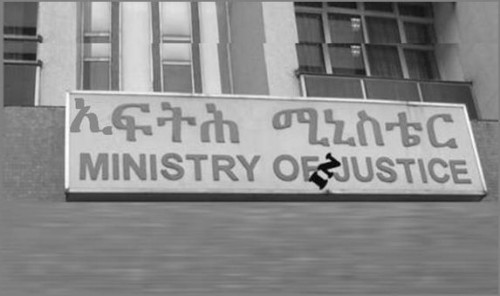 Talking about corruption in the Ethiopian “justice sector” is like talking about truth in Orwell’s 1984 Ministry of Truth (“Minitrue”). The purpose of Minitrue is to create and maintain the illusion that the Party is absolute, all knowing, all-powerful and infallible. The purpose of the Ministry of Justice in Ethiopia is to create the illusion that the ruling regime under the command and control of the Tigrean People’s Liberation Front (TPLF) masquerading as the Ethiopian People’s Democratic Front (EPDRF) is absolute, all knowing, all-powerful and infallible.
