Posts Tagged ‘Ethiopia’

Abune Petros in our heart.

Wednesday, May 8th, 2013

Abune Petros in our heart. By Yilma Bekele

On July 29th. 1936 Abune Petros was executed by the Italian fascist that were trying to colonize our country for his refusal to submit. On May 2nd. 2013 the monument that was built to commemorate our Holy Father was removed by the order of the TPLF party that is currently ruling our country. Our Holy Father died for the first time. The murder by a firing squad was an honor and showed his deep love for his people and country. The fascist killed his body but he made his home in every Ethiopian soul for ever and ever. We all carry Abune Petros in our heart. ‘Abune Petros Adebabaye’, ‘Abune Petros Hawelt’ is not just a location but the symbol of our pride and the true meaning of sacrifice for a higher cause.

The order to Kill Abune Petros was given by the fascist Viceroy Graziani but the trigger was pulled by solders from the North that were faithfully serving the fascist invader. The order to remove our monument to our beloved father was given by the TPLF party but the backhoe and flatbed truck was driven by modern day Banda’s.
They claim the removal is temporary. That is not the issue. Was it necessary is our question. Could it have been avoided is our point. Aren’t there some things considered priceless is our contention. The same people that moved heaven and earth to bring back our stolen Obelisk and erect it in its rightful place felt no qualms about dispatching daily laborers to bring our hero down and place him in a warehouse. We rejoiced when our obelisk was returned because it is the symbol of our glorious past. Although their leader dismissed our joy and happiness and tried to claim it as his peoples private history we bit our tongue and dismissed his rudeness for immaturity.

I agree it is difficult to personally relate to a stone like an obelisk. Nevertheless it is the product of our ancestors and a symbol of their ingenuity for that period in our past. But Abune Petros is a living symbol every one of us would have no problem claiming, admiring and silently thinking ‘would I have courage to act like him?’
Abune Petros is what I always thought we Ethiopians were like. I was raised at a time when being an Ethiopian was something special. There was not enough adjective to describe our country and people. Yes I am aware that we had lots of problems to resolve after all forging a nation is not a cake walk. There were many that were left behind and quite a few that did not get a fair share of what was on the table. We are still trying to come to terms with that.
That still should not dampen our glorious past. Abune Petros was one of those bigger than life Ethiopians that added a positive value to our experience. He defined patriotism, resolve, love, spiritual guidance and commitment to the truth. He accompanied our Emperor and the civilian army to Maichew and confronted the fascist army. He witnessed the gallantry of his people and the savageness of the European invaders. They came with modern weapons and poison gas to scare us to submission. We lost the battle but it only made us realize defeat was not an option. Surrender was not the language of the Ethiopian at that time. Yes times do change. A visitor would have a hard time believing the current generation descended from those that even washed the shoes of the foreigners least they take our soil with them.

Abune Petros continued to fight the way he knew. His religion and his love for his country were his weapons. From the monastery of Debre Libanos to far away churches he continued to rally his people to stand up straight and took the cry ‘By any means necessary!’ to drive the invader out of our cherished land. During his interrogation this is what he told the fascist authority when asked to accept Italy’s sovereignty over Ethiopia or face death.

“The cry of my countrymen who died due to your nerve-gas and terror machinery will never allow my conscious to accept your ultimatum. How can I see my God if I give a blind eye to such a crime?”
His last words before the bullets tore our bishop and Holy Father were:
“My fellow Ethiopians, do not believe the Fascists if they tell you that the patriots are bandits, the patriots are people who yearn for freedom from the terrors of fascism. Bandits are the soldiers who are standing in front of me and you, who came from far away to violently occupy a weak and peaceful country. May God give the people of Ethiopia the strength to resist and never bow to the Fascist army and its violence. May the Ethiopian earth never accept the invading army’s rule.”

His defiance and heroism became the battle cry of our patriotic army thru out the land and it echoed in our valleys and mountains from north to south east to west and the invader never saw a day of peace until they were driven out.
This was the man and his memory our new Bandas were trying to extinguish that day a week ago. They thought removing a statue would erase history. They tried to cover their mis-deeds with talk of progress. We are not against progress. We in the Diaspora contribute more than our share to help our country and people. As a matter of fact there would be no tall buildings, no dinner on the table and no profitable Ethiopian Airlines and no TPLF millionaire without remittance from the Diaspora. We just know that there are some things more important than others and our heritage, our history and our patriots cannot be kicked around wantonly. We are also well aware of TPLF’s habit of using wedge issues to divide us and hiding behind nation building while using a wrecking ball to destroy our history.

It is a sad sign of the times that our dear father’s memorial statue was removed without much protest. Those that preach about waging a ‘peaceful struggle’ against the new Bandas were nowhere to be seen holding a vigil. They were given an opportunity to unite and galvanize their people and use this Woyane insult against our history as a ‘teachable’ moment. Yes a little sacrifice is what is required to fight injustice. Yes there is imprisonment, injury even death in the struggle for freedom and dignity. People like Eskinder, Reyot, Andualem, Bekele Gerba , Abubeker and Woubeshet are behind bars because they choose not to submit to injustice and heed Abune Petros’s call to stand their ground. I am sure what gives them such determination is his everlasting pray “May God give the people of Ethiopia the strength to resist and never bow to the Fascist army and its violence.” We shall overcome.

For further Info please go to:

http://www.ethiopianorthodox.org/gallery/todaysphoto/abunepetros/index.htm

http://www.ethiopianreview.com/content/28504

Mengistu Hailemariam and our moral compass

Wednesday, May 1st, 2013

Mengistu Hailemariam and our moral compass. By Yilma Bekele.
Today I felt like crawling under the blanket and just hide. I know that is what children do. They think hiding under the blanket makes them invisible. It give them a feeling of security and that what I was looking for. Some place to hide and feel secure from my clueless people. Clueless is what we are and I guess I just have to live with it. Predictable like the season is how we function and I have to accept it.
What has gotten me down is the talk of the dead not yet dead news regarding the former dictator of my country. It looks like the despicable individual is not going to disappear from our radar no matter how far removed and how long ago we have parted company. Like a nightmare he keeps showing up in the most awkward and inopportune moments. His appearance this time around was not his doing but nevertheless he was used as weapon to clobber us with.
I am not really concerned about the hapless dictator it is us I worry about. You would think that after over twenty years of contemplating the total ramifications of what his involvement in our country’s history has meant to us that we have come to a few conclusions. We have looked at the situation and drawn a few lessons so we can keep it in the back of our brain for future reference good and bad. That is all experience is all about isn’t it?
Life is a learning experience. We succeed some fail a few but we draw conclusion so we know what works and what to avoid. That is how we move forward. Those that learn from past experience, analyze then adapt what works avoid that did not produce the intended result get to reap the benefits. Those that ignore the lessons of history end up digging their own grave.
That is what we are doing today, digging our own grave. The fact that we have not put the criminal dictator in perspective is very alarming and not so good news regarding our future. How could we be trusted with the future when we do not have a clear picture of our past? How do we know what we want tomorrow when we have not really sat down and looked at yesterday to see what went right and what exactly went wrong and why?
Two things happened simultaneously this last week. The ethnic based regime’s blunder aroused the ire of our people and exposed them to charges of criminal activity. To divert attention and blunt the impact they were able to concoct a ruse pointing away from their evil deeds. It was a simple ploy one plays on children and it worked. It worked because we did not take the last twenty years to learn, analyze and grow. It looks like we did not take the idea of raising a conscious, smart and morally upright citizen to heart in order to be able to lay a solid foundation to build the future Ethiopia. We did not invest time and energy to produce an intelligent, motivated and smart generation that is able to avoid the mistakes done by the past generation.
The last two weeks the major news coming out of our country was the plight of our Amara citizens being uprooted from their homes. It was not a pleasant sight. Simple farmers that make their living by sheer determination and constant struggle against nature using primitive tools were deemed to be unworthy of basic human respect and dignity and were ordered to move from their villages at a moment’s notice. It was very distressing to see fellow humans being treated like that in their own country. It became the focus of attention and revealed the nature of the illegal and corrupt regime in Ethiopia. It was not a welcome attention and the government rightly felt the heat.
There was attempt made by the opposition to investigate and gather evidence to bring the matter to the attention of all that are empowered to look at situations like this. It was not easy but they tried under the difficult circumstances presented by the regional Bantustans and the Federal government. Their representatives were jailed, abused and given a few hours to leave the region. Thanks to technology the whole world in general and the Diaspora Ethiopians were able to follow the news and keep in touch with their people.
The government first tried to deny that ‘ethnic cleansing’ is being carried out. They also attempted to blame the regional administration for the problem and finally were compelled to admit there was some truth to the allegations and were forced to ask the deportees to return. In a matter of a week the news was bringing clarity regarding the illegal and criminal nature of the regime in power. It was opening the eyes of many individuals to see the regime in a different light. The news was gathering momentum and the regime was entering a state of panic. The opposition and the Diaspora activists were even talking about appealing to the International Court of Justice and the United Nations.
Someone somewhere figured the weakness and clueless nature of the Ethiopian. They figured give them another bone to chew and they will drop everything and jump at the opportunity. They did not have to look far. They found an old discarded bone and tossed it in the middle of the unruly pack. Thus they put out a press release announcing the death of the tyrant that has been holed in Zimbabwe for the last twenty years. That is all it took for the frenzy to start, the earth to move and the heavens to open.
Are we that transparent? Are we that easy to fool? Fifty four percent of the Ethiopian population is under twenty five years of age. They have not witnessed the madness of the Derge era. To them Mengistu is a distant history. The history of Ethiopia including the Derg period is a self-serving tale as told by Woyane and their apologists. Neftegna, Monarchist, Dergist is an interchangeable term Woyane uses to ruin people’s lives. The fifty four percent cannot be relied upon regarding their knowledge of our past. Meles and his disciples’ main agenda was to discredit our past so they could build their distorted vision on a shaky ground. According to Woyane and their followers there is nothing good or redeemable about Ethiopia before their appearance.
It is a very difficult story to take to heart. Especially when life under Woyane is nothing but hell on hearth for the vast majority of our people. That is why the fifty four percent are all waiting their turn to leave by foot, boat, plane and any which way out. What got me a little concerned and a lot despondent is the failure of those aged 25-54 years and compromise twenty nine percent of the population. The ones that are politically involved and run our independent media outlets. They picked this disinformation campaign and run with it. I am not saying we should have ignored the story on the other hand it is our responsibility to tell the story with a certain amount of perspective thrown in to give the listener and reader some point of reference. Every time we mention the criminal dictator we should remind our people the role he played in the destruction of our country and people. That is the legacy he left behind and that is how he should be remembered. This idiotic idea of misplaced ‘Ethiopian chewanet’ is what works against us and blinds us from standing up against abusers and ill-mannered individuals. The kind of ways the news was reported was both embarrassing and self-defeating to say the least.
Dear editors of our independent media what are we supposed to make of your screaming headline announcing the ‘good health’ of a tyrant in exile that has not even acknowledged his criminal role and responsibility when he was the de facto head of state? Some of you even went the extra mile and called his house and talked to his wife while others relied on their reporters to find out the latest ‘breaking news’. Did you really think the sympathetic, feel good close to the heart story was appropriate regarding a criminal in exile? One of the headlines screamed “Former Ethiopian President Colonel Mengistu is alive and well…” I dove for cover.
Mengistu Hailemariam was a ruthless dictator, a cruel and horrible individual that will be remembered as a black mark in our country’s history. The fact that the one who came after him was a ruthless psychopath does not make the former any less of a criminal. Our independent medias’ reporting was journalism at its worst and an affront to truth and insensitive to the victims.
Where exactly did we go wrong? What exactly happened to our moral compass? It looks like we got a long way to go to differentiate bad from evil, truth from fiction and show some empathy towards those that were victimized by Mengistu and his accomplices. Mengistu which even writing his name brings pain and agony to my soul was the cause of much anguish to our country and people. This is not even past history but it happened yesterday in our life time. Many of those fathers and mothers, brothers and sisters that lost their beloved ones are still among us. The memory has not even faded from our collective mind.
To refresh your memory the ongoing exodus out of mother Ethiopia started under Mengistu. The first time in our countries history her children started running away from home. Ethiopia began losing its youngest and brightest and has not recovered ever since. The whole country became a killing field. The lawlessness nature of the regime brought about the degeneration of societal norms and the gradual destruction of culture. His regime rode rough on all that we hold dear and that has taken us long to build. His lack of basic leadership skills and ruthless evil nature decimated all that were educated, able and showed potential. He exposed our country to dangerous minds that used the opportunity to wrestle power cunningly. He is a military leader that left his troops in battle to save his dirty ass. He is wanted by the Ethiopian military to be court marshaled and is definitely a candidate for a firing squad. This is the individual you so zealously displayed and published letters written by Woyane and their sympathizers lauding his good side. Shame on you all!!!
Every one of us got something good and commendable within us. Something positive could even be said about evil individuals. I am sure Hitler was a German Nationalist that loved his country, Meles Zenawi was probably a good family man, Mussolini was probably a devout Catholic but that does not define the totality of the person. All three of them have their dark side that outweighs their positive nature. The evil one lurking behind the smiling face is what affects us.
Dear country people please remember choosing one abuser over another is not a virtue. Demanding no abuse is the way to go. Why in the world do we compare and contrast the crimes of our leaders instead of resolving for such never to happen to us again? Isn’t that the lesson to draw from the experience of the last forty years? How could I trust you with my future when some of you think of life as a pissing match and are busy picking the lessor of two evils instead on no evil? Is that where we find ourselves today that we are willing to accept a little less criminal than Meles instead of someone that respects the rule of law, the sanctity of life especially human life and love for mother Ethiopia?

ESAT and messengers of peace in Jose, Ca.

Wednesday, April 24th, 2013

ESAT and messengers of peace in Jose, Ca. By Yilma Bekele

Tamagne was here. I wrote that and felt I have said enough. Well since you asked I guess I will tell you the rest of the story. I thought by now you would know If Tamagne was here something big and important regarding Ethiopia happened. You know Tamagne; he does not do things little. He does not think of neighborhood, not even a region Tamagne goes the whole nine yards and dreams of a nation. Tamagne does not fly to Atlanta or Houstinn from his base in DC, our Tamagne crosses a continent all the way to California to spend an evening with his people. I am afraid he is outgrowing even that. Now we see Tamagne in New Zealand or Norway. I don’t need a fortune teller to predict we might hear from Tamagne from outer space. I will just sigh and mumble he must have found a lost Habesha that just don’t know when to stop and settle.

He has developed a new habit too. He does not travel light no more. As if the one man army is not enough he is accompanied by some heavy guns all around him. I am not talking about a bazooka or tank. No Tamagne has found the ultimate weapon disarm his enemies. He is accompanied with the messengers of love, brotherhood and tolerance. How I envy Weizero Mamita and Grazmach Beyene because they have given us such a precious gift. May God bless them.
I am sorry about my sloppy writing but you can’t blame me. Right now I am levitating and I am afraid it will take a while to bring me down to earth. I am floating with joy, happiness and hope and it is all due to Tamagne and his associates. I also noticed most of the folks I spent the evening with were a little delirious and as the evening went on the love and peace was infectious with Ethiopians spontaneously clapping, laughing and hugging without abandon. I told you, you should have been there.
ESAT San Jose
Messengers of peace and unity.
What were all these people doing on a beautiful Saturday afternoon is a good question? The only explanation I could give you is to say they are committed, they care and they just acted on it. Lots of people worked hard to make the event a success it was. They all have one thing in common, they were all Ethiopians. What brought them together is their love and concern for their homeland.
First were the organizers of the event. It took time and effort to find a good safe location. They have to arrange transportation and accommodation for their guests. Flyers and pamphlets have to be printed to advertise the event. The posters have to be distributed in the community, published on our Web sites and the tickets have to be sold door to door. Without them there is no event. Thank you my beautiful young friends. I am happy your effort was gladly embraced by your community.
Then there were our guests that have to travel far and close to spend a precious day with their people. They are all busy and successful people that are willing to share their views and stick their neck out for all of us to dissect and parse. They were chosen to sit on the podium because they have earned the respect of their community by their work and deeds and we all want to hear from them, meet them and share our views with them.
The most crucial element in this gathering are the guests. Their presence is what makes all that effort worthwhile. I always think it is beautiful to have plenty of people but even the attendance of a single individual to me is a success. We have to show respect and do what has to be done. Coming to an event is not easy. It requires planning commitment and energy. We have to juggle so many responsibilities in our daily life and spending a whole afternoon and evening attending an event is not an easy matter. There is work, family responsibility and other commitments to take into consideration, not to mention paying for the ticket, arranging transportation etc. etc.
All three actors in this important function have something in common that makes them special. They all love their country in a positive way. They value the importance of getting together and trying to find a common solution to make their ancient country a better place. They are not just talkers but doers that go the extra mile to make things happen. It is what is called a symbiotic relationship. One cannot survive without the other. One needs the other to grow and thrive.

Our guests made all of us proud. They said many important things and it is beyond this little presentation to do it justice. There were so many standing ovations, plenty of laughter and the evening went so fast our poor organizers were forced to rearrange their program to fit the occasion. The two young people assigned to lead the ceremony were consummate professionals that made it look so easy I even thought I could do that. Dressed in the splendor of our national colors they set the tone in a positive manner. The sound and video was perfect showing the organizers commitment to excellence.

Abatachen his Holiness Abune Melkesedek General Secretary of the Holy Synod-in Exile, Archbishop of Medhane Alem Cathedral in Oakland was sitting in the middle. That sight by itself was enough to make ones heart swell with pride and joy. He started the assembly with a prayer. I don’t know about you but I knew things were going to get better and better. How could anything go wrong when Abatachen gives his blessings?

I hope you don’t mind me paraphrase and put their speech in my own words. Abatachen spoke about the importance of faith and responsibility in our daily life. He gave us perspective regarding our ancient history and the crucial role religion has played in the making of our country. He thought us how respect for each other’s religion and tolerance of our differences has played an important role in forming the Ethiopia we know now. Then he looked at us and asked a crucial question. What makes us different from animals? He said we are born, we grow up we have family and we all die. He explained we humans are different because we determine road we travel. If you take an animal far from where he was born and give it the comfort he/she needs they will not leave but stay put. It will form a family take care of its offspring and die. But we humans are different. There should be more. We think about the future. What we leave behind for our offspring is a very important consideration of being a human. Life is not about a simple comfort for oneself and one’s family but thinking of the greater family is a crucial aspect of living a successful and whole life. Something to think about, what do you think?

My dear brother Sheik Imam Khalid is not a complicated person. He speaks clearly, forcefully and in sharp short sentences. He does not leave much for ambiguity. In this time of misinformation, propaganda and rumors it is a relief to listen to someone that does not beat around the bush and states his case in a clear manner. His love for his country and religion just oozes out of him. He laid to rest the fact that our Muslim brothers struggle is for the rights of their religious independence despite the many insane ideas being thrown around by the illegal regime in power. In simple words he wants the government to stop meddling in his religion. I loved the way he started his speech. His observation was regarding the duality of our personality. There is the family you, the work place you, the you that is routinely presented among friends and the Mosque or Church you. Why so many faces? That he said is the central problem. We have to resolve that issue within ourselves and come out clean. It is not complicated is it?
We also heard from our local Mosque religious leader and he spoke about the importance of working together, the culture of unity of purpose our people have developed thru out the years and that spirit that is still leading our struggle forward. Shamble was the person that gave color to the event. With his Masinko and beautiful voice he took us back and you can see the audience mesmerized with everyone going home in a mental trip. Thank you Shambel may be next year we will meet in Addis. As the Jewish saying goes “Lashanah haba’ah biy’rushalem’ I say to you ‘ ýememetaw amet biáddis abeba’

Our hosts had a surprise guest for us too. I told you they were firing with all eight cylinders. They brought us none other than the dragon slayer himself. My friend Abebe Gelaw in person. The assembly went wild. Who else to elevate our spirit and remind us of the importance of sticking out for our people when the time requires it. He defines the meaning of seize the time.

It was time for Tamagne to come to the podium. You can hear a pin drop. The anticipation was overwhelming. As I have said before Tamagne don’t have to do anything to paint smile and joy on our faces. He has this ability to channel our energy and magnify it back at us. Some shout, some clap the men whistle and the women ululate. Pandemonium in the house is what it felt like. The fire alarm was triggered by the noise, the earth shook and the security showed up in force. I am exaggerating a little aren’t I? Well I don’t have a video and this is the best I can do. You get my meaning.

I will not even try to tell you what Tamagne presented. I don’t really know for how long but whatever it was it was short. Time has a tendency to flee when he is on stage. His simplicity is what makes the situation complicated. He disarms you with the strength of his presentation. It is audio, video and god knows what else. My suggestion is do not at all challenge Tamagne, he carries this thumb drives full of facts and figures. For a person with a death sentence hanging around his neck he seems to be relaxed. If only Ato Meles has allowed him to present his defense when accused of being a terrorist I am sure the court would have thrown the dictator into Kality. Poor Meles he died knowing Tamagne has another date to clear his name in a real court of law. You know me I will be in that jury.
So what did we accomplish? A lot my friend. We showed we cared. We proved Abatachen right by working together to leave something behind for our country and children. We rose up to the occasion when called for. The idea of the gathering was to raise money so ESAT can continue the job of being the independent ‘eyes and ears’ of our people. From something like three hundred people we raised over thirty thousand dollars. The investment we made was not to realize profit. Our reward comes when ESAT uses the fund to do the job we have entrusted them with-faithfully and truthfully inform our people. I am absolutely sure they will do that with determination professionalism and purpose. If not we all are here to watch and speak out when both things go right or wrong.

As I said it was a festive afternoon and evening. It was nice to see Ethiopians gathered to show concern and love for country and each other. I said many good things about our guests. I put them up on a pedestal. It is not about hero worship or excessive adulation of individuals. To me it is all about giving credit where credit is due. The tone set by the late dictator was constant put down of our country, people and culture. He wanted to shine all by himself. That is not good. We have plenty of good things going for us. We are blessed with ancient culture that is built on love and tolerance as a foundation. We have lived for eons as a nation state due to that. To me our guests were building on that tradition. If we don’t put them up on a pedestal who would? If we don’t celebrate their accomplishments , if we don’t appreciate their sacrifice who then? None were paid to be there, no one made a penny of the event and no one was compelled to come. That is all commitment is about. May God and Allah bless them all and protect them and shield them from harm for they are our national treasure.

I am sure my cousin Fekreye will ask me “why do you make it so long’ I thought I should be faithful to such an important gathering of honorable people and it just kept coming out. Take your time and read it please, won’t you I worked hard on it.

By the way the next day Tamagne presided on another gathering in Seattle and you know folks of Seattle are a show off and they collected close to sixty thousand dollars. Seattle congratulations, we will meet again and we will be ready. We accept the challenge, we got work to do. Finally look at the picture below and see Tamagne at work-the power of love!

san jose event 2

Graziani and the TPLF, an Ethiopian saga.

Thursday, March 21st, 2013

Graziani and the TPLF, an Ethiopian saga. By Yilma Bekele

‘The Duce will have Ethiopia, with or without the Ethiopians’. Rodolfo Graziani

I am writing this as a proud Ethiopian because Graziani’s promise to the Fascist dictator was thwarted by my gallant ancestors. If it was not for the bravery and sacrifice of our grandparents, to day our country will be referred to as ex Italian Colony, we will be conversing in Italian, our national dish would be spaghetti and my name will probably be Mario. Please don’t knock it because my country being referred to as the only independent country in Africa, having my own national language, dining on Injera and answering to an original name is what defines me as unique member of the human race.

The Ethiopian and Italian entanglement goes very far back in history. The period known as ’the scramble for Africa’ from 1870 to 1914 is a good place to start. It was a time the European powers were invading, colonizing, occupying and abusing Africans all over the continent. After the scrooge of slavery this was another century where being black was not a desirable existence, not that it is any different now. To avoid warring each other the Europeans decided to sit around a table and carve out the continent into outright ownership of people and country and spheres of influence. Italy already had Libya and decided to include Ethiopia in its portfolio.

Unfortunate for the Italians the Ethiopians found the idea absurd to say the least. The battle of Adwa settled the matter and dealt the Europeans their one and only defeat in Africa. The victory at Adwa will forever define what it means to be an Ethiopian. Generations will use this colossal event to shape and mold their children to grow up with pride and determination to guard what is their own and not to covet what belongs to others.

The Italians never forgave us for the humiliation at Adwa. After waiting for forty years they came back in 1935 to avenge their defeat. They came back better prepared. They used superior weapons including poison gas trying to overwhelm our barefoot army on horseback. They occupied most of our sacred land. They won a few battles but were unable to win the war. Our grandparents never gave the invading army a single day of respite. The concept of guerilla warfare that has become the mainstay of all oppressed peoples response to overwhelming force was brilliantly utilized by our ancestors. You can say they wrote the book on mobile war using a few to harass and demoralize the enemy while recovering national strength.

This brings us to the infamous General Rodolfo Graziani Governor of Italian East Africa. His ghost is what is waking us up from where we having been lying down comfortably numb for over forty years. Graziani tried to do what Meles Zenawi was able to accomplish. I know harsh words but deservingly so. Let me tell you what Graziani did to us in 1936. The day was Friday February nineteenth. Viceroy Graziani decided to celebrate the birth of the Prince of Naples in Addis Abeba at the ‘Genete Leul palace.’ Abreha Deboch and Moges Asgedom two of the most beautiful Ethiopians our country has ever produced threw ten grenades at the fascist pig and his accomplices during the celebration.

What happened next will forever live in our heart and mind as the price paid when sovereignty is lost. The Federal Secretary Guido Cortese gave the following order to his solders:
“Comrades, today is the day when we should show our devotion to our Viceroy by reacting and destroying the Ethiopians for three days. For three days I give you carte blanche to destroy and kill and do what you want to the Ethiopians.”

Ethiopians were hunted down like pray animals and killed. Over thirty thousand (30,000) of our people died in revenge. No one was spared. They burnt the town down and murdered everything that moved. Graziani earned the name “butcher of Ethiopia.” I doubt there is anyone amongst that has not lost a distant relative in this bloodbath. Darkness fell on our country and we were given a taste of what it means to be under the mercy of an occupying force.
On the other hand Graziani’s animalistic and criminal behavior aroused the righteous anger of any and all red blooded Ethiopians. The fascist pigs never knew peace in the land of the habeshas until they were driven out the second time hopefully never to return again. This little note is by no means an adequate exposition of our fearless and gallant ancestors but it would be unforgivable not to mention Lij Haile Mariam Mamo-the first árbegna’, Dejazmacj Abarra Kasa from the north-west, Dejazmach balcha Aba Nebso from the south-west, Ras Abebe Argay leader of the band, Shaleka Mesfin Seleshi, Ras Desta Damtew from the south, Ato Belay Zeleke and host of other notables that stood a head above others and gave the enemy a taste of Ethiopian indignation.

As I said before the ghost of this evil specimen of a human being is with us again. In 2012 the town of Affile built a mausoleum in memory the fascist pig. Yes the same Graziani that ordered the killing of over thirty thousand people in a three days period, the same criminal that used mustard gas throughout our homeland killing in the hundreds of thousands of Ethiopians was honored as a patriot and a hero by his people. They felt they could do that because they knew there would be no one to stop them. What they saw was a country divided into nine Bantustans, a country in the process of degrading its past, a country willing to sacrifice its youth pushing, encouraging them to go where harm awaits them. Yes the citizens of Affile felt no shame because they knew no one will call them out.

We might be down but we are not dead yet. As there were ‘wust arebenoch’ during the occupation, there are still plenty of patriots that keep the flame of freedom alive. The shameful act of the people of Affile was too much to take. Patriotic Ethiopians decided to protest this fascist spit on our honor and insult to the memory of our people by marching and showing their righteous indignation in our homeland. You would think any government that is the recipient of this unjust provocation will lead the charge on behalf of its citizens. That it will use its moral power to unite its citizens and humanity at large and put the unrepentant Italians on notice that this kind of act is not acceptable, is counterproductive and unnecessarily brings buried memories to the forefront.

This is not unique to us. The Germans were made to accept responsibility for the crimes of Hitler, the Japanese were held liable for their atrocities in China and South East Asia, and the US showed its profound sorrow for slavery and so on. In the scheme of human history some shameful acts were committed and since no one can turn time back the responsibility of the current generation is to look back at the horror and shame and take responsibility and do what is necessary to teach its citizens so there would be no chance today or in the future for history to repeat itself.
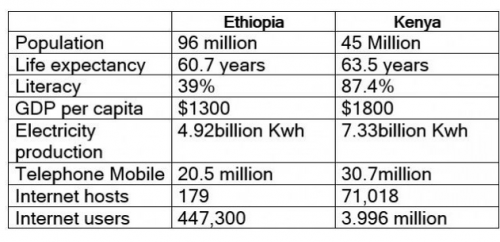
No need to travel to Germany or Japan when we can just walk over to our neighbor in the south. The Kenyans have sued the British government for imprisonment and torture during the Mau Mau uprising for independence and their case is being heard in London. As far as I know the Kenyan government has not jailed any of its citizens for requesting accountability. Needless to say we do not have a legitimate government that reflects the aspirations of the citizen. Thus our patriotic protesters that dared express their views on the matter were beaten by Woyane police and hauled to prison. Their protest was seen as a criminal act. The odd situation here is that a few Italians that felt this miscarriage of justice did protest in Italy but no one beat them up and none were imprisoned for peacefully making their objections known.

We are one unique people aren’t we? No one will believe this unfolding story taking place in our ancient land. No one with a fertile imagination will come up with this kind of scenario even for as fiction. When we think we have seen enough our Woyane masters idiocy they seem to have this bottomless pit and pull out a new and more bizarre behavior to confound our senses.

At the beginning I compared Graziani to the recently departed Meles Zenawi the Woyane warlord. Some of you probably thought I have gone too far. Some of you judged me unfair and filled with hate. I understand. I felt the same way when I wrote it down. I almost took it out. Then I slept on it. Further reflection made me realize I am not really off the mark. I will state my point, you my brethren be the judge.

Graziani was avenging his people’s humiliation at Adwa. He came back with a purpose. What exactly did he do to make sure Ethiopia will never rise again? Wanton killing was one. Selective murder was another. The use of mustard gas, burning of villages and the Addis massacre are examples of wanton killing. The May 19th murder of 297 monks and 23 laymen of Debre Libanos Monastery is a calculated act of terror to discredit our ancient religion. Furthermore the liquidation of the young Ethiopian intellectuals and their organization ‘The Black Lions’ was another assault on what is dear to us. Other than those that left the country with the Emperor and the lucky ones that found their way to Sudan and Kenya all were executed. This I will file under selective murder.

The Italians also redrew the map of our country to create separate Bantustans. They divided our country into six units as follows: 1) Eritrea to include Tigrai – capital Asmara 2) Amhara to include Begemeder, Gojjam, Wello and northern Shoa – capital Gonder 3) Galla and Sidamo –capital Jimma 4) Addis Abeba 5) Harar 6) Somalia-capital Mogadishu.

Well, well, well, where do you think the great mind of Meles came up with his kilil solution? Now you know what he has been reading while holed down in his cave in the mountains of Tigrai. History will also show that his first target was none other than Haile Selassie University in search of intellectuals to liquidate, imprison or exile.
The period from 1935 to 1941 is referred to as the time of Italian ‘occupation.’ It is not known as Italian ‘colonization.’ That is so because our resistance did not give the Italians the legitimacy they so desired. Our patriots never allowed the Italian flag to fly unchallenged. Our Emperor was gallantly going to every capital in Europe and the League of Nations keeping the flame of freedom alive while our patriots at home were waging a successful guerrilla war keeping the fascist army in a state of fear and uncertainty.

We their children have failed our forefathers. We are unable to resist a home grown fascist dominating us using an old user’s manual. There are groups fighting the regime but unfortunately no one has managed to break out and claim the vanguard role. We are working on that. Where there is oppression there is resistance and we are not different. It is obvious we’re fighting an uphill battle. Our people are not educated, our communication system is rudimentary and our enemy is very cunning with plenty of resource. The young and able that are open to new ideas are being systematically marginalized using cheap drug to numb the mind and encouraged to leave the homeland. No matter, the planes and advanced weapons did not deter our ancestors and surely illiterate and not more than a thousand Woyane diehards are not going to make us flinch from our destiny of making sure our country take its deserved place as the leader of all Black people.

Finally here is a beautiful and timely poem from a play written by Ato Yoftahe Negus while in exile in the Sudan as quoted by Ato Berhanu Zewde. You will find information on Ato Berhanu’s book at the end of this article.

Yoftahe Neguse Afajashegn

Bahru Zewde-The Ethiopian Intelegencia and the Italio Ethiopian War, 1935-1941 (The International journal of African Historical Studious, vol. 26, No. 2(1993.)
Richard Pankhurst –The Ethiopians- A History. (Blackwell Publishers USA 1998, pp238-239)

http://en.wikipedia.org/wiki/Yekatit_12#cite_ref-7

http://en.wikipedia.org/wiki/Rodolfo_Graziani

Al Amoudi companies that are looting Ethiopia

Monday, March 18th, 2013

The group of companies listed below are owned by Saudi agent Al Amoudi. These 40 companies are currently busy looting and plundering Ethiopia in partnership with the Woyanne apartheid junta. In the meantime, Al Amoudi’s puppet-masters in Saudi Arabia savagely attack young Ethiopian as shown in this video:

  1. Addid Gas and Plastics Factory PLC
  2. Addis Home Depot PLC
  3. Addis International Catering PL
  4. Blue Nile P.P. & Craft Paper Bags Manufacturing PLC
  5. Cabey PLC
  6. Daylight Applied Technologies PLC
  7. East West Ethio Transport PLC
  8. Elfora Agro-Industries PLC
  9. Lame Dairy PLC
  10. Mamco Paper Products Factory PLC
  11. Midroc Construction Ethiopia PLC
  12. Midroc Energy House Electro-Mechanical Services PLC
  13. MIDROC Ethiopia PLC
  14. Midroc Ethiopia Tecnology Group PLC
  15. Midroc Foundation Specialist PLC
  16. Midroc Gold Mine
  17. Modern Building Industries PLC
  18. Moha Soft Drinks Industry SC
  19. Mugad Travel PLC
  20. National Mining Corp.
  21. National Motors Corporation PLC
  22. National Oil Ethiopia PLC (NOC)
  23. Pharmacure PLC
  24. Rainbow Exclusive Car Rental and Tour Services PLC
  25. Salam Health Care PLC
  26. Sheraton Addis
  27. Star Soap and Detergent Industries PLC
  28. Summit Engineered PLC
  29. Trans Nation Airways PLC
  30. Trust Protection & Personnel Services PLC
  31. United Auto Maintenance Services PLC
  32. Unity University PLC
  33. Unlimited Packaging PLC
  34. Wamza Furnishing Industries PLC
  35. Equatorial Business Group PLC
  36. Ethio Agri-Ceft PLC
  37. Ethio Leather Industry PLC (ELICO)
  38. Huda Real Estate PLC
  39. Kebire Enterprise PLC
  40. Kombolcha Steel Products Industries PLC

(Source: http://sheikhmohammedalamoudi.com/page2.html)

The selling of Ethiopia to the highest bidder.

Saturday, March 16th, 2013

The selling of Ethiopia to the highest bidder. By Yilma Bekele
Actually that statement might not be true. We do know our country is being sold but we have no idea if the bidding has been open or closed. We have sold almost all of Gambella, we have leased half of Afar and Oromia has been parceled out bit by bit. Our Beer factories are under new owners, our gold mines belong to the fake Ethiopian sheik, Telephone is under the Chinese and our Airlines is looking for a suitor. Have we always looked for outsiders to own us?
Not really when you consider that we celebrated the victory at the battle of Adwa a few weeks back and that was the mother of all wars that made it clear this African country is not for sale. We might not have contributed much to the industrial revolution but we did manage to rely on our own ingenuity to follow along and do things our own way. You might not believe this but there was a time when Ethiopians actually used to be involved in making stuff from scratch. You think I am making things up don’t you? I don’t blame you because today you cannot even come up with one name that stands out as an Ethiopian entrepreneur, go getter or someone that shines like the north star based solely on his own sweat and blood.
The things that were accomplished by earlier Ethiopians are all around us but we don’t see them. All the things the current government brags about have their roots in the yester years they so much condemn and brush off. I don’t know where to start but here we go. Let us start with hospitals. Bella Haile Selassie (Bella), Leelt Tshay (armed Forces), Paulos, Haile Selassie Hospital (Yekati 12), Balcha, Ghandi, Tikur Anbessa, Ras Desta, Minilik etc. The vast majority of the doctors were Ethiopians, the hospitals were clean, well equipped and you don’t even have to take your own sheets and blankets.
How about Hotels? Ethiopia, Ghion, Wabi Shebele, Ras, Bekele Molla were the premier destinations. They were owned and operated by Ethiopians. When it comes to Ethiopian Airlines the Pilots were proud Ethiopians and the technicians were the envy of Africa. The Imperial government built the Airlines from scratch. Trans World Airlines (TWA) was a partner until we were able to train and staff our own and we did manage to do that.
If we talk about agriculture we did manage to establish the Sugar estates of Metehara and Wonji not to mention Setit Humera, the wheat and corn fields of Arsi, the fiber plants of Sidama and the cotton fields of Awash Valley are testimonial to our ingenuity. The sixties saw the emergence of the new educated Ethiopians that raised the bar of excellence.
The establishment of Africa Hall was how Africans showed respect to our Emperor and our old history when they choose Addis Abeba as the head quarter for the continent. The University at sadist Kilo was a gift to his people by the Emperor and it was a spectacular success. All the teachers were highly educated Ethiopians and the graduates were the pride of our country.
Why am I discussing such subject today? It is because two items reported by the media caught my eye a few days back. Both are an assault on our sovereignty and our ability to grow our own economy by Ethiopians for Ethiopians. Heineken a Dutch conglomerate is building the biggest brewery in Ethiopia and Guangdong Chuan Hui Group from China is given 41,000 Sq. meter of land to construct hotel and industrial complex. The way the story is being reported we should be jumping with joy. What could be better than those two benevolent multi nationals investing so much in our poor destitute country?
Is that how we should look at it? Is there another aspect to this story? In order to see the pros and con of the question posed In front of us it would have been nice if there has been a nationwide discussion to see if the plan makes sense when it comes to our homeland. That is how smart decisions are made. Open and vibrant nationwide discussion regarding such important issues that impact our national economy and our people’s well-being assures a better outcome.
That usually is not the case in our country. There are no checks and balances. There is no independent legislative body and the judiciary is a government tool. A single party the TPLF controls all and everything in the country. Our political leaders have no faith in the ability of the people to know what is good for them. That is why they approach their job as being a ‘baby sitter’ and are constantly fretting about what the people hear and read. Decisions are made by a few TPLF politburo members to be approved by the rubber stamp Parliament. Anyone that questions such a decision is branded as enemy of the people and dealt with.
Let us start with our beer story. You know beer is nothing but European Tella. It is bottled fancy and costs a little bit more. How long ago do you think we acquired the idea of brewing for a larger crowd? Eighty years ago my friend! St George brewery was started in 1922. Meta Abo Brewery was founded in 1963. Meta Abo was a partnership between government and private capital and started with a base capital of 2million Birr. The military junta nationalized both and the current TPLF Woyane regime inherited them with the rest of Ethiopia. What do you think these successive regimes did with our own old industry and land? Did they build on what was started? Did they reinvest the profit to make the enterprises bigger and better? Did they run our industries, enterprises and farms in a responsible and judicious manner?
Both St. George and Meta Abo are no more Ethiopian enterprises. BGI (an internationally acclaimed Brewing Company that operates in many countries.??) bought St George in 1998 for US 10 million ‘through foreign direct investment’(??) Meta Ambo was sold to Diego Industries-a British congalmorate for US 225 million. Heineken a Dutch multi-national acquired 18% of Bedele and Harar breweries for US 163 million in 2011. Raya Brewery an idea that has not materialized yet but promoted by Lt. General Tsadkan W.Tensai and investors such as Yemane (Jamaica) Kidane and other TPLF officials sold 25% interest to BGI for 650 million Br and invited Brewtech a German company as a partner.
As you can see the TPLF regime collected close to US 400 million from the sale of our home grown breweries. By all imagination that is chump change when you consider the ownership is lost and the profit for eternity belongs to the foreigners. Is this a good way to grow a national economy? Has it been done before or is this another of that failed ‘revolutionary democracy’ pipe dream?
BGI, Diego or Heineken are investing in our country to realize profit for their shareholders. What is our country getting out of this? The beer manufacturing business is a highly automated enterprise so it is not about job creation. Most if not all of the high paying managerial jobs will be occupied by the parent company. The malt, barley and other ingredients are imported and are considered a trade secret. We all know about creative accounting thus I am sure our country does not even benefit from the profit because the bookkeeping is rigged to minimize taxes.
Let us not even think of technology transfer since we cannot learn what we have already mastered. Remember we have been brewing beer since 1922. I will tell you what we got out of this unequal relationship. We as a people got royally screwed. The TPLF party officials got paid plenty for their pimping effort. The regime in its insatiable appetite for foreign currency bought a few months of respite to purchase oil, wheat, cooking oil etc. to postpone its inevitable collapse.
There are certain things we know how a growing economy with a nationalist government operates. We have seen how China, India, Malaysia, Brazil and other emerging economies handled their growth potential. They use what is known as subsidy to protect their infant industries from foreign predators. They allowed investment where technology transfer will bring benefit to their people but shielded their home grown industries from foreign competition.
Why do you think the TPLF bosses are interested in selling our sovereignty? I doubt it is because they are anti-Ethiopian even though the late evil PM used to suffer from inferiority complex when it comes to central highlanders. I believe it is because of their ‘get rich quick’ philosophy. They are in a hurry to accumulate before their Ponzi scheme comes crashing down. According to the UN billions of dollars are leaving our country. They are buying properties in the US and Europe, sending their children to expensive schools abroad and vacationing in exotic places with the money they steal from our country.
What are we the victims doing about this rape and pillage of our resources and the degradation of our national pride? I am afraid other than insistently talking there is nothing more most of us are doing about it. Why do you think that is so? I could think of a few things but ignorance comes to mind first and foremost. Our ignorance prevents us from connecting the dots and looking at the bigger picture. Our misplaced pride does not allow us to listen to others and learn to be able to formulate better solutions to our problems.
Today we have a population that is not familiar with its history. Sixty four percent (64%) of our people are under twenty five years old while twenty nine percent (29%) are under the age of 54 years. We have a toxic population on our hands. Those under twenty five grew up under the Woyane regime where being an Ethiopian is taken as a liability. While those under fifty four are the result of the Derge era of undermining religion, family, and stability. Ninety three (93%) of our population is a fertile ground for evil Woyane to plant shame, doubt and insecurity about being Ethiopian.
It is this population that is sitting on the side and cheering the selling of their country. For most people what bothers them is not what is lost but they spend endless energy to get a piece of the action. In Ethiopia stealing, lying, being part of a criminal enterprise is encouraged by the regime. When the recently dead Meles Zenawi said ‘even being a thief requires being smart’ he was giving a green light to his cadres and the population at large. The so called Diaspora is the number one enabler of the criminal Woyane machine. They use their new found riches to bribe Woyane so they could acquire stolen land to build their flimsy unsustainable condominiums and spend endless nights worrying if the next highest bidder will in turn take it away in broad day light.
This is exactly the reason we are having a problem forming a united front to get rid of this cancerous body in our midst. This is the reason even in exile we are unable to form a democratic, inclusive and worthy association that will benefit the many. The ninety three percent are in need of education in civic affairs and a dose of what it means to love your neighbor as you would love yourself.
May be it is the lords way of teaching us little humility and humbleness as he did with the children of Israel when he left them to wonder for forty years in the wilderness so they know what is in their heart. It is a choice we have-to be humble or perish due to pride.

http://allafrica.com/stories/201107051138.html?page=2

http://www.diageo.com/en-ie/newsmedia/pages/resource.aspx?resourceid=1168

http://blogs.ft.com/beyond-brics/2013/03/07/heineken-to-build-ethiopias-biggest-beer-factory/#axzz2MxqCwlH1

http://allafrica.com/stories/201107051138.html

A film in memory of Alem Dechasa

Monday, January 7th, 2013

By Rebecca Whiting

(Al-Akhbar) — The situation of migrant domestic workers in Lebanon, structured by a lack of protective labor laws and a culture of racial inequality, marks a huge failure in the country’s human rights record. Documentary filmmaker Vanessa Bowles chose to explore this cultural phenomenon and her personal relationship with it, having grown up constantly tended to by migrant domestic workers. Alem & Asrat was first screened in Lebanon January 4, a look at the realities of two women’s experiences.

In February 2012 a video captured on a mobile phone showed Ethiopian domestic worker Alem Dechasa being dragged by her hair and violently forced into a car in front of the Ethiopian embassy. It went viral. Lebanese society and the wider world were shocked by the public scene of abuse.

Days after the video was aired on LBCI, Dechasa, who had been put in a psychiatric hospital, hung herself. Despite the outcry and widespread nature of the video, the murmur soon died away. Though the most public case, Dechasa’s was tragically one of many. Human Rights Watch documented an average of one death a week due to unnatural causes during 2008, which included suicides and falls from buildings. No official count has taken place since.

Bowles began her project at the exact time of Dechasa’s death and wanted to tell her story. Concurrently, she wanted to delve into her own proximity to the lives of domestic workers. She talks openly about the bonds she formed with the women who have passed through her life and introduces Asrat, the young woman who has been with the Bowles’ family for the past five years. As she works, she talks about her reasons for leaving Ethiopia; a voice too rarely heard.

Bowles’ journey took her to Ethiopia to meet the families of Dechasa and Asrat. She is met by a group of young activists called the Good Ethiopians, who have been campaigning for Dechasa’s family. One of the activists says that if he had one message for Lebanese people, it would be that “Ethiopians are humans, too.”

The group take Bowles to meet Lemesa Ejeta, Dechasa’s partner and father of their two young children. In the small settlement of mud houses and lean-tos in Buraya outside Addis Ababa, Ejeta talks of the six years spent planning and the money borrowed for Dechasa’s move to Lebanon. It had seemed like their only hope of providing for their children.

Recruiting agents often tour the villages of Ethiopia, looking for women to traffic to Lebanon. The women have to pay a hefty charge of 10,000 Ethiopian Birr ($547) for their tickets and agent’s fees. Bowles meets other people from Dechasa’s village who have family members in Lebanon who speak out about their fears for their loved ones in such a hostile environment.

The Good Ethiopians organized a fundraising event and successfully secured the money to ensure that Dechasa’s children will have full educations. At the time of filming, Ejeta had still not told them of their mother’s death. The shots of their faces during the fundraising event where they see a large projected video of their mother being beaten are devastating.

At the end of Bowles’ film she goes to meet Ali Mahfouz, the brother of the head of Dechasa’s recruiting agency and the man who beat her. She described him as very eager to tell his version of the story. He talks, with little pity, of Dechasa’s being moved from one house to another when her employers would change their minds about wanting her. According to him she broke down and tried to harm herself after being sent to a third home within one month of arriving and receiving no wages for her work.

He wanted to send her back to Ethiopia as mentally unwell but said that she resisted, insisting that she could not return as she had not succeeded in sending money back to her family. The infamous scene in front of the embassy he describes as him trying to protect her from herself.

Activist Wissam al-Saliby has kept the blog Ethiopian suicides since 2009 in an effort to document the abuses and deaths of domestic workers. He explained that the there is no official incident tally as the only bodies that have the information are the individual embassies of the countries where the women come from. The vacuum in the reporting on these deaths is shocking, with only the severe cases being mentioned in the media. “So many deaths go unnoticed,” said Saliby.

Domestic workers are not covered by Lebanese labor laws, meaning that they have no minimum wage and no social security. Many of the women working here come from countries that have banned their nationals from working in Lebanon, including Ethiopia, the Philippines, and Madagascar, because of the lack of labor rights. Desperate for work, women are often trafficked into the country and have scant or no protection against abuse. Lebanon’s immigration system does not respect these bans from other countries and once out of their homelands, women are not discouraged from coming to work.

After years of pressure to reform labor laws, on 10 December 2012, International Human Rights Day, parliament announced a national human rights action plan, drawn in conjunction with the UN. The plan as yet is a draft that will be submitted to the government for approval and amendment. After eventually being passed through parliament it will be an annex to the constitution and is expected to take five years to implement.

Point 19 on the action plan concerns the rights of migrant workers. Several NGOs and experts were consulted in the drafting process, including Dima Haddad, senior social worker at Caritas Lebanon Migrant Worker Center, an organization that has long championed the rights of vulnerable workers, Dechasa included.

Haddad explained the framework of the plan put forward to the government concerning migrant workers. The plan recommends that Lebanon signs the two international conventions pertaining to the rights of migrant workers. Also, the labor law must be amended to include domestic workers.

Haddad further explained that, importantly, the sponsorship system must be abolished or replaced with one that respects workers’ rights. The plan calls for the regularizing of domestic workers recruitment agencies as well as working on agreements between Lebanon and the countries migrant workers originate from.

It is also suggested that the Ministry of Labor creates a national committee dedicated to developing a strategy for improving the situation of migrant workers on different levels. There is a further suggestion that social workers might take on the role of inspecting and monitoring homes as places of work.

On January 3, attorney at Caritas, Joyce Geha, finally received a date for a hearing of the case against Ali Mahfouz, which will take place February 11. The process took an exceedingly long time as she had to wait to be granted power of attorney by Dechasa’s parents and the Ethiopian embassy before she could represent her case and submit a request to the court against Mahfouz.

Should Mahfouz be charged with assaulting Dechasa and be implemented as a cause in her suicide, the case would be a precedent, Geha explains. According to Human Rights Watch, Lebanon has a very poor record of punishing those who abuse domestic workers.

Ethiopia 2013: Year of the Cheetah Generation

Monday, January 7th, 2013
che

Year of the Cheetahs

2013 shall be the Year of Ethiopia’s Cheetah Generation.

“The Cheetah Generation refers to the new and angry generation of young African graduates and professionals, who look at African issues and problems from a totally different and unique perspective. They are dynamic, intellectually agile, and pragmatic. They may be the ‘restless generation’ but they are Africa’s new hope. They understand and stress transparency, accountability, human rights, and good governance. They also know that many of their current leaders are hopelessly corrupt and that their governments are contumaciously dysfunctional and commit flagitious human rights violations”, explained George Ayittey, the distingushed Ghanaian economist.

Ethiopia’s Cheetah Generation includes not only graduates and professionals — the “best and the brightest” — but also the huddled masses of youth yearning to breathe free; the millions of youth victimized by nepotism, cronyism and corruption and those who face brutal suppression and those who have been subjected to illegal incarceration for protesting human rights violations. Ethiopia’s Cheetah Generation is Eskinder Nega’s and Serkalem Fasil’s Generation. It is the generation of  Andualem Aragie, Woubshet Alemu, Reeyot Alemu, Bekele Gerba, Olbana Lelisa and so many others like them. Ethiopia’s Cheetah Generation is the only generation that could rescue Ethiopia from the steel  claws of tyranny and dictatorship. It is the only generation that can deliver Ethiopia from the fangs of a benighted dictatorship and transform a decaying and decomposing garrison state built on a foundation of lies into one that is deeply rooted in the consent and sovereignty of the people.

Ethiopia’s Hippo Generation should move over and make way for the Cheetahs. As Ayittey said, Africa’s “Hippo Generation is intellectually astigmatic and stuck in their muddy colonialist pedagogical patch. They are stodgy, pudgy, and wedded to the old ‘colonialism-imperialism’ paradigm with an abiding faith in the potency of the state. They lack vision and sit comfortable in their belief that the state can solve all of Africa’s problems. All the state needs is more power and more foreign aid. They care less if the whole country collapses around them, but are content as long as their pond is secure…”

Ethiopia’s Hippo Generation is not only astigmatic with distorted vision, it is also myopic and narrow- minded preoccupied with mindless self-aggrandizement. The Hippos in power are stuck in the quicksand of divisive ethnic politics and the bog of revenge politics. They proclaim the omnipotence of their state, which is nothing more than a thugtatorship.  Their lips drip with condemnation of  “neoliberalism”, the very system they shamelessly panhandle for their daily bread and ensures that they cling to power like barnacles on a sunken ship. They try to palm off foreign project handouts as real economic growth and development.  To these Hippos, the youth are of peripheral importance. They give them lip service. In his “victory” speech celebrating his 99.6 percent win in the May 2010 “election”, Meles Zenawi showered the youth with hollow gratitude: “We are also proud of the youth of our country who have started to benefit from the ongoing development and also those who are in the process of applying efforts to be productively employed! We offer our thanks and salute the youth of Ethiopia for their unwavering support and enthusiasm!”

The Hippos out of power have failed to effectively integrate and mobilize the youth and women in their party leadership structure and organizational activities. As a result, they find themselves in a state of political stagnation and paralysis. They need youth power to rejuvenate themselves and to become dynamic, resilient and irrepressible. Unpowered by youth, the Hippos out of power have become the object of ridicule, contempt and insolence for the Hippos in power.

Ethiopia’s intellectual Hippos by and large have chosen to stand on the sidelines with arms folded, ears plugged, mouths  sealed shut and eyes blindfolded. They have chosen to remain silent fearful that anything they say can and will be used against them as they obsequiously  curry favor with the Hippos in power. They have broken faith with the youth.  Instead of becoming  transformational and visionary thinkers capable of inspiring the youth with creative ideas, the majority of the intellectual Hippos have chosen to dissociate themselves from the youth or have joined the service of the dictators to advance their own self-interests.

Chained Cheetahs

The shameless canard is that Ethiopia’s youth “have started to benefit from the ongoing development.” The facts tell a completely different story. Though the Ethiopian population under the age of 18 is estimated to be 41 million or just over half of Ethiopia’s  population, UNICEF estimates that malnutrition is responsible for more than half of all deaths among children under age five. Ethiopia has an estimated 5 million orphans; or approximately 15 per cent of all children are orphans! Some 800,000 children are estimated to be orphaned as a result of AIDS. Urban youth unemployment is estimated at over 70 per cent. Ethiopia has one of the lowest youth literacy rate in Africa according to a 2011 report of the United Nations Capital Development Fund. Literacy in the 15-24 age group is a dismal 43 percent; gross enrollment at the secondary level is a mere 30.9 percent! A shocking 77.8 per cent of the Ethiopian youth population lives on less than USD$2 per day! Young people have to sell their souls to get a job.  According to  the 2010 U.S. State Department Human Rights Report, “Reliable reports establish that unemployed youth who were not affiliated with the ruling coalition sometimes had trouble receiving the ‘support letters’ from their kebeles necessary to get jobs.” Party memberships is the sine qua non for government employment, educational and business opportunity and the key to survival in a police state. The 2011 U.S. State Department Human Rights Report concluded, “According to credible sources, the ruling party ‘stacks’ student enrollment at Addis Ababa University, which is the nation’s largest and most influential university, with students loyal to the party to ensure further adherence to the party’s principles and to forestall any student protest.”

Frustrated and in despair, many youths drop out of school and engage in a fatalistic pattern of risky behaviors including drug, alcohol and tobacco abuse, crime and delinquency and sexual activity which exposes them to a risk of acquiring sexually transmitted diseases including HIV.  Poor  youths (the overwhelming majority of youth population) deprived of educational and employment opportunity, have lost faith in their own and their country’s future. When I contemplate the situation of Ethiopia’s youth, I am haunted by the penetrating question recently posed by Hajj Mohamed Seid, the prominent Ethiopian Muslim leader in exile in Toronto: “Is there an Ethiopian generation left now? The students who enrolled in the universities are demoralized; their minds are afflicted chewing khat (a mild drug) and smoking cigarettes. They [the ruling regime] have destroyed a generation.”

Unchain the Cheetahs

Many of my readers are familiar with my numerous commentaries on Ethiopia’s chained youth yearning for freedom and change. My readers will also remember my fierce and unremitting defense of Ethiopia’s Proudest  Cheetahs — Eskinder Nega, Serkalem Faisl, Andualem Aragie, Woubshet Alemu, Reeyot Alemu, Bekele Gerba, Olbana Lelisa and so many others — jailed for exercising their constitutional rights and for speaking truth to power. But in the Year of the Cheetahs, I aim to call attention to the extreme challenges faced by Ethiopia’s youth and make a moral appeal to all Hippos, particularly the intellectual Hippos in the Diaspora, to stand up and be counted with the youth by providing support, guidance and inspiration. In June 2010, I called attention to some undeniable facts:

The wretched conditions of Ethiopia’s youth point to the fact that they are a ticking demographic time bomb. The evidence of youth frustration, discontent, disillusionment and discouragement by the protracted economic crisis, lack of economic opportunities and political repression is manifest, overwhelming and irrefutable. The yearning of youth for freedom and change is self-evident. The only question is whether the country’s youth will seek change through increased militancy or by other peaceful means. On the other hand, many thousands gripped by despair and hopelessness and convinced they have no future in Ethiopia continue to vote with their feet. Today, young Ethiopian refugees can be found in large numbers from South Africa to North America and the Middle East to the Far East.

In this Year of the Ethiopian Cheetahs, those of us with a conscience in the Hippo Generation must do a few things to atone for our failures and make amends to our youth. President Obama, though short on action, is nearly always right in his analysis of Africa’s plight: “We’ve learned that it will not be giants like Nkrumah and Kenyatta who will determine Africa’s future. It will be the young people brimming with talent and energy and hope who can claim the future that so many in previous generations never realized.” We, learned Hippos, must learn that Ethiopia’s destiny will not be determined by the specter of dead dictators or their dopplegangers. It will not be determined by those who use the state as their private fiefdom and playground, or those who spread  the poison of ethnic politics to prolong their lease on power. Ethiopia’s destiny will be determined by a robust coalition of Cheetahs who must unite, speak in one voice and act like fingers in a clenched fist to achieve a common destiny.

I craft my message here to the Hippos out of power and the intellectual Hippos standing on the sidelines. I say step up, stand up and be counted with the youth. Know that they are the only ones who can unchain us from the cages of our own hateful ethnic politics. Only they can liberate us from the curse of religious sectarianism. They are the ones who can free us from our destructive ideological conflicts. They are the ones who can emancipate us from the despair and misery of dictatorship. We need to reach, teach and preach to the Cheetahs to free their minds from mental slavery and help them develop their creative powers.

We must reach out to the Cheetahs using all available technology and share with them our knowledge and expertise in all fields. We must listen to what they have to say. We need to understand their views and perspectives on the issues and problems that are vital to them. It is a fact that we have for far too long marginalized the youth in our discussions and debates. We are quick to tell them what to do but turn a deaf ear to what they have to say. We lecture them when we are not ignoring them. Rarely do we show our young people the respect they deserve. We tend to underestimate their intelligence and overestimate our abilities and craftiness to manipulate and use them for our own cynical ends. In the Year of the Cheetah, I plead with my fellow intellectual Hippos to reach out and touch the youth.

We must teach the youth the values that are vital to all of us. Hajj Mohamed Seid has warned us that without unity, we have nothing.   “If there is no country, there is no religion. It is only when we have a country that we find everything.” That is why we must teach the youth they must unite as the children of Mother Ethiopia, and reject any ideology, scheme or effort that seeks to divide them on the basis of ethnicity, religion, gender, language, region or class. We must teach to enlighten, to uncover and illuminate the lies and proclaim the truth. It is easier for tyrants and dictators to rob the rights of youth who are ignorant and fearful. “Ignorance has always been the most powerful weapon in the arsenal of tyrants.” Nelson Mandela has taught us that “Education is the most powerful weapon which you can use to change the world.” Educating and teaching the youth is the most powerful weapon in the fight against tyranny and dictatorship. In the Year of the Cheetah, I plead with my fellow intellectual Hippos to teach the Cheetahs to fight ignorance and ignoramuses with knowledge, enlightenment and intelligence.

We must also preach the way of peace, democracy, human rights, the rule of law, accountability and transparency. No man shall make himself the law. Those who have committed crimes against humanity and genocide must be held to account. There shall be no state within the state. Exercise of one’s constitutional rights should not be criminalized. Might does not make right! In the Year of the Cheetah, I plead with my fellow intellectual Hippos to preach till kingdom come.

We need to find ways to link Ethiopian Diaspora youth with youth in Ethiopia in a Chain of Destiny. Today, we see a big disconnect and a huge gulf between young Ethiopians in the Diaspora and those in Ethiopia. That is partly a function of geography, but also class. It needs to be bridged. We need to help organize and provide support to Ethiopian Diaspora youth to link up with their counterparts in Ethiopia so that they could have meaningful dialogue and interaction and work together to ensure a common democratic future.

The challenges facing Ethiopia’s Cheetah Generation are enormous, but we must do all we can to prepare the youth to take leadership roles in their future. We need to help them develop a formal youth agenda that addresses the wide range of problems, challenges and issues facing them. All we need to do is provide them guidance, counsel and  advice. The Cheetahs are fully capable of doing the heavy lifting if the Hippos are willing to carry water to them.

Ethiopian Youth Must Lead a National Dialogue in Search of a Path to Peaceful Change

I have said it before and I will say is again and again. For the past year, I have been talking and writing about Ethiopia’s inevitable transition from dictatorship to democracy. I have also called for a national dialogue to facilitate the transition  and appealed to Ethiopia’s youth to lead a grassroots and one-on-one dialogue across  ethnic, religious, linguistic and religious lines. I made the appeal because I believe Ethiopia’s salvation and destiny rests not in the fossilized jaws of power-hungry Hippos but in the soft and delicate paws of the Cheetahs. In the Year of the Cheetahs, I plead with Ethiopia’s youth inside the country and in the Diaspora to take upon the challenge and begin a process of reconciliation. I have come to the regrettable conclusion that most Hippos are hardwired not to reconcile. Hippos have been “reconciling” for decades using the language of finger pointing, fear and smear, mudslinging and grudge holding. But Cheetahs have no choice but to genuinely reconcile because if they do not, they will inherit the winds of ethnic and sectarian strife.

In making my plea to Ethiopia’s Cheetahs, I only ask them to begin an informal dialogue among themselves. Let them define national reconciliation as they see it. They should empower themselves to create their own political space and to talk one-on-one across ethnic, religious, linguistic, gender, regional and class lines. I underscore the importance of closing the gender gap and maximizing the participation of young women in the national reconciliation conversations. It is an established social scientific fact that women do a far superior job than men when it comes to conciliation, reconciliation  and mediation. Dialogue involves not only talking to each other but also listening to one another. Ethiopia’s Cheetahs should use their diversity as a strength and must never allow their diversity to be used to divide and conquer them.

Up With Ethiopian Cheetahs!

Africans know all too well that hippos (including their metaphorical human counterparts) are dangerous animals that are fiercely territorial and attack anything that comes into their turf. Every year more people are killed by hippos (both the real and metaphorical ones) in Africa than lions or elephants. Cheetahs are known to be the fastest animals, but their weakness is that they give up the chase easily or surrender their prey when challenged by other predators including hyenas. A group of hippos is known as a crash. A group of cheetahs is called a “coalition”. Only a coalition of cheetahs organized across ethnic, religious, linguistic and regional lines can crash a crash of hippos and a cackle of hyenas and save Ethiopia.

In this Year of Ethiopian Cheetahs, I expect to make my full contribution to uplift and support Ethiopia’s youth and to challenge them to rise up to newer heights. I appeal to all of my brother and sister Hippos to join me in this effort.  As for the Cheetahs, I say, darkness always give way to light. “It is often in the darkest skies that we see the brightest stars.” Ethiopia’s Cheetahs must be strong in spirit and in will. As Gandhi said, “Strength does not come from physical capacity”, nor does it come from guns, tanks and war planes. “It comes from an indomitable will.” Winston Churchill must have learned something from Gandhi when he said, “Never give in–never, never, never, never, in nothing great or small, large or petty, never give in except to convictions of honour and good sense. Never yield to force; never yield to the apparently overwhelming might of the enemy.” Ethiopian Cheetahs must never give in!

Professor Alemayehu G. Mariam teaches political science at California State University, San Bernardino and is a practicing defense lawyer.

Previous commentaries by the author are available at:

http://open.salon.com/blog/almariam/

www.huffingtonpost.com/alemayehu-g-mariam/ 

Amharic translations of recent commentaries by the author may be found at:

http://www.ecadforum.com/Amharic/archives/category/al-mariam-amharic

http://ethioforum.org/?cat=24


“I am a journalist” – Reeyot Alemu

Sunday, January 6th, 2013

(IWMF) — It was only a matter of time before Ethiopian journalist Reeyot Alemu was sent to prison. Her country has become one of the most oppressive in the world for press freedom, with numbers of jailed journalists rising steadily each year.

Alemu was arrested on June 21, 2011, and accused of conspiracy to commit terrorist acts and participation in a terrorist organization under the controversial 2009 Anti-Terrorism Proclamation. Based on no evidence other than her articles criticizing the Ethiopian government, Alemu was sentenced to 14 years in Ethiopia’s notoriously ill-maintained Kaliti prison.

Although the U.S. government has expressed concerns about “the extent to which Ethiopians can rely upon their constitutionally guaranteed rights to afford the protection that is a fundamental element of a democratic society”, Ethiopia remains a key U.S. ally in its battle against al-Shabaab, al-Qaeda’s Somalia affiliate, which some believe has resulted in an unduly lenient attitude towards Ethiopia’s human rights violations.

The arrest of Martin Schibbye and Johan Persson, two Swedish journalists, made evident the damage to its reputation the Ethiopian government was willing to accept in its effort to silence independent reporters. They were picked up after crossing the Somali-Ethiopian border illegally while reporting on ONLF rebels and the humanitarian situation in the closed Ogaden region. The 14-month-long diplomatic tug of war under the watchful eye of the international media ended when Schibbye and Persson were pardoned and released in September 2012 after they admitted guilt and were sentenced to eleven years in prison.

Reeyot Alemu refused to admit guilt in exchange for clemency and has, instead, appealed the verdict. In August 2012, to the surprise of many experts in the diplomatic community, and in part due to the international attention Alemu has received, including winning the 2012 IWMF Courage in Journalism Award, two charges against her were dropped and her sentence was reduced to five years. Alemu hasn’t given up – her court dates have been postponed numerous times but there is still a chance that the appeals court will decide to drop the remaining terrorism charges against her on Tuesday, January 8th.

“Reeyot is young and well-educated. She could have easily left her country or chosen a different career – but she loves Ethiopia and her profession. She always held her head high and she gave me strength”, Martin Schibbye said in an interview with the IWMF.

The first time he met Reeyot Alemu was on a prison bus from Makelawi, the central police investigation headquarters in Addis Ababa, to the Magistrate’s Court where the prosecution repeatedly filed 28-day extensions to keep political prisoners in custody without charge. “What do you do?”, Schibbye remembered asking Alemu on their first encounter. “I am a journalist”, she replied. They quickly realized that everyone on that bus was a journalist or a politician from the opposition and that they were all charged with a crime they hadn’t committed: terrorism. “That was the moment when we realized that we had ended up in a major crackdown against free speech in Ethiopia”, Schibbye told the IWMF.

Despite being separated from each other for the majority of their time in prison, the journalists in Kaliti felt a strong bond and built an emotional support network to help each other through their long days of confinement and uncertainty. “Even locked up in a dark room without shoelaces, deprived of your freedom of expression as well as your physical freedom, you can still keep the most valuable thing that nobody can take from you: the right to determine who you are. Every morning we woke up and said to each other: We are journalists, not terrorists … this is just another day at the office”, Schibbye said.

After spending 438 days in the custody of Ethiopian authorities and closely monitoring the cases of his Ethiopian journalistic colleagues, Schibbye delivers a damning verdict on the state of democracy in Ethiopia. “There is no such thing as an independent justice system, it’s completely politicized. If the order comes from the federal level that Reeyot is to let go, she will be free. But if they feel that they gain more from keeping her in prison, for example to scare other independent journalists, they will keep her locked up. This decision lies entirely in the hands of the Ethiopian government.”

Schibbye suspects that intimidation of independent journalists played a substantial role in Ethiopia’s motivation to jail European journalists like himself and Johan Persson. “Reeyot and some of the other jailed journalists were brought to Johan’s and my sentencing hearing”, Schibbye recalled. “The Ethiopian authorities forced them to witness the rendering of our verdict as if to say: ‘Look what we can do to these European guys … imagine what we can do to you!’”

While organizations such as the IWMF may not have the political clout to provide direct protection or effect instant change in situations like Alemu’s, the value of international attention should not be underestimated. “When you’re locked up as a prisoner of conscience, the greatest fear is to be forgotten,” Schibbye explained. “The support from the outside is what keeps you going, it’s more important than food and medicine. And international recognition such as the IWMF Courage in Journalism Award does in fact provide a certain level of protection. Prison guards and administrators will think twice because they know the world is watching”, he said.

Even though their interactions were very limited due to a strict communication ban in Kaliti prison, Schibbye was deeply impressed with Alemu’s strong moral beliefs. She hasn’t grown tired of pointing out that she is a journalist, not a terrorist. “During the interrogation in Makelawi, Reeyot never broke down. She kept explaining to the police interrogators, some of them younger than her, why she was fighting for freedom of speech and democracy”, Schibbye remembers.

The last time Schibbye saw Alemu was in August 2012, not long before he and Persson were released from prison. They passed each other outside the prison administration offices, being escorted to and from their cells, Schibbye recalled. “She looked fragile but she is a survivor!”

Hailemariam Desalegn answers questions in Parliament

Thursday, January 3rd, 2013

Prime Minister Hailemariam Desalegn at a Q&A session in Parliament – January 1, 2013

Ethiopian Review’s 2012 Person of the Year

Tuesday, January 1st, 2013

Ethiopian Review’s 2012 Person of the Year is Julian Paul Assange.

The people of Ethiopia continued to wallow in misery in 2012 and the main cause is lack of freedom. The level of prosperity and quality of life in most countries are in direct parallel to the freedom their people enjoy. The most affluent people with the highest quality of life in the word are those who enjoy the greatest level of freedom. Over 95% of Ethiopians live in abject poverty not because Ethiopia lacks natural resources, or its citizens are lazy. The root cause of Ethiopia’s misery is lack of freedom. Ethiopia is being governed by one of the most brutal and stupid dictatorships in the world. We Ethiopians are unable, so far, to wage a successful struggle to remove the tyrannical regime that is tormenting and brutalizing us partly because of the billions of dollars that the regime is receiving from the United States and European Union. For our struggle to succeed, every bit of support we get from friends of freedom helps a great deal and we have to show our appreciation by giving due recognition. Julian Assange is one of the most important friends of freedom, and as he is currently being persecuted by the U.S. Government (read here), we need to stand with him and show our support and appreciation.

Because of Julian Assange’s effort, the world knows that heroic Ethiopians such as Andualem Aragie, Eskindir Nega, Reeyot Alemu, Woubshet Taye, Olbana Lelisa, Bekele Gerba and countless others are languishing in jail after being falsely accused of terrorism by a regime that is bankrolled by the U.S. Government and the European Union, and assisted by China.

U.S. diplomatic cables from Addis Ababa confirmed that the U.S. Government is fully aware that the TPLF junta’s terrorism charges against human rights advocates, journalists and political opponents have been fabricated, thanks to Julian Assange (read here). The U.S. cannot deny any more the atrocities that are being perpetrated against the people of Ethiopia by the regime it is financing.

Brave and creative individuals like Julian Assange are playing an important role in shaming the U.S. Government and forcing it to change its anti-human rights foreign policy using the power of information. The U.S. Government’s hypocrisy in regards to human rights is a well established fact before Julian Assange’s Wikileaks came into existence. But when it is confirmed by U.S. officials themselves through leaked documents, the U.S. foreign policy — which has produced more terrorists than the madrasas in Pakistan — will hopefully get heightened scrutiny by the American people.

Julian Assange is now a hunted man by none other than the Obama Administration. He is currently hiding inside the Ecuadorean embassy in London. The U.S. Government, that we all looked up to as a beacon of freedom, is trying to silence a website editor for exposing the crimes that are being perpetrated around the world in the name of the American people.

We understand that the U.S. Government has a legitimate need to keep its secrets, but that is not the job of journalists or website editors. The persecution of Julian Assange by U.K. and U.S. is a setback for press freedom in the world. It’s already giving some governments an excuse to pass laws that would make it a crime for the independent press to publish state secret.

In choosing Julian Assange as “Ethiopian Review’s Person of the Year for 2012,” we say thank you and appreciate his creativity and courage. We also want to add our voice to the calls being made by freedom loving people around the world for Obama to respect America’s most cherished liberty that is enshrined in the 1st Amendment to the U.S. Constitution, which prohibits the government from abridging the freedom of speech, or of the press.

Ring in Redress to All Humankind

Monday, December 31st, 2012

HR 2012 is gone. 2013 is on the way. Let us ring in redress to all humankind.

I wish a happy and prosperous new year to all of my readers throughout the world. To those who have unwearyingly followed my columns for nearly three hundred uninterrupted weeks, I wish to express my deep gratitude and appreciation. I am thankful for all of the support and encouragement I have received from my readers in Ethiopia and the Ethiopian Diaspora and others throughout the world.

I ask my readers to ring in the new year with a firm resolution to seek redress for human rights violations in Ethiopia, other parts of Africa and throughout the world. As Dr. Martin Luther King taught, “Injustice anywhere is a threat to justice everywhere. We are caught in an inescapable network of mutuality, tied in a single garment of destiny. Whatever affects one directly, affects all indirectly…”

Let us bid farewell to the old year and greet the new one with the poetic words of Lord Alfred  Tennyson:

Ring out the old, ring in the new,…

Ring out the false, ring in the true.

Ring out the grief that saps the mind,…

Ring out the feud of rich and poor,

Ring in redress to all mankind.

Ring out a slowly dying cause,

And ancient forms of party strife;

Ring in the nobler modes of life,

With sweeter manners, purer laws…

Ring out false pride in place and blood,

The civic slander and the spite;

Ring in the love of truth and right,

Ring in the common love of good…

Ring out the thousand wars of old,

Ring in the thousand years of peace.

Ring in the valiant man and free,

The larger heart, the kindlier hand;

Ring out the darkness of the land,…

Ringing Out 2012

I thought I would ring out 2012 by extracting snippets from selected weekly commentaries I wrote during the year.

In January 2012, I wondered aloud if there will be an “African Spring” or “Ethiopian Tsedey (Spring)” in 2012.  I cryptically answered my own question taking cover in Albert Camus’ book “The Rebel”.  “What is a rebel?”, asked Camus. “A man who says no… A slave who has taken orders all his life suddenly decides that he cannot obey some new command. What does he mean by saying ‘no’? He means, for example, that ‘this has been going on too long,’ ‘up to this point yes, beyond it no’, ‘you are going too far,’ or, again, ‘there is a limit beyond which you shall not go.’ But from the moment that the rebel finds his voice — even though he says nothing but ‘no’ — he begins to desire and to judge. The rebel confronts an order of things which oppresses him with the insistence on a kind of right not to be oppressed beyond the limit that he can tolerate.”

Africa’s Spring will arrive when enough Africans including Ethiopians collectively resolve to rise up from the winter of their discontent and make glorious spring and summer by declaring, “No! Enough is Enough!”

In February 2012,  I pointed out the shame and humiliation in receiving a Chinese handout (“gift”) in the form of  a gleaming “African Union Hall” to 50 plus African countries who could not afford the measly $200 million needed to  build such a quintessentially symbolic continental edifice.  I christened it “African Beggars Union Hall”.

The Chinese Dragon is dancing the Watusi shuffle with African Hyenas. Things could not be better for the Dragon in Africa. In the middle of what once used to be the African Pride Land now stands a brand-spanking new hyenas’ den called the African Union Hall (AU). Every penny of the USD$200 million stately pleasure dome was paid for by China. It is said to be “China’s gift to Africa.” Sooner or later China has to come to terms with three simple questions: Can it afford to fasten its destiny to Africa’s dictators, genociders and despots? How long can China pretend to turn a blind eye to the misery of the African people suffering under ruthless dictatorships? Will there be a price to pay once the African dictators that China supported are forced out of power in a popular uprising? To update the old saying, “Beware of Chinese who bear gifts.”

In March 2012, I boldly predicted that Ethiopia will transition from dictatorship to democracy. But I also cautiously suggested that dissolution of the dictatorship in Ethiopia does not guarantee the birth of democracy. There is no phoenix of democracy that will rise gloriously from the trash heap of dictatorship. Birthing democracy will require a lot of collaborative hard work, massive amounts of creative problem solving and plenty of good luck and good will. A lot of heavy lifting needs to be done to propel Ethiopia from the abyss of dictatorship to the heights of democracy. It will be necessary to undertake a collective effort now to chart a clear course on how that long-suffering country will emerge from decades of dictatorship, without the benefit of any viable democratic political institutions, a functional political party system, a system of civil society institutions and an independent press to kindle a democratic renaissance.

In April 2012 , I paid a special tribute to my personal hero Eskinder Nega, winner of the 2012 PEN Freedom to Write Award. Eskinder Nega (to me Eskinder Invictus) has been jailed as a “terrorist” by the powers that be in Ethiopia. But Eskinder is a hero’s hero. His cause was taken up by an army of world renowned journalists who have themselves suffered at the hands of dictatorships including Kenneth Best, founder of the Daily Observer (Liberia’s first independent daily); Lydia Cacho, arguably the most famous Mexican journalist; Akbar Ganji Faraj Sarkohi Iran’s foremost dissidents; Arun Shourie, one of India’s most renowned and controversial journalists and many others. Recently,  Carl Bernstein (one of the two journalists who exposed the Watergate scandal leading to the resignation of President Richard Nixon) and Liev Schreiber paid extraordinary homage to Eskinder Nega.  Bernstein said, “No honor can be greater than to read Eskinder Nega’s words. He is more than a symbol. He is the embodiment of the greatness of truth, of writing and reporting real truth, of persisting in truth and resisting the oppression of untruths,…”

Eskinder Nega is my special hero because he fought tyranny with nothing more than ideas and the truth. He slew falsehoods with the sword of truth. Armed only with a pen, Eskinder fought despair with hope; fear with courage; anger with reason; arrogance with humility; ignorance with knowledge; intolerance with forbearance; oppression with perseverance; doubt with trust and cruelty with compassion. I lack the words to express my deep pride and gratitude to Eskinder and his wife, journalist Serkalem Fasil (winner of the 2007 International Women’s Media Foundation “Courage in Journalism Award”), for their boundless courage and extraordinary sacrifices in the cause of press freedom in Ethiopia. It is said that history is written by the victor. When truth becomes the victor in Ethiopia, the names Eskinder Nega and Serkalem Fasil will be inscribed in the Hall of Fame for unfaltering courage and steadfast endurance in the face of Evil.

In May 2012, Abebe Gelaw, a young Ethiopian journalist stood up in the audience at the Food Security 2012  G8 Summit in Washington, D.C. and cried freedom. The late Meles Zenawi sat in catatonic silence as the young journalist shouted out: “Meles Zenawi is a dictator! Meles Zenawi is a dictator! Free Eskinder Nega! Free Political Prisoners! You are a dictator. You are committing crimes against humanity. Food is nothing without freedom! Meles has committed crimes against humanity! We Need Freedom! Freedom! Freedom!”

The “heckler’s veto” is one of the most precious rights of American citizens. The idea is really simple. It is always governments who abuse their power to silence their critics and those who disagree with them. With the “heckler’s veto”, the individual silences the government and the powerful. The tables are turned. Zenawi was silenced by Abebe! In that moment, Abebe gloriously realized the true meaning of the tagline of his website addisvoice.com – “A Voice of the Voiceless”. Ironically, the voice of the voiceless rendered speechless the man who had rendered millions voiceless!

In June 2012, I joyously witnessed the unity of Christian and Muslim religious leaders against those seeking to divide them. Hajj Mohamed Seid, a prominent Ethiopian Muslim leader in exile in Toronto, made an extraordinary statement that should be a lesson to all Ethiopians: “As you know Ethiopia is a country that has different religions. Ethiopia is a country where Muslims and followers of the Orthodox faith have lived and loved each other throughout recorded history.  Even in our lifetimes — 50 to 60 years — we have not seen Ethiopia in so much suffering and tribulation. Religion is a private choice, but country is a collective responsibility. If there is no country, there is no religion. It is only when we have a country that we find everything… They [the rulers in Ethiopia] have sold the land [to foreigners] and have kept the most arable land to themselves. The money from the sale is not in our country. It is in their pockets… Is there an Ethiopian generation left now? The students who enrolled in the universities are demoralized; their minds are afflicted chewing khat (a mild drug) and smoking cigarettes. They [the ruling regime] have destroyed a generation…

In July 2012, I held a private celebration on the occasion of the ninety-fourth birthday of  President Nelson Mandela. May he live long with gladness and good health! Madiba has been a great inspiration for me very much like Gandhi. Madiba and Gandhi were lawyers who spoke truth to power fearlessly. For Madiba, Gandhi, and Martin Luther King, true human rights advocacy was devoid of all political ambition. The politics of human rights is the politics of human dignity, not ideology, political partisanship or the pursuit of political office. The committed human rights advocate thrives on hopes and dreams of a better future, not the lust for political power or craving for status, position or privilege. I have been relentlessly “sermonizing” (as some affectionately refer to my weekly commentaries) on human rights in Ethiopia and against dictatorship for many years now. I have done so not because I believed my efforts will produce immediate political results or expected structural changes overnight. I stayed in for the long haul because I believe defending, advocating and writing about human rights and righting government wrongs is right, good and the moral thing to do.

In August 2012, I bade farewell to Meles Zenawi who passed away from an undisclosed illness. It was a difficult farewell to write. For over two hundred seventy five weeks, without missing a single week, I wrote long expository commentaries on the deeds and misdeeds of the man who was at the helm of power in Ethiopia for over two decades. Meles and I would have never crossed paths but for the massacres of 2005 in which some 200 unarmed protesters were shot dead in the streets and another 800 wounded by police and security officials under Meles’ personal command and control.

Meles was a man who had an appointment with destiny. Fate had chosen him to play a historic role in Ethiopia and beyond. He was one of the leaders of a rebel group that fought and defeated a brutal military dictatorship that had been in power for 17 years. In victory, Meles promised democracy, respect for democratic liberties and development. But as the years wore on, Meles became increasingly repressive, intolerant of criticism and in the end became as tyrannical as the tyrant he had replaced. In his last years, he created a police state reinforced by a massive security network of spies and surveillance technology. He criminalized press freedom and civil society institutions. He crushed dissent and all opposition. He spread fear and loathing that penetrated the remotest parts of the countryside.  For over 21 years, Meles clutched the scepter of power in his hands and cast away the sword of justice he held when he marched into the capital from the bush in 1991. Meles was feared, disliked and demonized by his adversaries. He was loved, admired, idealized and idolized by his supporters. In the end, Meles died a man who had absolute power which had corrupted him absolutely. In his relentless pursuit of absolute power, Meles missed his appointment with destiny to become a peerless and exemplary Ethiopian leader.

In September 2012, I explained why I supported President Obama’s re-election. I tried to make an honest case for supporting the President’s re-election despite deep disappointments over his human rights records in Africa in his first term.   Did President Obama deliver on the promises he made for Africa to promote good governance, democracy and human rights? Did he deliver on human rights in Ethiopia? No. Are Ethiopian Americans disappointed over the unfulfilled promises President Obama made in Accra, Ghana in 2009 and his Administration’s support for a dictatorship in Ethiopia? Yes. We remember when President Obama talked about the need to develop robust democratic institutions, uphold the rule of law and the necessity of maintaining open political space and protecting human rights in Africa. We all remember what he said:  “Africa does not need strong men but strong institutions.”  “Development depends on good governance.” “No nation will create wealth if its leaders exploit the economy.” Was he just saying these words or did he truly believe them? Truth be told,  what the President has done or not done to promote good governance, democracy and human rights in Ethiopia is no different than what we, the vast majority of Ethiopian Americans, have done or not done  to promote the same values in Ethiopia. That is the painful truth we must face.

In October 2012, I wrote about breast cancer awareness for Ethiopian women and men. There is a strange and confounding culture of secrecy and silence about certain kinds of illnesses among many Ethiopians in the country and those in the Diaspora. Among the two taboo diseases are cancer and HIV/AIDS. The rule seems to be hide the illness until death, even after death. We saw this regrettable practice in the recent passing of Meles Zenawi. Meles’ illness and cause of death remain a closely guarded state secret. It is widely believed that he died from brain cancer. This culture of secrecy and silence has contributed significantly to the needless deaths of thousands of Ethiopians. There is substantial anecdotal evidence that far too many Ethiopian women living in the U.S. have needlessly died from breast cancer because they failed or avoided to get regular breast cancer screening fearing a positive diagnosis. Secrecy and silence when it comes to breast cancer is a self-imposed death warrant!

In November 2012, I remembered. I remembered the hundreds of unarmed citizens murdered in the streets by police and security officials under the personal command and control of Meles Zenawi in Ethiopia on June 6-8 and November 1-4, 2005, following the Ethiopian parliamentary elections in May of that year. According to an official Inquiry Commission, “There was not a single protester who was armed with a gun or a hand grenade as reported by the government-controlled media that some of the protesters were armed with guns and bombs. [The shots fired by government forces] were not intended to disperse the crowd but to kill by targeting the head and chest of the protesters.” I also remembered Yenesew Gebre, a 29 year-old Ethiopian school teacher and human rights activist set himself ablaze outside a public meeting hall in the town of Tarcha located in Dawro Zone in Southern Ethiopia on 11/11/11. He died three days later from his injuries.  Before torching himself, Yenesew told a gathered  crowd outside of a meeting hall,  “In a country where there is no justice and no fair administration, where human rights are not respected, I will sacrifice myself so that these young people will be set free.”  I remembered why I was transformed from a cloistered armchair academic and hardboiled defense lawyer to a (com)passionate human rights advocate and defender.

In December 2012, I fiercely opposed the potential nomination of Susan Rice, the current U.S. Ambassador to the U.N. I argued that Rice has been waltzing (or should I say do-se-do-ing) with Africa’s slyest, slickest and meanest dictators for nearly two decades. Rice and other top U.S. officials knew or should have known a genocide was underway or in the making once RAF and interahamwe militia began killing people in the streets and neighborhoods on April 6, the day Rwandan President Juvenal Habyiarimana was assassinated. They were receiving reports from the U.N. mission in Rwanda; and their own intelligence pointed to unspeakable massacres taking place in Kigali and elsewhere in the country. Rice feigned ignorance of the ongoing genocide, but the irrefutable documentary evidence showed that Rice, her boss Anthony Lake and other high level U.S. officials knew from the very beginning (April 6, 1994)  that genocide was in the making in Rwanda. On September 2, 2012 at the funeral of Meles Zenawi in Addis Ababa and at a memorial service for Meles in New York City on October 27, 2012,  Rice delivered a eulogy that virtually canonized Meles. In her blind eulogy, Rice turned a blind eye to the thousands of Ethiopians who were victimized, imprisoned and killed by Meles Zenawi. Rice could not see the police state Meles had created. To literally add insult to injury, Rice called Meles’ opponents and critics “fools and idiots”. Truth be told, I was deeply offended by Rice’s hubristic remarks and her audacity, pomposity, nerve and insolence to insult and humiliate Ethiopians in their own country in such callous and contemptuious manner.  Ethiopians have been robbed of their dignity for 21 years. But I will be damned if any foreigner, however high or exalted, should feel free to demean, dehumanize and demonize my people as “fools and idoits”.  Recently, Rice explained: “I know I’m vilified for having said anything other than, ‘He [Meles] was a tyrant,’ … which would’ve been a little awkward, on behalf of the U.S. government and in front of all the mourning Ethiopians.” Rice has no qualms calling Ethiopians “fools and idiots” but she writhes in agony just thinking about calling Meles a tyrant?!? Some people just don’t get it!!!

In 1994, Rice was willfully blind to the genocide in Rwanda. In 2012, she was willfully blind to the long train of human rights abuses and atrocities in Ethiopia.

America does not need a friend and a buddy to African dictators as its Secretary of State. America does not need a Secretary of State with a heart of stone and tears of a crocodile. America does not need a “see no evil, hear no evil, speak no evil” Secretary of State.  America needs a Secretary of State who can tell the difference between human rights and  government wrongs!

Let us join hands to ring in redress to all mankind in 2013. Let us all work together for human rights for all and against all government wrongs!

Professor Alemayehu G. Mariam teaches political science at California State University, San Bernardino and is a practicing defense lawyer.

Previous commentaries by the author are available at:

http://open.salon.com/blog/almariam/

www.huffingtonpost.com/alemayehu-g-mariam/ 

Amharic translations of recent commentaries by the author may be found at:

http://www.ecadforum.com/Amharic/archives/category/al-mariam-amharic

http://ethioforum.org/?cat=24

DLA Piper, a hired gun for rogue nations

Sunday, December 30th, 2012

DLA Piper chief executive Nigel Knowles poses with Obama

A Newsweek article by Joshua Kurlantzick points out the shameful activities of some law/lobbying firms in Washington DC that are hired guns for criminal regimes around the world who are terrorizing their people. The most notorious among them is DLA Piper that receives over $50,000 per month from the genocidal junta in Ethiopia for lobbying U.S. Government officials to play down the brutal repression in the country. DLA Piper has also been trying to shut down Ethiopian Review on behalf of the Meles regime’s moneyman Al Amoudi. The effects of DLA Piper’s lobbying has been disastrous to Ethiopia and the Horn of Africa region. Its client, the regime in Ethiopia, has been committing unspeakable atrocities through out Ethiopia and the region with impunity while getting billions of dollar in assistance from the US. In Ogaden and Gambella regions of Ethiopia, the regime’s troops wiped out entire villages, as documented by international human rights groups. The U.S. Government, which is quick to point out human rights violations around the world, has said little about Ethiopian regime’s crimes, due in large part to DLA Piper’s lobbying effort.

The Hired Guns: When leaders of rogue nations hire Washington lobbyists, opposition voices get crowded out.

By Joshua Kurlantzick | Newsweek

Once the province of a few fringe players operating on the margins of Washington, lobbying for foreign countries has become big business for the most prestigious firms in D.C. According to data from the Department of Justice, the number of registrants—forms submitted by people registered to represent foreign countries—grew from about 1,800 in the first half of 2005 to 1,900 in the first half of 2009, the most recent data available. Human-rights activists say there has been a steeper rise, particularly in terms of dollars spent, among some of the most brutal regimes on earth, including several sanctioned by the U.S. for their human-rights abuses.

The Republic of the Congo spent $1.5 million on lobbying and PR firms and other representation in the first half of 2009 alone, according to reports compiled by the Justice Department. Angola, one of the most corrupt nations in the world, spent more than $3 million in that period. Teodoro Nguema Obiang, the brutal dictator of African petrostate Equatorial Guinea, who took power more than three decades ago in a coup, has hired the law firm of former Bill Clinton aide Lanny Davis to lobby on his behalf, for the annual sum of $1 million. (Davis says the arrangement is contingent on Obiang’s progress on human-rights issues.) Chris Walker, of the NGO Freedom House, says this is all a reflection of the fact that “authoritarian regimes recognize there is a greater payoff in participating in and influencing the decision-making process, rather than sitting it out.”

In the past, foreign lobbying by rogues in Washington was a relatively small game. Nazi agents lobbying in Washington before World War II had tainted the whole enterprise, a stain that would take decades to erase. Though allies like Japan or Britain could find representation, the task of shilling for the nastiest governments fell to those like Edward von Kloberg III. Wearing a cape and calling himself “Baron,” a made-up honor, he represented Saddam Hussein and Nicolae Ceausescu, among others. Many developing nations, including China, meanwhile, had little idea how to win influence in Washington through lobbying. China has built a lobby since its harsh experience in 2005, when Congress, playing upon a strong anti-China sentiment among constituents, scuttled an attempt by China National Offshore Oil Corp. to purchase American petroleum firm Unocal. Now even new regimes waste no time finding their men in Washington. After seizing power in a coup last summer, and facing immediate criticism from the Obama administration, Honduras’s new military rulers quickly spent at least $400,000 to hire powerful American firms to lobby for them.

One result is that lobbying has become less transparent. U.S. law requires lobbyists to disclose all contracts with foreign clients, but the reality is that filings about foreign clients offer little information, and some lobbyists simply don’t file. “I was so careful to document every phone call, every meeting, and then I found that some other people, they don’t file at all,” says one lobbyist who works extensively with foreign clients. “Does anything happen to them? Not really.” Since the mid-1960s, in fact, the U.S. government has never successfully prosecuted anyone for violating the disclosure rules.

The rise in foreign lobbying may have also compromised the policymaking of current and future U.S. government officials. With little oversight, lobbyists can represent the most repressive regimes and then turn around and work in government. According to John Newhouse, author of a forthcoming book on the influence of foreign lobbies on American policies, one of John McCain’s senior foreign-policy advisers during his 2008 campaign, Randy Scheunemann, simultaneously worked for McCain and as a paid adviser to the government of Georgia, which had been accused of human-rights violations. Despite McCain’s reputation as a leading champion of human rights, Scheunemann largely escaped questions about whether his lobbying might have affected his foreign-policy advice to the powerful senator. Similarly, while at Cassidy & Associates, lobbyist Amos Hochstein oversaw the Equatorial Guinea account, which required him to argue the merits of one of the most repressive regimes on earth. Still, after leaving Cassidy, Hochstein landed a prominent job on the (ill-fated) 2008 presidential campaign of Connecticut Sen. Chris Dodd, a politician also known for his longstanding human-rights advocacy. Now Hochstein says he helped “move the ball forward on human rights” in the country.

Lobbying can turn down the pressure on authoritarian regimes. After years of intense lobbying, Equatorial Guinea’s Obiang managed to transform his image in Washington from a venal autocrat into a solid American ally and buddy of U.S. business. In 2006 he strode out of a meeting at Foggy Bottom with Secretary of State Condoleezza Rice, who declared him “a good friend.” Last year Obiang met with Obama for a public photo op, which is coveted by foreign leaders. Similarly, according to several congressional staffers, the authoritarian regime in Kazakhstan won support for its chairmanship of the Organization for Security and Co-operation in Europe by hiring lobbyists to help quiet congressional critics of Kazakhstan’s human-rights record. Ethiopia’s lobbying, meanwhile, has helped to defuse charges that the government has turned increasingly authoritarian. In a memo sent to congressional offices, DLA Piper, representing Ethiopia, argued, “The terms ‘political prisoners’ and ‘prisoners of conscience’ are undefined and mischaracterize the situation in Ethiopia,” and should be removed from a bill that condemned the Ethiopian regime for detaining opposition activists.

All this has taken a toll. Many democratic countries retain lobbyists in Washington to handle issues like trade disputes or intellectual-property challenges. But in those free countries, human-rights activists or opponents of the government could hire their own lobbyists in Washington and make their cases to the American government. Not so in the world’s most repressive countries. Though there are rare exceptions, like the Tibetan government in exile, most human-rights activists in authoritarian countries cannot make the close connections in Washington, or come up with the funds needed to match the lobbying of leaders like Obiang. The result: while thugs get heard in Washington, the voices of their opponents remain silent.

(With R. M. Schneiderman in New York. Kurlantzick is a fellow at the Council on Foreign Relations.)

Gen. Samora Yenus in a German hospital – update

Friday, December 28th, 2012

UPDATE – December 28, 2012: Ethiopian Review sources are reporting that armed forces chief of staff Gen. Samora Yenus is back in a Germany hospital. In August, we reported that Samora, looking frail, returned to Addis Ababa to attend dictator Meles Zenawi’s funeral, and that he will return to the hospital.

UPDATE – August 21, 2012: Samora Yenus has been observed at Bole Airport today along with other TPLF junta officials receiving Meles Zenawi’s body. Our sources have verified that he returned to Addis Ababa two days ago from Germany, but he will return to continue his medical treatment.

Samora YenusThe late Ethiopian dictator Meles Zenawi’s military chief of staff, Gen. Samora Yenus, is currently in Essen, Germany, receiving medical treatment.

Doctors at Essen University Hospital have diagnosed Samora with Pneumocystis Carinii Pneumonia, which is a symptom of AIDS, according to Ethiopian Review Intelligence Unit sources.

Samora was taken to Bole Airport by ambulance after he collapsed following a TPLF meeting last week, and flown to Germany.

Lt. General Seare Mekonnen is now in charge of the armed forces in Ethiopia, Ethiopian Review sources in Addis Ababa reported.

TPLF Inc. as a ‘silent killer’

Monday, December 24th, 2012

Aklog Birara, PhD

Have you ever wondered, as I have, why Ethiopia and the Ethiopian people are caught in a vicious cycle of disillusionment, dispossession and disempowerment? Have you pondered, as I have, the simple truth that the vast majority of the Ethiopian people have less say and thus less power over their political and economic affairs in their own country compared to a few ethnic elites and foreign investors such as Saudi Star and Karuturi? Have reflected on the implications for this and the coming generation of the virtual control of the pillars of the Ethiopian economy by foreign entities, and a few ethnic elites allied to TPLF Inc.? Have you taken one second of your time to ponder the destruction of the environment by unscrupulous investors and the regime that encourages them? Have you taken a few minutes of your time to reflect why Ethiopian Christians working in Saudi Arabia find themselves in a predicament for praying in a Muslim State while Saudis are free to build mosques and to pray as they wish anywhere in Ethiopia?

Anywhere one looks, Ethiopians within and outside the country cry for a government leadership to protect theirs and their country’s national interests. These and other core policy related questions on Ethiopia and Ethiopians suggest an enormous gap in organization and leadership that is purpose-driven. What we see in every global indicator is a country where there is growth without improvement in wellbeing for the majority. In fact, data shows that the poor are getting poorer; and the no of those in absolute poverty is growing at or above the rate of economic growth that benefits only a few. This is the reason why I suggest consistently that Ethiopia and all Ethiopians are crying for a caring and inclusive alternative in governance.

I would argue that the urgent gap in responsive governance is ethnicity, religious and demography neutral. All Ethiopians feel it in some form or another. So, division makes no sense. Only a strong and prosperous multiethnic state that responds to all stakeholders can survive and thrive. Accordingly, we need to recognize that all Ethiopians have a stake; and are thus responsible in filling the vacuum. In light of this, it is time that we expand and embrace the definition and action steps that will lead the entire society to a better and more promising alternative than the current one. We cannot do this as long as we are guided by the ethnic and divisive script imposed on us by TPLF Inc. This system survives and gains from growth that does not improve the lives of people.

We need to consider the higher moral ground that the same way “families and friends need leaders who model purpose-driven lives,” Ethiopian society and communities anywhere and everywhere should expect to defend their human rights; improve their lot; and chart a more promising future for their children. Can this really be done? Can Ethiopian political, civic and faith leaders and intellectuals surmount their own narrow interests and prejudices for the sake of the country and its diverse population? The simple answer is that there is no other choice. If those who oppose the current system are genuine, they must discard old animosities and forge ahead with renewed optimism and cooperate with one another. Otherwise, we should stop the entire business of protest politics and politics as a business enterprise: the model TPLF Inc. has imposed on each of us.

I suggest in this piece that Ethiopians who wish to be treated with respect and dignity anywhere in the world and who wish a better future for this and the coming generation stop the none sense of ethnic and religious or demographic divisions. What TPLF Inc. has and is doing is enough as it is. They can start with baby steps: stop demeaning and undermining one another. Stop the culture of revenge and innuendos. Reach-out to and talk to one another as adults. Work with and collaborate with one another. Campaign against all forms of injustice collaboratively. Treat individual dissenters as Ethiopians and not as members of this or that tribe. Accept our diversity as a source of strength and celebrate one another. Demand and promote innovative, inclusive, smart and wiser alternative organization and leadership–with demonstrated capability of grasping what is at stake (the bigger picture of the country and its people; and committing self to set aside minor differences; and practicing the discipline and consistency of forging a unity of purpose among all ethnic, religious and demographic groups. Here, it is commitment to the common good that matters most. If we fail to do this fast, we have no one to blame but ourselves. These baby steps will not be easy; but can be done.

In the Ethiopian context, a unity of purpose must affirm failures of the past without being trapped in it. It must affirm commitment to justice, the rule of law, passion for unfettered and equitable access to economic and social opportunities, and representative governance based on free and fair elections. A child in Gambella must believe that he/she is an Ethiopian and deserves the same rights as a child in Tigray or Oromia or Addis Ababa and so on. We must decide and work day and night to create favorable conditions that embrace each child regardless of ethnic or religious affiliation. This has the best chance of safeguarding past gains while advancing a more promising future for the vast majority of Ethiopians that the current system is unable to deliver. This will not happen unless adults show commitment that transcends ethnicity and partisanship. This is not a world for the weak, timid and partisan. A strong, just, inclusive, fair and prosperous Ethiopia will be good for everyone. This is why I suggest that it is not just the so-called “unity crowd” that will benefit from a just, fair and inclusive system. It is all Ethiopians.

The acid test of alternative organization and leadership is readiness and ability of political, civic, religious and other elites to mobilize the country’s mosaic and establish a brighter and more inclusive alternative that restores faith and confidence in the political process of the future. This will not be as easy as it seems. If it were; it would have been achieved by now. Take a look back at political history that is still fresh. MEISONE and EPRPP decided to fight one another rather than to advance the common goals of the Ethiopian people and the sacred interests of the country. I do not have to tell you what happened and who paid a huge price. Division for the sake of power and narrow ideology or ego or tribe is disastrous. Hypocrisy is the mantra of those who are afraid to take a principled stand for a bigger and larger cause.

How does one explain divisions among Ethiopian Orthodox Church leaders and followers? I believe that, within the Ethiopian Orthodox faith, we need one creed and leadership as we need one country. I reject factionalism and tribalism within the Ethiopian Orthodox faith as much as I reject narrow nationalism and big nation chauvinism in political doctrine. Divisions reinforce hypocrisy and cynicism. I will give you a simple example on hypocrisy of faith. A group of activists tried to mobilize the Ethiopian Diaspora in the Washington Metropolitan Area for a protest against Saudi Government mistreatment and human rights violations of Ethiopian Christians. Religious leaders failed to participate and give moral support. How do they explain this to their followers?

Given the formidable forces we face as people , any alternative organization and leadership would have little chance of success unless and until we unlearn the debilitating impacts of divisive ethnic politics: the ‘silent killer.’ How can we do this? Why not embrace and practice such fundamental principles as integrity, purity of heart, spirit of cooperation with one another, commitment to serve the entire population and the country in our day to day lives? Why not show capacity to reject all forms of ethnic, religious, gender and age based bigotry, prejudice, corruption, nepotism and discrimination ourselves? Why not subordinate narrow, personal and group agendas to the common good of saving the country and serving the Ethiopian people as a whole? How difficult are these to do? How would we triumph over TPLF Inc. without dramatic changes in our own mindset, values and how we treat one another as Ethiopians? What form of coalition or transition are we after if we do not answer these and other fundamental questions? I suggest that discussing alternatives without demonstrating real change in our own mindsets and in our dealings with one another will not be credible in the eyes of the Ethiopian people or the global community. The London Conference of 1991 took place without sober analysis and discussion of similar questions. This is a real challenge for all activists and opponents to TPLF Inc.
Seventy Five to Eighty percent reject TPLF Inc.

At the risk of repeating, those of us who wish to pursue a more promising future for all Ethiopians must appreciate that our own bickering and division are the most constraining contributors to the strength of TPLF Inc. By all accounts, less than a quarter of Ethiopians accept the legitimacy of the current governing party (Gallop). It is thus an understatement to say that regardless of ethnic, religious or demographic affiliation, close to 80 percent of the Ethiopian people reject TPLF Inc. and want change. Western powers would want an alternative that would serve their interests best as was the case in London in 1991. The root causes of disillusionment, disempowerment, dispossession, abject poverty, hunger and intellectual and financial capital flight out of Ethiopia is deliberate ethnicization of politics and economics by TPLF Inc., a monopoly.

Almost everyone is reduced to subservient status. If you cannot count in your own homeland; you cannot expect to count anywhere else in the world. This is why nation states that are strong and defend your interests overseas have a voice. Almost everyone anywhere in the world is forced to fear the system that keeps them entrapped and powerless. People know this but cannot contest that the primary motive of ethnicization is to run the country purely as a business monopoly. The formation of political parties on the basis of ethnic affiliation serves the ultimate purpose of command and control over local, regional and national politics, resources and markets. Your rights mean nothing at all. This is by no means to suggest that there are no second class type beneficiaries. Some prefer second class status because they have not experienced a better system; and are suspicious of change. TPLF Inc. is smart enough to remind secondary beneficiaries that they should guard against restoration of the old system. The hidden message is specific to one so called dominant ethnic group. The tragedy is not so much that this camouflage persists; but that the rest of us fall into the trap. The result is a reinforcement of ethnic division and disempowerment that serve TPLF Inc.

Duality of ‘silent violence or killing’

Ethnicization of politics and economics serves two strategic objectives: divide and rule and extract as much rent as possible from the national economy. Please note that division serves TPLF Inc. most. The greater the division among Ethiopians; the larger is the opportunity to extract rents in different forms; and to make people believe that they are beneficiaries. Where have you seen growth that expands poverty? Extraction is hard to do in a multiethnic society unless some of the benefits go to supporters and ethnic elites who serve as intermediaries. If you want to justify a system, hire small beneficiaries who believe that the sky is blue. Foreign Direct Investment (FDI) operates within this environment and serves TPLF Inc. best. Whether we accept it or not, it is, largely intermediaries (middle management) who facilitate the policy and decision-making authority of TPLF Inc. When you are a subordinate, the likelihood of dissenting against the dictates of the merged state is negligible. The Constitution, laws and regulations are bendable and changeable in accordance with the demands of TPLF Inc. Anyone who threatens TPLF Inc. risks the possibility of losing his or her private property or citizenship at any time. There is nowhere to hide except fleeing the country. More intellectual flight, especially those who are national leaning means more domestic vacuum that can compete and safeguard national resources and markets. Ethiopia is void of this asset.

What do regulations and laws do?

Under this system, regulations, laws, banks and other financial intermediaries serve political purposes: the staying power of TPLF Inc. They are therefore not value neutral. How else would you explain the phenomenon that generals and high officers–paid modest salaries to defend the country–are among the wealthiest and most powerful people in the country? Their powerful and wealth status resembles corrupt governance in Egypt and Pakistan than Ghana, Mauritius or Brazil. These generals and high officials are coopted through financial and economic incentives the same way as ethnic elites who belong to the EPRDF and who serve as intermediaries (middle men). Both are among the lead proponents of TPLF Inc. This phenomenon leads me to assert that the business of ethnic politics in Ethiopia today is financial and economic reward. It is the notion of “what is in it for me” that seems to prevail throughout the entire system. Some in the Diaspora reflect the same values. This is why the Diaspora’s role in prolonging the system that divides and disempowers is coming under increasing scrutiny by activists. In any case, it is fair to conclude that the system does not encourage commitment to and service to ordinary citizens, communities and the country.

In this sense, the Ethiopian Prime Minister is absolutely right when he said to business leaders last year that if people are not careful they will more or less lose their country. Why did he say this? Increasingly, foreign firms are assuming the pillars of the economy while Ethiopians with wealth are either investing in consumption oriented ventures or taking their monies out of the country at an alarming rate. They have no confidence in the government or the future of the country. How sad? Contrast this with Indonesian corruption that emphasized growing the economy and benefitting Indonesians as a commitment.

The Prime Minister is right and wrong. The problem is that it is the system he set up that created selfishness, greed, capital flight and unbelievable income inequality. His extended family and ethnic elites are the lead beneficiaries. This phenomenon does not surprise me a bit. It takes an enabling social, economic and political environment to encourage saving and investment in productive sectors that will change the system radically. It takes national leadership to motivate the private sector to do what is right for the country and its diverse population. Some of the most corrupt nations in the world, Indonesia for one, were and are still led by nationalist groups. At least, what is stolen is invested domestically in factories that generate jobs; raise incomes; and expand the middle class. This is not the case in Ethiopia. It seems that the system has created a culture of greed, fear of the future and total disregard for this and the coming generation and the overall development of the country. The current motto is “What is in it for me?” and not “what am I doing for the country and its people while enriching myself?” There is a huge difference between the two.

In this reward and punishment type of arrangement that serves TPLF Inc. and its allies well, the real and potential losses for communities, the society and the country are self-evident. They are everywhere for anyone willing to see. Sad but true, some in the Diaspora who run back and forth on a visit to the country as tourists or to manage their assets or to access opportunities fail to reflect on how the vast majority of the population lives. It is glitz of villas, apartments, eating places, hotels, roads and other physical infrastructure– that needs to be maintained and paid for—that catch their fancy and immediate attention. I often wonder whether Diaspora tourists ask the prudent question of how road infrastructure that lasts an average of five years will be maintained. Who will pay the maintenance costs? Dig deep into the artificial economy; and you will find that most Ethiopians are poorer today than they were 21 years ago. They barely eat one meal a day.

A properly and well integrated and planned economy stimulates productivity and raises individual incomes from large numbers of people. Investments in industry, agro-industry, agriculture and so on trigger structural changes in dramatic and sustainable ways. Infrastructure alone will not do that. The Ethiopian economy is import dependent. Industry accounts for about 4 percent of exports. By structural changes I have in mind factories that offer job opportunities to millions. Factories that produce fertilizers that feed agriculture. I have in mind a smallholder farming revolution that is supported by low cost inputs such as fertilizers, better seeds, access to credits and markets and so on. A smallholder farming revolution would do wonders for the country and the rural and urban population than land giveaways to Saudi Star to feed rich consumers in the Gulf or to Karuturi to supply cheap foods to Indian consumers. For citizens to benefit, Ethiopian smallholders deserve tenure security and freedom to produce and market and gain higher incomes so that they can send their children to school and so on. In short, I suggest that glitz alone does not contribute to sustainable and equitable growth and development regardless of the number of high-rises, condominiums, hotels, eating places for the few well-to-do, including Diaspora tourists, villas etc. Ask a simple question. Who, among the Ethiopian poor or low level civil servants or soldiers or factory workers or Saudi Star employee can afford to live in a condo in Addis Ababa, Mekele or Gondar? Who can afford food that Diaspora visitors or donors or high level government officials can afford? This is among the reasons why the system is a ‘silent killer.”

Portrayal of ‘silent violence or killing’

The Socialist military dictatorship killed innocent people in public and boasted about it. It triggered domestic and global outrage. In contrast, TPLF Inc. learned from this mistake and ‘kills quietly or silently’ than its predecessor. This makes it more dangerous and sinister. We see this vividly in the brutal beating of Andualem Aragie in jail. Given this most recent example, dissidents and reasonable people in the Diaspora cannot afford to forget and neglect enormous losses for the society and the country under TPLF Inc. Loses occur on a recurring basis. The concern I have is that we seem to be in a mode of just accepting loses as normal; and go on as if nothing has happened. Here are clear and harmful examples with devastating impacts. Ethiopia lost its sea ports for which the society pays billions of dollars for services. This loss took place without the consent of the Ethiopian people. No voice.

In a secret deal with the now northern Sudanese government led by President Bashir, Prime Minister Meles’ government granted substantial pieces of Ethiopian territory to Bashir’s regime. During the initial period if TPLF Inc. lands from Gondar, Wollo and other regions, were carved out and reconfigured for the benefit of what is commonly known as “Greater Tigray,” a condition that will not serve the greater good. This ethnic based reconfiguration and incorporation will create animosity among the population for generations to come. The regime will no doubt go; but the animosity will persist for generations.

TPLF Inc. granted millions of ha of the most fertile farmlands and water basins to businesses and individuals from 36 countries and to Tigrean elites. Oakland Institute reported that 75 percent of domestic owners in Gambella are Tigrean. This comes across as internal ‘land colonization.’ Tigreans should not blame other Ethiopians why they perceive that they are part of the problem. The medicine is to contest this outright; and to join others in rejecting TPLF Inc. Like the reset, they should accept the notion that Ethiopians suffer silently from a double whammy: foreign large-scale commercial farm colonization by invitation and real natural resource transfers to ethnic allies. Karuturi, Saudi Star and other foreign owned large-scale commercial farms are the new landlords in the country. These new land lords gain profits by dispossessing Ethiopians. How would an Anuak child feel about a condition that displaces and dispossess her/him? What are the rest of us doing about it? Transparency International, Global Financial Integrity and UNDP all confirm that billions of dollars of scarce foreign exchange is stolen from Ethiopian society each year. Corruption is a net cost to this and the coming generation in multiple ways. It is the current and future generations who will pay a huge price for this.

Ironically, foreign owned large-scale commercial farms are protected by branches of Ethiopia’s police, security and defense forces. In Central America and Pakistan, Special Forces paid for by investors protected such establishment against the population. Those who struggle for alternative organization and leadership ought to ask, “Whose interests do police, security and armed forces protect in Gambella or the Ogaden or anywhere?” It certainly is not the interests of the people who are forced out of their lands or the long-term interests of the country.

Opponents have a moral responsibility to educate ordinary soldiers, police and others that their repressive roles on behalf of TPLF Inc. or foreign investors will alienate them from their own extended families and communities. We cannot do this in meaningful ways if we are detached from the Ethiopian reality on the ground.

‘Silent violence or killing’ does not discriminate

Regardless of ethnic or religious affiliation, those who dissent against the above and other social, political and economic injustices are subjected to cruel and inhumane treatment without any let up. Andualem Aragie, an individual who hails from Gondar, was beaten up in his cell by an inmate because he stood for justice, democratic freedom and the rule of law. He did not dare to challenge the system because of his ethnic affiliation. He did this as an Ethiopian. His is a prime example of ‘silent killing’ by TPLF Inc. I do not have any proof to suggest that the inmate who assaulted him was planted by the governing party. However, I challenge the notion that anyone imprisoned by the one party state cannot and should not expect safety and security even in jail. It is a travesty that says more about the cruel and unjust system than about the inmate. The system does not tolerate dissent or symbols of dissent whether in jail, in the Diaspora or within the country. It does its job silently and methodically.

This takes me back to the formation and acceptability of ethnic-based political parties under TPLF Inc. I argue that this is part of the strategy of divide and rule; and a clever mechanism to coopt and subordinate the majority by using ethnic elite and other self-serving intermediaries. The more division there is; the less challenge to and dissent against TPLF Inc. Aspiring elites are recruited to the club on the basis of their submission, commitment to defend and serve the system while advancing self-interest. The business of ethnic politics is therefore to ensure that narrow band of-largely ethnic elites- are well served. Those of us who want a better future for all Ethiopians need to accept the truth that ethnic division and narrow self-interest entail enormous costs for the majority of people; and for the long-term viability and security of the country. The economic and financial incentives that accrue from this system are so critical for the beneficiaries that they become both pawns and the most avid supporters of ethnicization of politics and economics. At one level, it is hard to blame secondary beneficiaries. It is a matter of survival. What other option do they have? Those of us who oppose the system do not show consistent commitment to come to the aid of those who suffer within the country. We just react or protest for a day and stop. Secondary beneficiaries who may resent the system know our weakness, namely, our inability to mobilize resources and aid those who advance justice and fair treatment. The challenge for us is to make distinctions between the top leadership of TPLF Inc. and the rest and determine to expose this cruel and repressive system consistently. We can plant seeds of separation among constituent parts that sustain TPLF Inc.

Focus on the system that sustains ‘silent violence and killing’

I suggest that our singular focus should be less on our division and more on the system that sustains repression through division; and breeds social and economic inequality. I further suggest that the real political and social foundation of the struggle for a better and more inclusive society is in Ethiopia and not overseas. TPLF Inc. created the EPRDF to mobilize dissatisfied ethnic-based political elites in order to enlarge the party’s narrow political power base. To some, this strategy gave ethnic politics a democratic façade. This façade has no human face. However, it is, ultimately, the Ethiopian people who should judge in a free and fair election. The system now uses this ethnic architecture against those it perceives inimical to its well-designed political, social, financial and economic goals and interests. This is why Andualem and others are paying with their lives. Like other patriotic and nationalist individuals who stand for justice, the rule of law and political pluralism, he represents the hopes and aspirations we all share. He is thus a symbol of a brighter future for all Ethiopians and must be treated as such. TPLF Inc. applies the same methodology of punishing him, his family and friends and his community by making life totally intolerable. The intent is to make sure that others fear the brutality of the regime. This happens to Anuak, Somali, Amhara, Oromo, Gurage, and Tigray alike. Why can’t we recognize this and collaborate?

Given this recurring history of gross human rights violations against the innocent and the dispossession of the Ethiopian people as a whole, and acknowledging those who stand firm for justice and freedom, I am saddened to note that even Andualem’s dire and deplorable condition does not move and revolt those of us in the Diaspora in meaningful and sustainable ways. We seem to possess souls that do not move; hearts that do not empathize; minds that do not distinguish; and actions that do not make a dent. These are not Ethiopians values. I opine that we can no longer see people such as Andualem or others like him just as another individual activist individual in trouble. Rather, we must see him as a symbol of resistance and defiance from a new generation of potential leaders who represent hope and promise: “purpose-driven lives.”

It is time that we wake up and reject ‘silent violence and killing’ against any Ethiopian such as Andualem who stands for justice and freedom.
2/21/2012

Leveling the playing field in Ethiopia

Saturday, December 22nd, 2012

By Yilma Bekele

The press release was short and to the point. It was only six paragraphs long and was written in a matter of fact way. There were no trumpets blaring, no press conference with TV lights and no lavish dinner to commemorate the event. The announcement reminded me of the proverb ‘best things come in small packages.’ So it was without much fanfare I read the most important announcement on Abbay Media and Quatero. Tucked among the news was the announcement regarding the formation of Ginbot 7 Popular Force (GPF).

It is vintage G7. Doing what needs to be done in a deliberate and intelligent manner. Since their inception the folks of G7 have gone about building their organization, finding common ground with others and laying a firm and solid foundation to move our quest for freedom and dignity in a purposeful manner. Their accomplishment the last four years speaks volumes to their ability as leaders of a new style of struggle that is beginning to bear fruit.
As the establishment of ESAT was a game changer, as the successful meeting of mind with the OLF was a ground shaking event this announcement regarding the formation of Ginbot 7 Popular Forces is a monumental achievement in the annals of our struggle. It is a milestone in the evolution of our struggle to be free and democratic.

It is a brand new day in Ethiopia. Our struggle is entering a new phase. It is a necessary phase imposed upon our people by the belligerent and lawless regime. It was not an easy decision for the Front to make. No one relishes the idea of an armed confrontation especially with one’s own brothers and sisters but there comes a time when self-preservation becomes a vital issue. The short announcement makes that fact clear.
The TPLF regime has been in power for over twenty years now. The last twenty years have been a period of destabilization, conflict and agony for our people. No one can deny that. The result of this chaotic and illegal system is laid in front of us. Despite the much heralded so called ‘economic miracle’ thrown on our face our country is mired in famine and poverty, our children are scattered all over the world, our daughters are enslaved in the Middle East by the thousands, our people are denied the simple luxury of reading a free paper or listening to independent news and our jails are filled by innocent victims of a mad system.

This is what makes the formation of GPF a must and important component of our struggle. The Ethiopian people have tried every avenue open to let the regime know that the monopoly of power is not conducive to a just and harmonious system. Our people have bent backwards to accommodate the regime to change its aggressive ways. International organizations such as the European Union and others have tried to mediate. The arrogant and petty government has shown complete disregard to our needs and concerns.

That is why I wrote ‘leveling the playing field’ in the title. Violence is a two way street. Up until now the TPLF regime has the monopoly of violence. It has used it with impunity. The late dictator even used to taunt as to try fighting back. We are patient people. But despite the failings of the last few years we are also brave people. At long last we have decided to stand our ground and defend our people from evil. Self-defense is a God given right to every human being. It is time we in Ethiopia exercise that right.

We celebrate those that are still trying to let the TPLF regime know their peaceful intentions to bring change. It is to no one’s interest to shed blood in anger. The death of a single Ethiopian should be avoided at all cost. That can only happen when there is the rule of law in the country we call Ethiopia. It could not come about by a government based on a single ethnic group, by a government hell bent on monopolizing army, commerce, communications and politics by a chosen few.

GPF is our shield. GPF will prove to the arrogant TPLF army and security there will be consequences to aggression. As anything started by the seasoned leaders of Ginbot 7 there is no question GPF will prove itself to be a worthy child of Tewodros, Yohanes, Minilik, Aba Jifar, Tona and many other patriots. There is no question in my mind that the Ethiopian people will take GPF into their fold, love and nurture it. Our wish has been fulfilled and TPLF nightmare has just started.

There will be those that will try to belittle our effort and mock our resolve. Some will accuse the Diaspora of fanning the flames of war. No matter the die has been cast and the long journey has started. It is sad that in this day and age we have to pick up arms instead of the ballot to bring change. But one cannot choose his battle. This has been forced upon us. We have waited too long to respond in kind. Once we have started the process our job is to try to make it a short and less costly endeavor. Our responsibility is to encourage, support in any way possible and push our family, friends and the international community to stand with us at this time of great need.

We salute the combatants of GPF for their sacrifice on our behalf. We want them to know they are in our hearts and minds every waking moment of our life. We promise we will do all that we could in our part to help them achieve the goal of liberating our mother land from the clutches of darkness. Forward with the brave sons and daughters of Ethiopia, we your people in exile raise our hands in salute and shout so all can hear ‘Ethiopia is rising and a new day has begun!!!’ May you march in triumph as your ancestors did thru the millennium.

Lorenzo Taezaz And The Italo-Ethiopian War (1935-1941)

Wednesday, December 19th, 2012

By Daniel Kindie

Lorenzo Taezaz could be considered as one of the legendary heroes of the Italo-Ethiopian war of 1935-1941. From the day he left his homeland in 1925, until his untimely death in Sweden in 1946, he had an unusual life. Few Ethiopians of his generation have enjoyed a life so intense and so productive over a period of 21 years. He contributed more than his share to the liberation of Ethiopia from Italian fascism. Yet, the young generation of Ethiopians, which has grown up after the war, are almost entirely ignorant about him. The reason of his consignment to oblivion, for instance, has never been fully known. Similarly, the manner of his death which invites more questions than answers is passed over in complete silence.

The purpose of this study is limited in scope. First, it is to introduce Lorenzo Taezaz to the general reader, and possibly, to stimulate more discussion about him among scholars who study Ethiopia. Second, to investigate the actual role he played in the 1935-1941 period of Ethiopia’s struggle against fascism. This requires some information about the man’s early life, and the circumstances for his departure from Eritrea. Who was he? And what was his background? I will treat the essentials of his early life and discuss the reasons why he left his homeland, how he met Ras Teferi Mekonnen [the future Emperor Haile Selassie I], and how he started his career with the Ethiopian government.

I have reviewed the existing literature. As will be noticed, it gives him scant coverage. Most of the literature refers to him only in passing. Even important events in which he was involved appear in snippets rather than as a whole, so that their overall impact is diffused, preventing one from ever knowing his full story. For this reason, I had to interview a number of people. These include: his daughter, Mrs. Woizerit Lorenzo, the late Ambassador Ephreim Tewolde Medhin, his lifelong friend, Dr. John Spencer, a war time colleague who knew him from 1936-1946, and Mebratu Taezaz, his brother. Three of them were interviewed in Asmara in 1983, and Dr. Spencer, on 30 August 1987 in New Haven, Connecticut.

There is some controversy about the circumstances of his departure from Eritrea. The controversy has something to do with Italian war plans to invade Ethiopia, and Lorenzo’s alleged understanding of that plan as related to me by his daughter. Before coming to grips with his actual role in the fascist Italy period, therefore, I have found it important to evaluate his daughter’s version of Lorenzo’s immigration to Ethiopia. For this reason, I had also to provide some sketchy information about the historical background of the Italian occupation of Eritrea and the subsequent threat to the rest of Ethiopia.

Brief Background

Lorenzo Taezaz was born on 30 June 1900 in the Akele Guzaie province of Eritrea, then an Italian colony. He received his first education in Italian schools in Asmara and Keren and started his career with the Italian colonial administration when he was still very young. Because of his intelligence and hard work, Lorenzo rose to the rank of Secretary to the Governor of Asmara, the highest position that an Eritrean could reach in the colonial administration.

In 1924, while on vacation in Aden, he met Ras Teferi Mekonnen, the future Haile Selassie, who was there on an official visit, and who encouraged him to go to Ethiopia. A year later, Lorenzo went to Addis Ababa. Subsequently, Ras Teferi Mekonnen arranged for his education, and along with other Ethiopians, he sent him to France on a government scholarship. Lorenzo spent the next eight years at the University of Montpelier where he completed his studies in Law and Philosophy. Apart from his native Tigrigna, he already spoke Amharic, Arabic and Italian, but Montpelier also provided him with an opportunity to master French and English.

He returned to Ethiopia in 1933 and began to serve the Ethiopian government in several capacities: Secretary, Ministry of Justice (1933); member of the Anglo-Ethiopian Boundary Commission which demarcated Ethiopia’s borders with former British Somaliland (1933-34); member of the same Commission which was charged with the duty of surveying the grazing grounds of the Ogaden, and investigating the causes of the Wal-Wal incident of 1934, which led to the Italo-Ethiopian War of 1935-1941; appointed private secretary of Haile Selassie, and in addition he served as liaison officer to the international press (1935-1936). He even saw action at the Battle of Maichew (1936) that culminated in the defeat of the Ethiopians by the Italians.

Lorenzo had presented a plan to Haile Selassie to transfer the government center to Gore (1) – a remote and inaccessible town in western Ethiopia from where the counter-offensive could be prosecuted. However, the costs and risks of fighting the mechanized Italian army was debated and measured against the risks and costs of not fighting. When the Council of Ministers agreed by twenty one to three vote(2), that the risks were too grave and the costs too high, it was decided that Haile Selassie should go and personally present Ethiopia’s case to the League of Nations. In May 1936, therefore, Lorenzo left Ethiopia and accompanied Emperor Haile Selassie in his exile to Europe. There, he was appointed Ethiopia’s Permanent Delegate to the League of Nations and subsequently took an active role in the struggle against Italian fascism. During the occupation, Lorenzo secretly entered Ethiopia on several occasions. After Ethiopia’s liberation in 1941, he was appointed Minister for Foreign Affairs (1941-1943), Minister for Posts, Telephones and Telegrams (1943), President of the Chamber of Deputies (1943-1944), Minister to Moscow, USSR (1944-1946), and Delegate to the Paris Peace Conference (May 1946). A month later, he died in a hospital in Stockholm, Sweden.(3)

When I visited the late Ambassador Ephreim Tewolde Medhin at his residence in Asmara, he was ninety years of age. The following is a summary of what I was able to gather from him:

Interview I. Ambassador Ephreim Tewolde Medhin:

Lorenzo was my life long friend. Ever since we left Eritrea, we shared adversity and happiness together. There was no future for both of us in Eritrea. In 1925 we escaped to Aden. It should be recalled that Lorenzo had met Ras Teferi Mekonnen in Aden a year earlier and had thus invited him to go to Addis Ababa. I took the boat and waited for him in Djibouti. When we met in Djibouti, both of us were in tears. From there, we took the train and went to Addis Ababa. Ras Teferi Mekonnen asked us what we wanted to do. Both of us requested him to send us abroad to school, which he did. I went to Beirut. Lorenzo went to France… What we did for Ethiopia during the war, is for history to judge. We stayed in Europe to help intensify the diplomatic struggle, but Lorenzo was exceptional. He even traveled inside Italian occupied Ethiopia on secret missions. I can assure you that he was a selfless patriot. At a time when an entire generation of educated Ethiopians was simply wiped out by fascism, he was Ethiopia’s eyes and ears. The British only talked to him.(4)

Dr. John Spencer knew Lorenzo for some ten years. The following provides what he could recall from memory:

Interview II: John Spencer:

I met Lorenzo on 15 January 1936 in Dessie at the headquarters of His Majesty the Emperor Haile Selassie. I remember everything very well. Even the place where we met was kept dark for fear of Italian air raids. In general, he gave me the impression of an extremely reserved man. Perhaps his inner nature needed privacy and solitude for reflection. He had a quick mind and a sharp tongue. He impressed me as being an intellectual. He spoke excellent French and English. We collaborated on the war bulletins for some months in Addis Ababa. We met again in London in June 1936 where we worked together. He was very meticulous. It was easy to work out a sentence with him. He helped draft Haile Selassie’s 1936 address to the League of Nations, translated his speeches and led the Ethiopian delegation to Geneva. In 1938, Haile Selassie wanted to return to Ethiopia to lead the resistance, and so, he sent Lorenzo to Ethiopia to assess the situation and to help organize the Arbegnoch (the patriots). He did a thorough job. As a result, the Emperor decided to move. However, the British strongly objected to the plan, contending that it was premature. But the truth is, since they were negotiating with the Italians over the Mediterranean, they did not want the talks to be prejudiced. Lorenzo again spent some months inside Ethiopia in 1939 and re-organized the resistance. He did a marvelous job. The Italians left Ethiopia in 1941, and I met Lorenzo in Addis Ababa in 1943. This time, he was the foreign minister. He performed very well. It was not an easy task to evict the British from Ethiopia. He had a terrible time as they were toying with the idea of establishing a protectorate over Ethiopia. But, nevertheless, he came out with flying colors. The last time I met him was at the Paris Peace Conference in May 1946. A month later, he died in Sweden.(5)

Source Review

There is an enormous literature on Italian fascism and Ethiopia. But as pointed out earlier, however, the coverage on Lorenzo is scanty, and where it is not, disconnected details are not united.

Kebede Tesema, an important Ethiopian intelligence officer of the time, who was later to occupy several ministerial posts in Haile Selassie’s government, published Historical Notes (Addis Ababa, 1955). Among other things, his book contains invaluable information on how the Ethiopians managed to sustain effective guerrilla warfare against the mechanized Italian Army. Although he fully recognizes Lorenzo’s vital contribution to the prosecution of the war, strangely enough, he does not say much about his role in making that operation effective. Similarly, the Italian journalist, Del Boca, in his illuminating book, The Ethiopian War 1935-1941, (London, 1965), mentions Lorenzo three times. Even then, this is done in the context of his exile to Europe along with Haile Selassie, the speech he made at the League of Nations in 1938, and how he distributed arms to the insurgents in Western Ethiopia in 1939.

In the same way, Richard Greenfield, in his Ethiopia, A new Political History, (New York, 1965), provides some insight into the valuable information Lorenzo brought out of Ethiopia describing the extent of guerrilla operations and the poor morale of the Italians.

John Spencer, who served the Ethiopian government for many years as advisor in foreign affairs, as has already been pointed out, knew Lorenzo from 1936-1946. In his informative book, Ethiopia At Bay (Algonac, Michigan 1984), he writes of Lorenzo’s French education, the information he used to collect from the war fronts (1934-35) for the publication of war bulletins, his translation of Haile Selassie’s speeches into French in Geneva, and the detailed information he brought out of Ethiopia in 1939 regarding the status and operations of the patriotic forces. He also mentions the invaluable contributions Lorenzo made to the military campaigns through which the emperor returned to Ethiopia in 1941, and Haile Selassie’s praise of the significant role played by Lorenzo in the liberation campaign of Ethiopia.

In his recent book on the Italo-Ethiopian War, Haile Selassie’s war: The Italian-Ethiopian Campaign, 1934-1941 (New York, 1984), Anthony Mockler provides Lorenzo’s biographical sketch in just six lines and dismisses his activities with the Ethiopian refugees in the Sudan and Kenya, in just a couple of paragraphs. Beyond that, there is nothing. There is also the autobiography of Haile Selassie, My Life and Ethiopia’s Progress, 1892-1937 (London, 1976). In this book, Haile Selassie praises Lorenzo’s diplomatic skill and the outstanding services he rendered to the country.

Let us then begin with a brief survey of Italy’s involvement in the affairs of the area – an involvement which probably caused Lorenzo’s departure from his place of birth.

Background to the Italian Occupation of Eritrea and the Threat Against Ethiopia

The Eritrea of the 1920s that Lorenzo left, was a sad place. Eritreans were constantly reminded of their inferiority in their own country by their colonial masters, the Italians. The Asmara municipality excluded them from all participation. In the central government hierarchy, they had no part. Eritreans could at best aspire to be low-paid clerks or orderlies. There was no trace when they could advance towards participation in government, or of administration scheme which could lead to it. There was to be, in perpetuity, only rulers and the passive ruled.(6) The combined effect of the policy of colonial oppression, social humiliation and material deprivation had several results in Eritrea. Of immediate concern to us during this particular period is the immigration of some 200,000 Eritreans to Ethiopia. One such Eritrean was Lorenzo Taezaz.

Why did he escape from Colonial Eritrea? Was his immigration to Ethiopia largely inspired by personal feelings of hopelessness in his future in colonial Eritrea, or by some other purpose? Was he conscious of a specific threat against Ethiopia at the time? How was it possible for him to play an outstanding role in the resistance movement against fascism, and eventually to become Ethiopia’s Foreign Minister? These questions are pertinent. It is useful to consider them in the context of the historical background that led to Italy’s involvement in the affairs of the people of the region.

As far as Italy was concerned, Asmara was merely a stepping-stone to bigger designs: Eritrea was acquired with the larger objective of the whole Ethiopia in mind.(7) The fact that between 1890 and 1896 Italy launched a series of assaults against Ethiopia from Eritrea is a sufficient testimony to that design. In any event, the series of intolerable military encroachments on Ethiopia’s sovereignty culminated in the Battle of Adowa of 1896, in which the Italians were routed.

As The Spectator of March 7, 1896 observed regretfully:

The Italians have suffered a great disaster – greater than has ever occurred in modern times to white men in Africa. Adowa was the bloodiest of all colonial battles. (8)

Italy’s pride was wounded. If ever Rome was to occupy a respectable place in the councils of Europe, that national humiliation and disgrace had to be avenged. Thereafter, propelled by Mussolini’s 1922 dictum, that “Italy must either expand or explode,”(9) fascism came to power. In such a situation, the first policy declaration el Duce made was to settle once and for all, the great account which has been left open since 1896.(10) “If only Italy had 6,000 more soldiers in Adwa, the result would have been different,” he was to say later.

To that end, he gave the necessary directives for building up Eritrea’s economic infrastructure in order to facilitate military mobility for the conquest of Ethiopia. Such a direction can be discerned from a letter Mussolini wrote in 1925 to the Prince of Scala, the Minister of the Colonies, in which Mussolini called his attention to the poor defensive conditions of Eritrea, and to correct such deficiencies as might exist.(11) Since nobody was threatening Eritrea, one can only interpret that message to mean preparations for committing aggression against Ethiopia.

Similarly, Pietro Badoglio, the Chief of Staff of the Italian Armed Forces, had instructed General Malladra in 1926 to carry out a thorough study of Eritrea’s defenses (read preparations for war), including the possible use of poison gas, either through aerial bombing or through artillery shelling.(12) Ten years later, Badoglio, who directed Italy’s invasion of Ethiopia from Colonial Eritrea and Somaliland, did precisely that.

Lorenzo’s Departure from Eritrea

I had heard contradictory accounts about Lorenzo’s departure from Eritrea. Since the evidence provided by anyone of the people I talked to was insufficient to prove any point, I decided to interview Woizerit Lorenzo, his daughter. In response to my question why her father, who was privileged by the standards of many Eritreans, because he was working at the Civil and Political Affairs Department of the colonial administration, left Colonial Eritrea and went to Ethiopia, Woizerit Lorenzo explained her father’s immigration in the following way:

Interview III:

One day, while he was filing papers, he read a secret military document which spelt out Italian war plans against Ethiopia, including the intention to use poison gas. Taken by shock and horror, while he was weeping, his tears dropped on the papers and spoiled the document. No sooner had this taken place than his Italian boss discovered what had happened and asked him why he was sprinkling water on vital government document? Being naive and innocent, he confessed that it was not water that spoilt the pages, but his tears. “Why did you have to weep”? asked the Italian. “Because I read the secret document which tells a lot about what you intend to do against Ethiopia,” he replied. “Yes, but that has nothing to do with you Eritreans. You are worried about a different people and society, which should not be of concern to you,” retorted the Italian. Three days later, Lorenzo told Ephreim Tewolde Medhin about what he had read. After that, both discussed the matter and escaped to Aden and from there they went to Addis Ababa where they met Haile Selassie.(13)

How much reliance could be attached to the information, especially that provided by his daughter? Did he really escape from Eritrea because of what he had read? And did such information ever exist? The 1925 letter of Mussolini to the Minister of the Colonies may provide a clue. There is also Badoglio’s handwritten instruction to General Malladra regarding the use of poison gas. These clues, when considered along with the fact that mustard gas that had been shipped into Massawa was utilized to substitute for the mountain warfare in which Italians lacked training (14), may lend considerable weight to what Woizerit Lorenzo contends. However, when Italy launched its unprovoked aggression against Ethiopia in 1935, the country was not prepared to resist the aggression. In fact, the primary cause of Ethiopia’s defeat was that it had no arms, and was allowed none. The secondary cause of its defeat was that it had no aviation.(15) It therefore appears very unlikely that Lorenzo had access to secret war plans. For, if he did, he would have made it available to Hale Selassie, and that would have given Ethiopia a span of ten years with which to strengthen its defenses.

One is inclined to think that his daughter has read back into the past on the basis of the actual use of poison gas, the likely Italian preparations to do something against Ethiopia and Lorenzo’s patriotic role against fascism. In such a set-up, it becomes easy within the family to make Lorenzo into an even more prescient hero. While one does not deny the utility of oral sources, perhaps the most one can say in this particular case is that her information cannot be used to supply adequate answers to the type of questions we raised earlier.

That Lorenzo served the Italian authorities from 1920-1925, is not debatable, and that he met Haile Selassie in Aden in 1924 is not also in dispute. But what cannot be sustained is the contention that he escaped from Eritrea because of the “secret document” he had read. Available evidence does in fact support the view that his escape from his home land was likely motivated by his daily exposure to constant humiliation, provocation and racial discrimination.

In this regard, let us consider the views of the London Times correspondent George Steer, who was expelled from Addis Ababa by the Italians in 1936, and who later participated in the liberation campaign of Ethiopia in the capacity of a British Intelligence Officer in charge of Offensive Propaganda. Steer who knew Lorenzo both in Europe and in Africa has this to say:

He rose to be Secretary to the Governor in Asmara when he was still very young, for Lorenzo is quick as lightening. It was the highest position that he could reach: Lorenzo is not a white man. Embittered by his servile condition, he could bear it no longer after a scene in a small cinema to which Italian friends had invited him. Other Italians hissed them for bringing in a colored man. Lorenzo was already miserable enough. With his savings he fled to Aden and waited there in poverty until [Haile Selassie] picked him up.(16)

One is inclined to accept this version of Lorenzo’s escape from Colonial Eritrea. It is also likely that Steer heard it from the man himself. Since impressions of youth are more lasting that those of the immediate past, it seems that such an experience had a chilling effect on his outlook. It made him resent the Italians very deeply. In expecting him to treat them not as an equal, but with a submissiveness demanded of a subject, the Italians succeeded in converting him into an envenomed and resolute enemy for all time.

Thereafter, and as mentioned earlier, Lorenzo went to school in France, and having returned to Ethiopia in 1933, he began to serve the government in several capacities until he was forced into exile again by the Italians, this time to Europe along with Haile Selassie.

Lorenzo’s Role Against Italian Fascism

Haile Selassie’s moving address to the League of Nations that stirred the conscience of the world and which was drafted by Lorenzo in part reads:

I am here to give Europe warning of the doom that awaits it, if it bows before force. I ask the fifty-two nations assembled here to give my country the support they promised her. There is not on this earth any nation that is higher than any other, apart from the kingdom of God. God and History will remember your judgment.(17)

It should be noted here that after delivering this historic address to the League of Nations, the Emperor Haile Selassie settled in Bath, England. As far as the League was concerned, therefore, it was Lorenzo, who in his capacity as Permanent Delegate of Ethiopia accredited to that world body, who continued the diplomatic struggle in Geneva. To that end, he even carried his credentials signed and sealed in his pocket. If any motion prejudicial to Ethiopia were to be tabled at the Council, he had all the intention of walking into the Assembly Hall and occupying the vacant post.(18) However, he was also impatient with the obstacles that loomed on all sides. As was to be expected, when Ethiopia was sacrificed by the League at the altar of political expediency, Lorenzo could not but agree with those few Ethiopian ministers who saw the virtues of guerrilla warfare.

With regard to the situation inside Italian occupied Ethiopia, it should be noted that Italian atrocities that were regarded by many as the apogee of fascist barbarity had reached a climax. The Ethiopian nationalist movement was gaining ground. There was continuous rebellion, even if it was uncoordinated, bedeviled as it was by factions which adhered to personalities rather than programs. Italian censorship was so strict that little information reached the outside world. It was therefore assumed that the fascists were making good their occupation of the country. Hence, in February 1938, Haile Selassie decided to dispatch Lorenzo to make a secret visit to Ethiopia and to explore the possibilities of his return to lead the resistance. Lorenzo had to succeed in this mission, if only because the prospect of failure was too grim to contemplate. Accordingly, he went to Ethiopia and spent several months inside the country. He delivered Haile Selassie’s messages to the various leaders of the resistance, assessed their strength and weakness, mediated their disputes, distributed arms at strategic points, helped to integrate them into a cohesive fighting force, and left the country.(19) Three months later, Lorenzo was back in Europe. Haile Selassie was so impressed by what he had to tell him, that he decided to report the whole situation to the League of Nations, some of whose members had started recognizing Italian occupation of Ethiopia. But since the emperor was ill, Lorenzo had to read the speech for him, which in any case, he had drafted:

Is the League, the appointed guardian of the principles of international justice, about to sign its own death warrant by tearing up with its own hands the covenant which is the sole justification of its being? Is right to triumph over Might, or Might over Right? [Let me reiterate to you here and now] that an implacable guerrilla warfare is being waged and will continue to be waged until either the [country] is evacuated by the Italians, or the Ethiopian people have been exterminated.

… The Italian government exercises no control over the greater part of Ethiopia… Its troops merely control the towns (where) garrisons can only be supplied with provisions and munitions by means of aircraft. (I am annexing to this statement) the petitions presented by the Ethiopian warrior chiefs setting forth the situation and asking for the assistance of the League of Nations.(20)

The petitions, no doubt, were written by warrior chiefs, at Lorenzo’s suggestion. He took the petitions with him and annexed them to Haile Selassie’s speech. And from the point of view of those States that were hesitating to recognize Ethiopia’s occupation by Italy, the speech and the petitions mush have had a restraining influence. Countries like Sweden, Mexico, the USA, USSR and others never recognized Italian occupation of Ethiopia.

In 1939, Lorenzo went back to Ethiopia on a similar mission. According to George Steer, who seems to have closely following his activities:

Lorenzo, a lively man who used to worry where to get the next stamp to send a letter to the Secretariat of the League of Nations, came to Paris by arrangement. His timing was good. The League of Nations did not meet that year. He went off dressed in a tarboosh, saying that he was a Sudanese of the Eritrean frontier tribe of the Habab.(21) The volcano (the Ethiopian resistance movement) permanently simmered, and Lorenzo’s coming gave it a poke. He poked it all around – north and south, east and west, skillfully exploiting the resentment that had been simmering. Among other things, he composed the quarrels of the resistance leaders in Gojjam after three days of negotiation. Elsewhere, he promised the people that the end is not far off.(22)

Similarly, Christopher Sykes, who describes Lorenzo as “an Ethiopian of high character and distinguished record,” reports that he was known at this time as Wolde Michael, elsewhere as Thompson and correctly as Lorenzo Taezaz.(23) The French intelligence officer, Colonel Robert Monnier, who had also made a clandestine journey in the interior of Ethiopia in July 1938, taught Lorenzo how to use a compass in his arduous travels. Lorenzo therefore extensively traveled inside Ethiopia. He constantly disguised himself in order to elude the Italians.

But in areas where he felt secure, he appeared in an Ethiopian army officer’s uniform with a considerable escort of Ethiopian soldiers. The fact that Lorenzo was able to wonder about Ethiopia in uniform and with an escort, it was said, is an indication of the state of affairs prevalent inside the country.(24) At other times, he traveled disguised as a priest or as a peasant.(25) After several months in the country, and after having established an Ethiopian Intelligence Bureau in Khartoum Lorenzo proceeded to Cairo to give full account of his discoveries to the skeptical British Middle East Headquarters.(27)

By the winter of 1939, he was back in England with news to gladden and inspire. Again Haile Selassie wanted to move, but this time, the British were not convinced that he had a large following in the country. In 1938, if Britain did not act in support of Haile Selassie, it must have been certainly acting, when it argued that the emperor’s wish to move to Ethiopia and to lead the resistance was premature. But the truth is, as Spencer remarked, since Britain was negotiating with the Italians over the Mediterranean, it did not want the talks to be prejudiced. However, British reluctance a year later had some merit worthy of note. At a meeting of some 900 patriotic commanders which took place in Gondar, the need to abolish the monarchy and declare Ethiopia a republic was discussed. To that end, even a document was prepared for the League of Nations touching on the form which a future government of the country might take.(28) Since Britain was aware of that, London did not want to end up by backing a man whose leadership was challenged. To dispel their doubts, however, Lorenzo was sent back to Ethiopia. This time, he was to provide evidence that important members of the resistance affirmed their allegiance to the emperor. He collected 10,000 signatures in a matter of weeks and helped to persuade the British to support Haile Selassie’s claim to the throne.

On June 10, 1940, Italy declared war on France and Britain. As a result, Haile Selassie was allowed to go to Khartoum to organize and lead a liberation army. He immediately asked for the battalion of trained Eritreans which had deserted from the Italian army in 1937, but which was kept in internment in Kenya.(29) Who else but Lorenzo could go to Kenya? He went there and read them Haile Selassie’s invitation requesting them to join the resistance. They responded with wild cries of delight,(30) and they did. Back in Khartoum, more work was waiting for Lorenzo, and more duties that needed his attention. He wrote the decrees and the military mobilization orders of Haile Selassie, which the British Royal Air Force effectively utilized in the propaganda warfare against the Italians. Eritreans in Kassala, for instance, were seen to kiss the seal, press it to their foreheads and weep.(31) At long last, as the British army moved to evict the Italians from Ethiopia, it entered the country along the tracks blazed by Lorenzo Taezaz.(32)

Conclusion

It was pointed out earlier that because the existing literature gives scant coverage to Lorenzo’s background in general, and to the actual role he played in the Italo-Ethiopian war of 1935-1941 in particular, this study would attempt to rectify that limitation. From the discussion we have already had, we can therefore make the following conclusions.

Although Lorenzo’s escape from Eritrea was largely motivated by the reality of an empty future in his homeland, his uncompromising position against fascism seems to have been largely inspired by his early experience of constant humiliation and racial discrimination. Those painful memories have lived with him for very many years. In those days, Haile Selassie needed educated young Ethiopians to help him in his modernization program. He sent several of them to Europe to study European methods of administration, science and technology. As fate would have it, in sending Lorenzo to France, he did make a wise decision. It paid off.

Lorenzo, who lacked neither ideals nor insight, successfully played several roles as a pressman, diplomat, intelligence officer, agitator, and counselor, and discharged his responsibilities with great distinction. In the process, he displayed great fortitude and endurance. For no one can dispute the key role he played in Ethiopia’s liberation. But more than most, Lorenzo’s commitment to duty must have strengthened Haile Selassie’s faith in education.

By delivering the Emperor’s messages to the various leaders of the resistance, Lorenzo provided the movement with a sense of direction and helped co-ordinate the internal and external struggle against Italian fascism. Whenever disputes arose among the leaders, by appealing to their sense of patriotism and by mediating their conflicts, he helped in the emergence of a cohesive and formidable fighting force that carried out devastating guerrilla operations against a mechanized army considered invincible at the time.

If thousands of peasants could turn into soldiers overnight, fight with limitless courage, and turn the tide of the war, they owe it to Lorenzo’s organizational and agitation ability and to the arms he distributed to them at critical times and places. If Eritrean soldiers, who were in the service of fascism, could desert the Italian army and join the Ethiopian forces of resistance, it was in part because of the knowledge that Lorenzo was around.

As a lawyer, and fluent in several European languages, Lorenzo effectively argued Ethiopia’s case in Geneva, and gained for his country considerable sympathy and support.

When the British government hesitated in supporting Haile Selassie’s return to Ethiopia, contending that the emperor had no power base inside the country, Lorenzo was instrumental in changing London’s mind. He went to Italian occupied Ethiopia, collected the signatures of 10,000 important members of the resistance who affirmed their allegiance to the emperor, and convinced the British to go along with Haile Selassie. Is there any wonder then, if the late Prime Minister Endalkachew Mekonnen could immortalize Lorenzo’s name in the funeral oration by paying tribute to his memory in words that are both fitting and deserving?(33)

Bibliography and Endnotes

1. Steer, G. L. Caesar in Abyssinia, Hodden and Stoughton Ltd., London 1936, p. 356.

2. Ibid, p. 364.

3. The rumor mills in Ethiopia have been grinding out conflicting stories about his death. It is strongly alleged by many Ethiopians that Lorenzo was poisoned by Wolde Giorgis Wolde Yohannes, Haile Selassie’s powerful Minister of the Pen, who deeply resented Lorenzo’s wide popularity with Haile Selassie. Spencer for one is convinced that he died a natural death. He claims that Lorenzo suffered from intestinal adhesions.

4. Interview I, December 10, 1983, Asmara. The Ambassador was very sick, but still he was kind enough to talk to me for some minutes. While trying to recall the circumstances of their departure

from Eritrea, tears were constantly in his eyes.

5. Interview II was conducted on August 30, 1987, New Haven, Connecticut.

6. Longrigg, H. Stephen: A Short History of Eritrea, the Claredon Press, 1945, p. 135.

7. Marcus, Harold: Haile Selassie I, the Formative Years, 1892-1936, University of California Press, 1987, p.84.

8. The Spectator, March 7, 1896.

9. Coffey, M. Thomas: The Lion by Tail, the Story of the Italo- Ethiopian War, Viking Press, New York. 1970, p.7.

10. Kirkpatrick, Ivor: Mussolini, A Study in Power, Hawthorn Books, New York, 1964.

11. de Bono, Emilio: The Conquest of the Empire, London 1937, p.2.

12 Instructions for General Malladra, Rome, 10 July, 1926, IFM/MAI, 50/24/64, ibid., Marcus, p.76.

13. Interview III, July 15, 1983, Asmara.

14. Barker, A.J.; The Civilizing Mission: A History of the Italo-Ethiopian War of 1935-1936, the Dial Press, New York, 1968, p.242.

15. Ibid, Caesar in Abyssinia, p.8.

16. Ibid, p.73.

17. The Autobiography of Emperor Haile Selassie I, translated by Edward Ullendorff, Oxford University Press, 1976, pp.299-312.

18. Sanford, Christine: Ethiopia Under Haile Selassie, J.M. Dent and Sons Ltd. London, 1946, p.100. His brother, Mebratu Taezaz whom I interviewed in Asmara on August 15, 1983, informed me: “Between 1937 and 1941, Lorenzo entered Ethiopia several times. He had to disguise himself sometimes as a woman, sometimes as a peasant, and sometimes as a priest. The Italians could not tolerate his activities and had to issue an award for anyone who could catch him.”

19. An important Italian source that provides interesting reading about Lorenzo especially from the Italian point of view is Angelo del Boca’s Gli italiani in Africa Orientale, Vol. I: Dall’Unita alla marcia su Roma, Bari, Laterza, 1976, pp.97, 189, 246, 691; Vol. II: La conquista dell Impero: (1979); pp. 336-339, Vol. III (1982), La caduta dell’ impero, pp.27-28.

20. League of Nations, Provisional Agenda of the 101st Session of the Council, May 9th, 1938, Geneva: Document C. 193. M. 104. 1938. VII.

* Why Paris? Britain also was not making much progress in its negotiations with Mussolini. Haile Selassie was still in England and he could be used against Italy. Since Steer was working for the British Intelligence Service, he must have been instructed to contact Lorenzo.

21. Steer, G.L.: Sealed and Delivered, Hodden and Stoughton Ltd. London, 1942, pp. 8-41.

22. Ibid.

23. Sykes, Christopher: Orde Wingate, A Biography, The world Publishing Co., 1959, New York, pp. 240-244. Wingate commanded the British army in the liberation campaign of Ethiopia.

24. Ibid, Sanford, p. 104.

25. Ibid, Baker, p. 309.

26. Gabre Meskel Habtemariam was from Seraie, Eritrea. He completed his studies in engineering, University of Paris in 1928. In the 1940s he was editor of the Voice of Eritrea, which demanded Eritrea’s unification with Ethiopia.

27. Sanford, Christine: The Lion of Judah Hath Prevailed, J. M. Dent & Sons Ltd., London, 1955, p.86.

28. Greenfield, Richard: Ethiopia, a New Political History, Frederick A. Praeger Publishers, New York, 1965, pp. 247-48.

29. Ibid, Sykes, p. 244.

30. Ibid, Sealed and Delivered, p. 103.

31. Ibid, The Lion of Judah, p. 33.

32. Ibid, p.26.

33. Lorenzo! You are no more with us. But history will remember you as a great patriot. You stand head and shoulders above us all. The outstanding services you rendered to the cause of Ethiopia’s liberation have already occupied a prominent place in the history of Ethiopia. Your tenacity, bravery and single mindedness of purpose, will, forever, inspire millions of Ethiopians. For more of the oration, see Sendick Alamatchin, Amharic Weekly, June 25, 1946.

Susan Rice is now Fried Rice – a great news for her victims in Africa

Saturday, December 15th, 2012

By Yilma Bekele

Good news is always welcome. Then there is the extraordinarily good news that jars you from your slumber. And when the good news happens right around Christmas there is nothing one can do other than put more log in the fire place, take a generous helping of the twelve year old scotch light up a fat Cohibas and sit back with Cheshire cat smile imprinted on ones face. That is what I wanted to do yesterday if only I had a fireplace, aged scotch or a fat cigar. Not to worry I had the good news and it brought a wide smile.

The good news is the exit of Susan Rice from the idea of becoming the Secretary of State. Poor Susan she did not even get nominated but they dangled her name out there to be trashed and mangled. They found out she is toxic. It looks like contemplating Susan Rice as foreign policy maker brought queasiness and nausea to some king makers.

Susan’s demise woke me up. The last few weeks I was in ‘Ground hog day’ land. Have you watched the movie ‘Ground Hog Day’? That was what I felt like. In that story the main character finds himself repeating the same day again and again. That is our country Ethiopia in a nutshell. The same crap story told over and over again until we become numb to it.

In the movie Phil the main character comes to face with his shallow and indifferent existence and is compelled to make amends. He was able to break the loop of indifference, apathy and selfishness. You know what my ultimate fear is? As an Ethiopian, it is to think that we are unable to get out of this loser loop we are wallowing for the last few decades.

We pride ourselves as being the oldest Nation State in history. We are quick to point out that we were never colonized. Both are commendable feats. The issue facing us now is what has that got to do with today. Those past accomplishments though daring have no relevance to the situation we are in now. Where exactly are we at today? We are with all due respect technologically backward, quality of life at the bottom any human achievement, a very inadequate educational and health system, an oppressive and lawless political arrangement and the epicenter of famine and starvation.

No need to deny that, no need to cringe and totally useless not to face realty. Unless one comes face to face with one’s ailment solution cannot be found. The first step towards recovery is realizing we have a problem and it is the cause of the many difficulties faced by our country and people. The best approach to bring about change is to look at the specific problems our behavior is causing and tackle that. For example being a coward makes us bow to authority, lack of character makes us lie and cheat to each other, our problem with low self-esteem makes us indifferent to the plight of fellow countrymen, our selfish attitude works against our own self-interest in the long run and we play the blame game to distance ourselves from the problem at hand and avoid responsibility.

The last few months have been trying times extraordinaire. It was like we were caught in a vortex, meaning a whirling mass of nothingness coming at us from all sides. I am of course talking about the US presidential elections and my Ethiopian brethren’s behavior here in good old America. I am sure glad it is over. The unbridled enthusiasm of my fellow Ethiopians escapes any and all explanations. Some were consumed by it, a few were stressed out plenty were hating on the Republican Party while lost souls like myself were diving for cover. It was not easy. There was no place to hide.

It was an impossible mission trying to get a response why my friends were gung ho about Barrack Obamas reelection. To tell you the truth I had nothing against it. At the same time I did not find any reason to be frenzied or extremely emotional either. Of course I will vote for him if given the chance but I wouldn’t be twisted out of shape or lose any sleep regarding the outcome if different.

Please note here that I am speaking as an Ethiopian since choosing someone is based on purely selfish needs. What is he gona do for me is the only question the average person asks of a candidate unless of course one is altruistic and I am afraid that is not what most people are. Most Americans voted for candidate Obama because he promised to lower taxes for the middle class, bring immigration reform, set a dead line regarding the country’s involvement in Afghanistan, killed Osama and seemed to have a functional family. Mr. Romney’s constant foot in the mouth situation and show of absolute detachment from reality was a great help towards Mr. Obama’s reelection attempt.

The crucial question to an Ethiopian is of course what is he going to do for my country Ethiopia? That was what I wanted to be addressed when conversing with my Ethiopian-American family and friends. If their support is due to the fact that he is the son of Africa or he shows empathy towards the middle class I completely agree. My problem was when a few want to drag poor Ethiopia into the equation and claim his reelection will help our country. As they say the devil is in the details and here is one situation where the truth does not jive with reality.

Four years ago Mr. Obama appeared on the scene as the messenger of change. In all his speeches he made it clear that the US under his leadership will stand with the down trodden and the oppressed in a new kind of way. Upon being elected that was his message when he toured the Middle East and that was his message to his African family when he made a brief stopover in Ghana. We were overjoyed when he put dictators everywhere on notice that their days of horror is over. Here is a long excerpt from President Obama’s speech to Africans from Accra, Ghana in July of 2009.

“We must start from the simple premise that Africa’s future is up to Africans…..First, we must support strong and sustainable democratic governments……
As I said in Cairo, each nation gives life to democracy in its own way, and in line with its own traditions. But history offers a clear verdict: governments that respect the will of their own people are more prosperous, more stable, and more successful than governments that do not.

This is about more than holding elections – it’s also about what happens between them. Repression takes many forms, and too many nations are plagued by problems that condemn their people to poverty. No country is going to create wealth if its leaders exploit the economy to enrich themselves, or police can be bought off by drug traffickers. No business wants to invest in a place where the government skims 20 percent off the top, or the head of the Port Authority is corrupt. No person wants to live in a society where the rule of law gives way to the rule of brutality and bribery. That is not democracy, that is tyranny, and now is the time for it to end…. But I can promise you this: America will be with you. As a partner. As a friend.”

Beautifully said don’t you think so? No one could have said it better. I distinctly remember the time and place when I read that speech, would it be too much to reveal that it gave me mental orgasm? If mere words can intoxicate this was it. I cried. At last, I said a friend in a place of power, my prayers have been answered.

I waited and waited and waited some more. I told myself may be next week, next month you think next year? Unfortunately what Mr. Obama says and what President Obama does is not the same thing. There is a dis-connect between words and deeds. “Barack Obama became a less ideological but more effective version of George W Bush,” said Professor Aaron Miller, a vice-president at the Woodrow Wilson Centre. How true.

Thus the coddling of dictators continued unabated, the use of drones to kill from afar got accelerated and the marginalization of Africa did not cease. My country Ethiopia became a pawn in America’s war with its enemies. My dictator was invited to sit alongside his masters, the enablers that choose not to see what he was doing to my country as long as he served their purpose.

President Obama’s State department never stopped detailing the crimes of the dictator against his people while President Obama’s Pentagon was generous in furnishing weapons, transportation and training to those who use it against the same people and commit the crimes to be recited by Human Rights Watch, Amnesty International and the victims themselves. And most of all Mr. Obama’s rhetoric against dictators, deniers of freedom and human right abusers never stopped.

Thus when my Ethiopian American friends were moving heaven and earth to get their candidate reelected I wondered why? What would the other guy running for the office do different than what is being done to us now? If they are supporting the President as an American citizen I understand but why are they throwing the word Ethiopian in front of their designation. That is not fair. To show them that they actually do not matter the newly re-elected President threw Susan Rice at us as a thank you prize. Take that my Ethiopian-American constituent.

Wait a minute isn’t this the same Susan Rice that insulted Meles Zenawi’s victims as fools? Is it the Susan Rice that travelled all the way to Addis to vouch the humanity of the butcher and mad man? Yes the one and only Susan Rice that went to Harlem to preach at the war lord’s memorial. Of course there is more to her than that. During the second term of Bill Clinton’s Presidency our Susan Rice was Assistant Secretary of State for African Affairs and how do you think she showed her love to Africa? It was by friending characters such as Rwanda’s Kagame, Uganda’s Museveni, Ethiopia’s Zenawi, and Congo’s Kabila. Could you think of any loathsome characters as these? The five dysfunctional sycophants are responsible for the death of hundreds of thousands of Africans and Susan Rice shares the credit and blame.

Rumor had it Mr. Obama might nominate Susan Rice to be the next Secretary of State. Shall we say the response has been heartwarming to a marginalized Ethiopian? I have been sitting back and enjoying the dictator lover twist in the wind. Her recent problem started when Obama’s White House used her as a ‘fall guy’ for the Benghazi attack. She was paraded out with false intelligence to keep Mr. Obama out the headlines for the debacle during the election. Our intelligent and highly educated friend went on national TV distorting the truth and reality since making shit up is nothing new to her. I very much enjoy our ‘idiotic and foolish’ friend travelling from one Senator’s office to another with her tail between her legs begging for love. Watching her swatted like a pesky fly is as far as I am concerned a priceless sight.

The one thing I find curious is that when recounting her shortcomings no one seems to mention her love of dictators and mad Africans as worthwhile failing. They talk about her miserable performance at the UN, her Benghazi disinformation campaign and even her investment in the oil pipe line deal but nothing about her involvement in the Rwanda massacre, not a whisper regarding her friendship with the Ethiopian criminal PM and her love for African dictators. It shows you how much we matter.

So a few of my Ethiopian friends started a petition to let Mr. Obama know what they think of the lady. I mean she insulted our struggle for freedom, she mocked us and she did it all in public. It is like one of us calling Martin Luther king a fool or Malcolm X an idiot. How many Ethiopians do you think signed the petition? A minuscule amount did.

Why do you think that is so? You think it is due to that little sickness I mentioned earlier? The matter of low self-esteem, Cowardice, selfishness and ignorance all rolled in one? Thus we campaigned for Mr. Obama so he can look after our interest and when he acts against it we are afraid to say wait a minute that is not why we elected you! I don’t see labor unions, women’s organizations, Hispanic groups playing dead when their interest is threatened. What is it about us that is willing to make excuse when stepped on?

You see that same trait is displayed in our National politics. We are willing to dance with the criminals in powers as long as they throw a piece of land, cheap hotels and brothels to frequent when we visit home. When exactly did we become a nation of lemmings? Watch the YouTube video link at the end and you can see what I mean. Guess what there must be some kind of power that looks after us. The fact that every Christmas the giving to our nation and people never stops is one clue. Three years ago ESAT was established, a year ago OLF denounced the separate trail and joined the mother fold and this year the giving has been a little overwhelming. The sudden death of Dictator Meles Zenawi and the faux patriarch and now Susan Rice’s humiliation begs for an answer. Despite our cheap character and betrayal of our motherland those that harm or conspire to hurt good old Ethiopia live to regret their transgressions. It looks like harming our mother comes with ugly consequences.

DLA Piper back in London court to harass Ethiopian Review

Friday, December 14th, 2012

DLA Piper goes to a London court again representing the Woyanne junta and their money launderer and fellow thief Mohammed Al Amoudi to harass me and try to shut down Ethiopian Review (see here). Last time, in 2011, they succeeded in getting the London court to award them £175,000. I took the low amount as an insult. Why not $1 million or $100 million? This time I urge the London court to award DLA Piper and its clients a much bigger amount or else I may sue them for slander.

Remembering the victims of 2003 Gambella Massacre

Thursday, December 13th, 2012

By Obang Metho | Solidarity Movement for a New Ethiopia (SMNE)

December 13, 2012

Click here to see video of testimony by survivors of 2003 Gambella massacre

Gambella massacre

Victims of Tigre People’s Liberation Front

December 13, 2012 marks the 9-year anniversary of the brutal massacre of 424 disarmed Anuak in Gambella, Ethiopia by the TPLF/EPRDF Defense Forces armed with guns and militia groups armed with machetes. Not just the families of the victims, but all Anuak, will forever remember that dark day that brought so many pains, tears and suffering.

Even after 9 years, some widows, some fathers, some mothers and children are still waiting to bury their loved ones properly. Some day their bodies, which were buried in mass graves, will be exhumed and buried with proper respect by their families and loved ones. Someday a memorial of remembrance may be erected in Gambella in their honor, to remind people that behind every name on that memorial, is a human life, given as a precious gift from God, our Creator.

Such memorials may be erected all over Ethiopia where innocent lives of Ethiopians have been taken. Someday, a large monument—a wall of shame—could be erected in Addis Ababa with the names of the Anuak and the names of all other people throughout Ethiopia who have lost their lives at the hands of this government that devalues human life.

On this Anuak Memorial Day, Anuak in Gambella cannot join with Anuak in the Diaspora in observing this day. It is prohibited by the TPLF or EPRDF government. Instead, they will have to look forward to the day they will be able to join together in a service such as the ones being held in USA, Canada, Europe, Australia, Kenya, South Sudan and in other cities where there are Anuak where they are free to remember the death of more than 1500 other Anuak who were killed in the next two years following the December massacre.

Because public mourning is not allowed, those who want to remember family members, friends and community members who died, must quietly carry out some kind of observances within their homes and hearts.

This TPLF regime wants to erase it from the memory of the Anuak, but this will never happen. Someday, all the details will be revealed for all to see on the shame-filled pages of our Ethiopian history books. Until then, Anuak are still waiting for those responsible to be brought to justice. As one Anuak who lost a family member recently said, “the TPLF and it killers have moved on, but we will never stop grieving or rest until the killers have been brought to justice and until our family members are buried properly.”

For the Anuak people and supporters of the Anuak, let us all remember this day together. Let us take this day of sorrow and make it a day of reconciliation and healing among all peace-loving Ethiopians. This pain we feel was brought because of hate, anger, envy and greed and we want to create a different Ethiopia.

May God bless all of those who are remembering this day of tragedy and may God help bring about an Ethiopia where truth, justice, freedom, reconciliation and harmony prevail over death and destruction.

Please take a few minutes and watch this heartbreaking video below: The testimonies of survivors and other witnesses of the December 13th Massacre. http://www.youtube.com/watch?v=uaZty97JXzU 

E-mail: obang@solidaritymovement.org

http://www.solidaritymovement.org
 smne logo

————————————————-

The Bible Says (Ecclesiastes 11:4), ”

- If You Wait for Perfect Conditions, You Will Never Get Anything Done – “

” – One Action is More Valuable Than a Thousand Good Intentions -

The growing child prostitution and human trafficking in Ethiopia should put all Ethiopians to shame

Wednesday, December 12th, 2012

EDITOR’S NOTE: While Ethiopia’s regime cooks up fantastic numbers to show double digit growth, the realities on the ground are more sobering and depressing.  The political elite is addicted to foreign handouts and human trafficking. In an economy where unemployment runs as high as 50% and foreign exchange is continuously in short supply, the regime has embarked on a major initiative to export young women for profit. Within Ethiopia itself, poverty, bad cultural practices and the presence of so many alms givers in a destitute country is exposing poor and vulnerable children to exploitation.

Stolen Childhoods: Child Prostitution And Trafficking In Ethiopia

By Graham Peebles

Prostitution, perhaps the most distressing form of child abuse, is an epidemic throughout Ethiopia. The innocence of a childhood shattered, causing a deep feeling of shame, poisoning the sense of self and excluding the child from education, friends and the broader society. A society, which stands idly by whilst children suffer, speaking not in the face of extreme exploitation, denying the truth of extensive child exploitation and acts not, is a society in collusion.

In the capital, prostitution abounds, “It is difficult to give an exact figure for the prevalence of child prostitution in Addis Ababa but observation reveals that the numbers are increasing at an alarming rate in the city”1 The joint Save the Children Denmark and Addis Ababa City administration (SCD) study states: “Interviewing children revealed that over 50% started engaging in prostitution below 16 years of age. The majority work more than six hours per day”

There are many grades or levels of prostitution, “Some children engage in commercial sex in nightclubs, bars and brothels, while others simply stand on street corners waiting for men to pick them up.” (CPAA)

The SCD study “identified types of child prostitution: working on the streets; working in small bars; working in local arki or alcohol houses; working in rented houses/beds and; working in rent places for khat/drugs use. Each location exposes the children to different risks and hazards.”

“The major problems that have been faced by children engaged in prostitution include: rape, beating, hunger, etc. Based on the responses of children engaged in prostitution, about 45% of them have been raped before they engaged in the activity”. (CPAA)

The dangers associated with child prostitution affect the girls physical and mental/emotional health. Violent physical abuse, being hit and raped is common, Birtuken a 17 year old child sex worker (CSW), “prostitution is disastrous to the physical and social wellbeing of a person.” (CPAA)

The impact on the long-term mental health of a child working in prostitution, can often cause chronic psychological problems, “the emotional health consequences of prostitution include severe trauma, stress, depression, anxiety, self-medication through alcohol and drug abuse; and eating disorders.2

The risk of contracting sexually transmitted diseases (STD’s) and HIV/Aids is great, so too the chances of unwanted pregnancies, as men, immersed in selfishness and ignorance, refuse to wear condoms. Their arrogance and macho bravado is a major cause in the spread of HIV/Aids in Ethiopia USAID3 suggests, “1.3million people are now living with the virus in the country”. It is estimated that “70 per cent of female infertility is caused by sexually transmitted diseases that can be traced back to their husbands or partners.”4 “Women in prostitution have been blamed for this epidemic of STDs when, in reality, studies confirm that it is men who buy sex in the process of migration who carry the disease from one prostituted woman to another and ultimately back to their wives and girlfriends.” (EoP)

There are various causes for the growth in child prostitution in urban and rural areas as well as Addis Ababa, arranged marriages, illegal under Federal Law is cited as a key factor, “Research carried out in 2005 established that most victims of commercial sexual exploitation found in the streets of Addis Ababa had been married when they were below 15 years of age” (SAACSEC) In highlighting the factors that drive children away from their homes and into commercial sex work, the CPAA study found that “Most of the child prostitutes came from regions to look for a job, due to conflicts at home, early marriage and divorce.

Poverty, death of one or both parents, child trafficking, high repetition rates and drop out from school and lack of awareness about the consequence of being engaged in prostitution are key factors that push young girls to be involved in commercial sex work”. (CPAA)

In addition to arranged marriage, which is a significant cause, the study found that “the major reasons identified by the children themselves for engaging in commercial sex work are: poverty (34%), dispute in family (35%), and death of mother and/or father. 40% joined prostitution either to support themselves or their parents. Quite a large number of girls (35%) have joined prostitution due to violence within the home. Thus violence within the family is the main cause for children fleeing from home.”

The causes listed are complex and interrelated. At the epicenter of these diverse reasons though sits the family. Conflict at home is for many girls (and boys) the force driving them away from family and onto the streets of Addis Ababa, or one of the provincial towns and cities. Division and conflict grow from many seeds, repeated physical abuse at the hands of a parent or stepparent, rape at the hands of a Father, stepfather or extended family member, physical and verbal abuse, all are factors that force girls to leave the home and seek release from what has become a prison like existence of servitude, intimidation and fear. “When physical and psychological punishment becomes intolerable, it may lead to the child running away from home. Girls tend to become prostitutes when they run away from home.” (VACE2)

Another burgeoning group from which many children fall into the net of prostitution is that resulting from HIV-orphans who have lost their parents to the virus. “Ethiopia has one of the largest populations of orphans in the world: 13 per cent of Ethiopian children have lost one or both parents…the number of children orphaned solely by HIV/AIDS has reached over 1.2 million. These children find themselves at a very high risk of entering commercial sex to survive, yet there is very limited support available for them either from government [emphasis mine}.”(AACSE)

Coherent or dysfunctional, the social fabric is a tapestry of interrelated, interconnected strands. Neglect by the Ethiopian Government in areas diverse, and fundamental is the glue that is binding together a polluted stream of suffering and pain.

Bussed in Married off

In 2006/7, I worked with the Forum for Street Children Ethiopia (FSCE), running education projects for the children in their care. Girls living and working on the streets, mainly the hectic cobbled broken pathways around the Mercato Bus station. “This extremely poor neighborhood in the city has become ‘the epicentre of the capital’s illegal [emphasis mine] industry of child prostitution’5

The children at FSCE ranged in age, although many did not even know their date of birth; most the children do not have documentation “the problem is further aggravated by a widespread lack of birth registration” (CPAA). Some were as young as 11 years old, “over 50% started engaging in prostitution below 16 years of age” the study states. “In almost every case the girls come to the city from the countryside, their families cast many out, others sent to Addis to work”.

Arriving at the city’s main bus-station, shrouded in naivety and fear, with little or no education, the girls make easy pickings for the men that greet them, with a warm smile, and a cunning mind only to mistreat, use and exploit them. With nowhere else to go, and no alternatives, the girls find themselves working the street and the journey into the painful, destructive prison of prostitution has begun.

Many, according to Save the Children Denmark (STCD), come from the Amhara region, the second most populated region, with a population of over 20 million. These children arrive in the capital knowing nobody, with (probably) no money and no contacts.”Enforced child marriages, abuse, and the prospects of ending their days in the grip of poverty are factors pushing Ethiopian girls as young as nine years of age’” (VACE), to risk their childhood and their lives in the city.

According to (CPAA) “There are many factors pushing the girls away from the region, (Amhara) including poverty, peer pressure and abuse. But child marriage is one of the most common explanations we hear when interviewing the girls,” Arranged marriages are widespread in the (Amhara) region in the north of Ethiopia, where young girls, children are forced to marry adult men, all too often this ‘union’ results in rape, abuse and violence, from which the innocent child is forced to flee, only into the clutches of exploitation, violence and abuse. And do they recover, is there healing and release, is a childhood stolen, a childhood lost, let us pray it is not so.

Marriages entered into unwillingly by extremely young girls, some as young as seven years old usually in exchange for reparations of some kind, money, cattle, land, lead all too often to abuse and violence, “traditional practices like female genital mutilation (FGM) and early marriage, are causes for the increased violence against children.” 14-year-old boy 6 “in Wolmera Woreda, the practice of FGM is nearly universal since girls must be circumcised before marriage.” (VACE2) Once committed to a marriage, by parents who often regard the child as no more than an object to be traded, the girl is frequently raped and mistreated and treated as a servant. “Abduction, rape and early marriage may ultimately lead many girls to prostitution. Early marriage and abduction seldom produce successful marriages. In fact, such relationships are short-lived. As a result, most of these young girls run far away from their husbands in an attempt to start a new and happier life elsewhere. Unfortunately, many of them end up as prostitutes.’ (VACE2)

“Early marriage is illegal (except under particular circumstances), weak law enforcement [Emphasis mine] allows this practice to be widely followed throughout Ethiopia; the phenomenon is reported in almost every region of the country.

Nationwide, 19 per cent of girls were married by the age of 15 and about half were married by the age of 19; in Amhara region, 50 per cent of girls were married by the age of 15. “When the marriage finally collapses, the girls usually migrate to urban areas since breaking a marriage arranged by their relatives is considered a shameful act and they are no longer welcome within their families and communities.

Once in larger towns they end up living in the streets given their lack of skills to find employment. Such dire circumstances lead many girls to be exploited in commercial sex.” (CPAA)

To break free of a forced marriage entered into against the child’s will, and be punished by banishment from the family home, is a form of social injustice based on traditions, which have long failed to serve the children, the family or the community at large. It is time long since past that these practice’s where changed. Education, cultivating tolerance and understanding of the Human Rights of the Child are keys to undoing such outdated destructive sociological patterns, together with the enforcement of the law to deter parents and prospective ‘husbands’.

No options, no hope

No child enters into prostitution when they have a choice, “prostitution is seen as a social ill that is unaccepted, prohibited and fought in most parts of our continent. Prostitution is not only a question of morality but a human problem, a problem of human exploitation, a problem of societal failure in providing equal opportunities.” (CPAA) “At the end (of the interview) Belaynesh said that no girl/woman would like to be a prostitute but the problems force them to be in such a situation.” The circumstances that lead a young girl away from the games and innocence of childhood and what should be, the love and gentle kindness of her family, into the shadows of prostitution, may vary and circumstances differ, suffering though is common to all those forced into such a lifestyle, the impact long lasting and severe, the consequences dire, destroying many lives.

The children at FSCE in Mercato told us their stories, often with shame, through tears and embarrassment, always with pain. A thread connected them all, yes poverty, was a major issue, so too poor education however, the stream that united the group of wonderful 11 to 18 year olds, was a breakdown in human relationships, of one kind or another.

Once outside the family, and society, young girls desperate to survive have little choice but to work as CSW. For those recruiting and selling girls It is a business, for the children on the streets it a torture. “Almost all respondents do not like prostitution (99%). Almost all the girls are involved in prostitution not because they like what they are doing but due to other factors, to support themselves or their families.” (CPAA) “Child prostitution [is] a big business involving a whole series of actors from abductors at bus stations, to blue taxis and bar/hotel owners who tend to see children as the spices of their trade. The business actors, oblivious to pervasive taboos, have long abandoned recruiting adult prostitutes.” (CPAA)

Trafficking lives

Child prostitution and trafficking of children are inextricably linked. They are of course both illegal. All international conventions, from The Convention on the Rights of the Child (UNCRC) to International Labor Organisation (IL0), as one would expect, outlaw them. So too do Ethiopia’s Federal laws, “The 1993 Labor Proclamation forbids employment of young persons under the age of 14 years.

Employment in hazardous work is also forbidden for those under 18. The Penal Code provides means for prosecuting persons sexually or physically abusing children and persons engaging in child trafficking including juveniles into prostitution. Federal Proclamation no.42/93 protects children less than 14 years not to engage in any kind of formal employment.” (CPAA) And yet both child prostitution and the trafficking of minors goes on, and on and on. “The United Nations Children’s Fund (UNICEF) reported that girls are trafficked both within the country and abroad to countries in the Middle East and to South Africa.”7

Children are brought from rural areas of Ethiopia to the capital city by brokers, “ttraffickers, who feed on parent’s low awareness with false promises of work and education for their offspring.” The numbers are staggering, the money tiny, the damage unimaginable “up to 20,000 children, some 10 years old, are sold each year [for around $1.20 to $2.40] by their parents and trafficked by unscrupulous brokers to work in cities across Ethiopia.”8 And who would do such a thing. Who would ‘sell’ an innocent child; condemn a child to slavery and brutal exploitation, pain and acute distress? “These traffickers are ‘typically local brokers, relatives, family members or friends of the victims. Many returnees are also involved in trafficking by working in collaboration with tour operators and travel agencies.”9

“The Code of Conduct for the Protection of Children from Sexual Exploitation in Travel and Tourism has not been signed by any travel and tourism company in Ethiopia.” (CPAA) The Ethiopian Government acting in the interest of the children upon their homeland, and their responsibilities under international law, should rightly and immediately make all tour operators sign the afore mentioned treaty, or face closure, and criminal prosecution.

“The International Organization for Migration (IOM) stated that Ethiopian children are being sold for as little as US$ 1.20 to work as domestic servants or to be exploited in prostitution.” The Middle East is the major international destination of choice for traffickers, “Many Ethiopian women working in domestic service in the Middle East face severe abuses indicative of forced labor, including physical and sexual assault, denial of salary, sleep deprivation, and confinement. Many are driven to despair and mental illness, with some committing suicide. Ethiopian women are also exploited in the sex trade after migrating for labour purposes – particularly in brothels, mining camps, and near oil fields in Sudan – or after escaping abusive employers in the Middle East.”10 “At least 10,000 have been sent to the Gulf States to work as prostitutes.”(CTE)

Let us not even begin to look at the complicity of such states in the destruction of the lives of these children and women, the ‘little ones’ that dance upon the waters of life, seeking only a gentle heart to trust, finding the dark days of Rome, and in despair we cry “Men’s wretchedness in soothe I so deplore,”11

Meles Zenawi loves to ‘talk the talk’ to his western allies, the US, Britain, the European Union and the like, whilst turning a blind eye, a deaf ear to the cries of the child being beaten, the young girl being raped and traded for sex and the teenager separated from her family, her friends and her childhood, sold into servitude and abuse within Ethiopia and across the Red Sea in the oil rich ‘Gulf States’.

(This article is part of a series).

Notes:
1. Addis Ababa City Admin Social & NGO Affairs Office (SNGOA), Save the Children Denmark (SCD) and ANNPPCAN-Ethiopian. Child Labor in Ethiopia with special focus on Child Prostitution Study. ‘Child Prostitution in Addis Ababa 2006 (CPAA)
2. Health Effects of Prostitution (EOP), Janice G. Raymond
3. http://www.usaid.gov/our_work/global_health/aids/Countries/africa/ethiopia.html
4. Jodi L. Jacobson, The Other Epidemic
5. Sofie Loumann Nielsen. The Reporter 10 September 2010
6. Violence against children in Ethiopia (VACE). Africa Child Policy Forum
7. http://www.childtrafficking.org/cgi-bin/ct/main.sql?ID=2067&file=view_document.sql
8. ILO. http://www.childtrafficking.org/cgi-bin/ct/main.sql?file=view_document.sql&TITLE=-1&AUTHOR=-1&THESAURO=-1&ORGANIZATION=-1&TOPIC=-1&GEOG=-1&YEAR=-1&LISTA=No&COUNTRY=-1&FULL_DETAIL=Yes&ID=2067. (CTE)
9. Ecpat Global Monitoring report status of action against commercial sexual exploitation of children, Ethiopia. (AACSE)
10. http://ovcs.blogspot.com/2008/01/ethiopia-is-source-country-for-human.html
11. Faust Part One, Mephistopheles.

(About the author: Graham Peebles is Director of The Create Trust, a UK registered charity, supporting fundamental social change and the human rights of individuals in acute need. He may be reached at graham@thecreatetrust.org)

Susan Rice and Africa’s Despots

Tuesday, December 11th, 2012

By Salem Solomon | New York Times

ON Sept. 2, Ambassador Susan E. Rice delivered a eulogy for a man she called “a true friend to me.” Before thousands of mourners and more than 20 African heads of state in Addis Ababa, Ethiopia, Ms. Rice, the United States’ representative to the United Nations, lauded the country’s late prime minister, Meles Zenawi. She called him “brilliant” — “a son of Ethiopia and a father to its rebirth.”

Few eulogies give a nuanced account of the decedent’s life, but the speech was part of a disturbing pattern for an official who could become President Obama’s next secretary of state. During her career, she has shown a surprising and unsettling sympathy for Africa’s despots.

This record dates from Ms. Rice’s service as assistant secretary of state for African affairs under President Bill Clinton, who in 1998 celebrated a “new generation” of African leaders, many of whom were ex-rebel commanders; among these leaders were Mr. Meles, Isaias Afewerki of Eritrea, Paul Kagame of Rwanda, Jerry J. Rawlings of Ghana, Thabo Mbeki of South Africa and Yoweri K. Museveni of Uganda.

“One hundred years from now your grandchildren and mine will look back and say this was the beginning of an African renaissance,” Mr. Clinton said in Accra, Ghana, in March 1998.

In remarks to a subcommittee of the Senate Committee on Foreign Relations that year, Ms. Rice was equally breathless about the continent’s future. “There is a new interest in individual freedom and a movement away from repressive, one-party systems,” she said. “It is with this new generation of Africans that we seek a dynamic, long-term partnership for the 21st century.”

Her optimism was misplaced. In the 14 years since, many of these leaders have tried on the strongman’s cloak and found that it fit nicely. Mr. Meles dismantled the rule of law, silenced political opponents and forged a single-party state. Mr. Isaias, Mr. Kagame and Mr. Museveni cling to their autocratic power. Only Mr. Rawlings and Mr. Mbeki left office willingly.

Ms. Rice’s enthusiasm for these leaders might have blinded her to some of their more questionable activities. Critics, including Howard W. French, a former correspondent for The New York Times, say that in the late 1990s, Ms. Rice tacitly approved of an invasion of the Democratic Republic of Congo that was orchestrated by Mr. Kagame of Rwanda and supported by Mr. Museveni of Uganda. In The New York Review of Books in 2009, Mr. French reported that witnesses had heard Ms. Rice describe the two men as the best insurance against genocide in the region. “They know how to deal with that,” he reported her as having said. “The only thing we have to do is look the other way.” Ms. Rice has denied supporting the invasion.

More recently, according to Jason K. Stearns, a scholar of the region, Ms. Rice temporarily blocked a United Nations report documenting Rwanda’s support for the M23 rebel group now operating in eastern Congo, and later moved to delete language critical of Rwanda and Uganda from a Security Council resolution. “According to former colleagues, she feels that more can be achieved by constructive engagement, not public censure,” Mr. Stearns wrote recently on Foreign Policy’s Web site.

Ms. Rice’s relationship with Mr. Meles — which dates from 1998, when she was a mediator in an ultimately unsuccessful effort to prevent war between Eritrea and Ethiopia — also calls her judgment into question.

In fairness, in her eulogy, Ms. Rice said she differed with Mr. Meles on questions like democracy and human rights. But if so, the message did not get through; under Mr. Meles during the past 15 years, democracy and the rule of law in Ethiopia steadily deteriorated. Ethiopia imprisoned dissidents and journalists, used food aid as a political tool, appropriated vast sections of land from its citizens and prevented the United Nations from demarcating its border with Eritrea.

Meanwhile, across multiple administrations, the United States has favored Ethiopia as an ally and a perceived bulwark against extremism in the region. In 2012 the nation received $580 million in American foreign aid.

Eritrea is no innocent. It has closed itself off, stifled dissent and forced its young people to choose between endless military service at home and seeking asylum abroad. But I believe that the Security Council, with Ms. Rice’s support, went too far in imposing sanctions on Eritrea in 2009 for supporting extremists.

President Obama has visited sub-Saharan Africa just once in his first term — a brief stop in Ghana. One signal that he plans to focus more on Africa — and on human rights and democracy, not only economic development and geopolitics — in his next term would be to nominate someone other than Susan Rice as America’s top diplomat.

Salem Solomon is an Eritrean-American journalist who runs Africa Talks, a news and opinion Web site covering Africa and the global African diaspora.

Susan Rice and Africa’s Unholy Trinity

Sunday, December 9th, 2012

Matriarch of the Unholy Trinity

Susan Rice, the current U.S. Ambassador to the U.N., has been waltzing (or should I say do-se-do-ing) with Africa’s slyest, slickest and meanest dictators for nearly two decades. More cynical commentators have said she has been in bed with them, as it were. No doubt, international politics does make for strange bedfellows.

Rice’s favorite dictators in Africa are the “Unholy Trinity” — Paul Kagame of Rwanda, Yoweri Museveni of Uganda and the late Meles Zenawi of Ethiopia — all former rebel leaders who seized power through the barrel of the gun and were later baptized to become the “new breed of  African leaders” (a phrase of endearment coined by Bill Clinton to celebrate the “Three African Amigos” and memorialize their professed commitment to democracy and  economic development). She has been best friend for life and the acknowledged Guardian Angel, champion, apologist, promoter, advocate, grand dame and matriarch of the trio. She has shielded the “Fearsome, Threesome” from legal and political accountability, deflected from them much deserved criticism and thwarted national and international scrutiny and sanctions against the.

Rice, Rwanda and the Genocide That Was Not

In April 1994, when the Clinton Administration pretended to be ignorant of the unspeakable terror and massacres in Rwanda, Susan Rice — who by her own description “was a young Director on the National Security Council staff at the White House, accompanying the then-National Security Advisor, Anthony Lake” — and currently the putative heir apparent to Secretary of State Hilary Clinton, was unconcerned about taking immediate action to stop the killings. Rather, she was fretting about the political consequences of calling the Rwandan tragedy a “genocide”. In a monument to utter moral depravity and conscience-bending callous indifference, Rice casually inquired of her colleagues, “If we use the word ‘genocide’ and are seen as doing nothing, what will be the effect on the November [congressional] election?” Rice later shed crocodile tears for having made her senseless statement while simultaneously claiming she does not quite remember making it,  but regretted “if I said it.” Lt. Colonel Tony Marley, the U.S. military liaison to the Arusha peace process (the Arusha Peace Accords which resulted in the 1993 agreement for power sharing between Hutus and Tutsis in Rwanda) was so baffled by Rice’s statement, he observed, “We could believe that people would wonder that, but not that they would actually voice it.”

In less than 100 days, 800 thousand Rwandans by U.N. estimate had been killed in the genocidal madness. For weeks, Rice, her boss Lake and other top U.S. officials labored and agonized not to call the monstrous Rwandan genocide, a genocide. They continued to play their sinister semantic bureaucratic games to make sure there were no official references to “genocide”, “ethnic cleansing”, “extermination” and the like in connection with the Rwandan tragedy. But far from regretting her role in underrating the Rwandan genocide and the massive and gross violations of human rights, over the past decade and half Rice has turned a blind eye, deaf ears and muted lips to extrajudicial killings, suppression of the press, decimation of opposition parties and imprisonment of large numbers of dissidents in Africa and aided and abetted Africa’s dictatorial trio. She has coddled, pampered, nurtured, protected and sang praises for these ruthless dictators.

U.S. policy in the 1994 Rwandan genocide will remain a testament to shame, diplomatic duplicity, bureaucratic sophistry and plain old fashioned callous deceitfulness. On April 6, 1994, the plane transporting Rwandan President Juvenal Habyarimana, Burindian President Cyprien Ntaryamira and other officials was shot down as it returned from Tanzania. The prime suspects in the assassination are believed to be elements of the Rwandan Armed Forces (RAF) who had rejected a power sharing agreement Habyarimana had reached with the rebel Rwandan Patriotic Front (RPF) a year earlier. Immediately following Habyarimana’s assassination, RAF members aided by extremist militia elements known as the Interahamwe (which in Kinyarwanda means “those who stand/work/fight/attack together”) went on a rampage indiscriminately killing government officials, ordinary Tutsis and other moderate Hutus.

Rice and other top U.S. officials knew or should have known a genocide was underway or in the making once RAF and interahamwe militia began killing people in the streets and neighborhoods on April 6. They were receiving reports from the U.N. mission in Rwanda; and their own intelligence pointed to unspeakable massacres taking place in Kigali and elsewhere in the country. In a Memorandum dated April 6, 1994, the day of the Habyiarimana assassination, Deputy Assistant Secretary Prudence Bushnell, the State Department’s number two official for Africa matters, predicted:

If, as it appears, both Presidents have been killed, there is a strong likelihood that widespread violence could breakout in either or both countries, particularly if it is confirmed that the plane was shot down. Our strategy is to appeal for calm in both countries, both through public statements and in other ways…

On April 11, 1994, in a Talking Points Memorandum prepared for the Undersecretary of Defense for Policy, the Deputy Assistant Secretary of Defense for Middle East Africa concluded:

Unless both sides can be convinced to return to the peace process, a massive (hundreds of thousands of deaths) bloodbath will ensue that would likely spill over into Burundi. In addition, millions of refugees will flee into neighboring Uganda, Tanzania and Zaire…Since neither the French nor the Belgians have the trust of both sides…, there will be a role to play for the U.S. as the “honest broker.”

But Rice and company intentionally chose to minimize the extreme nature of the violence and kept on issuing empty declarations, pleas for a cease fire and calls to the parties to come to the negotiating table.

Two weeks into the genocide on April 22, presidential National Security Advisor Anthony Lake, Rice’s boss, issued a statement “expressing deep concern over the violence that continues to rage in Rwanda following the tragic deaths of Rwandan President Habyarimana and Burindian President Ntaryamira two weeks ago.” Lake called on “all responsible officials and military officers” to bring the “offending troops under control” and implement a “cease fire and return to negotiations.” By late April, the U.S. was still playing a “see no genocide, hear no genocide and speak no genocide” public relations game. On April 28, Bushnell “telephoned Rwandan Ministry of Defense Cabinet  Director Col. Bagasora to urge an end to the killings.” Bushnell told Bagasora that in the “eyes of the world, the Rwanda military engaged in criminal acts, aiding and abetting civilians massacres” and demanded that the Rwandan “Government make every effort to implement the peace accords.” Three weeks into the genocide, Bushnell was still talking about “massacres” as others “expressed deep concern over the violence.

On May 1, the central issue facing the Defense Department intra-agency group established to generate proposals on what to do in Rwanda was how to characterize the mindboggling genocidal carnage (excuse me, “massacre”). According to the “Discussion Paper” of this group, participants were warned not to use the “G” word because using that label could result in U.S. taking preventing action, exactly the same kind of concern explicitly raised by Rice:

1.      Genocide Investigation: Language that calls for an international investigation of human rights abuses and possible violations of the genocide convention. Be careful. Legal at State was worried about this yesterday– Genocide finding could commit USG to actually “do something”.

By May 5, the U.S. had considered jamming Rwandan radio stations such as Radio Mille Collines which was coordinating attacks and broadcasting highly inflammatory ethnic propaganda against Tutsis, moderate Hutus, Belgians, and the United Nations mission in Rwanda resulting in thousands of deaths. That idea was discarded as “ineffective” and  “expensive costing approximately $8,500 per flight hour”.

A little over one month into the genocide, a Defense Intelligence Report dated May 9, 1994, concluded:

… In addition to the random massacre of Tutsis by Hutu militias and individuals, there is an organized, parallel effort of genocide being implemented by the army to destroy the leadership of the Tutsi community. The original intent was to kill only the political elite  supporting reconciliation; however, the government lost control of the militias, and the massacre spread like wildfire. It continues to rage out of control.

By May 21, six weeks into the genocide, incredibly, U.S. officials were still debating whether they should call the carnage a “genocide” despite the open and notorious fact that tens of thousands of Rwandans were being slaughtered. In a May 21 “Action Memorandum” sent to Secretary of State Warren Christopher the question presented was “Has Genocide Occurred in Rwanda?” under the heading “Issue for Decision”, the Memorandum formulated the policy question as follows:

Whether (1) to authorize Department officials to state publicly that “acts of genocide have occurred” in Rwanda and (2) to authorize U.S. delegations to international meetings to agree to resolutions and other instruments that refer to “acts of genocide” in Rwanda, state that “genocide had occurred.

Of course, there was no question genocide was taking place in Rwanda. The Legal Analysis drafted on May 16, five days preceding the “Action Memorandum”, left no doubt about the occurrence of genocide. After citing the 1948 Convention on the Prevention and Punishment of the Crime of Genocide, to which the U.S. is a party, the Legal Analysis concluded:

The Existence of Genocide in Rwanda

There can be little question that the specific listed acts have taken place in Rwanda. There have been numerous acts of killing and causing serious bodily or mental harm to persons. As INR [Bureau of Intelligence and Research] notes, international humanitarian organizations estimate the killings since April 6 have claimed from 200,000 to 500,000 lives. (INR also notes that this upper figure maybe exaggerated, but that is not critical to the analysis.).

[The UN estimated the number killed in Rwanda in less than 100 beginning on April 6, 1994 as 800,000; the Rwandan Government estimated 1,071,000 were killed in the genocide.]

Despite public protestations of ignorance of the Rwandan genocide, rivers of crocodile tears of not having done  something to prevent it and moral expiations about Clinton’s “worst mistake of my presidency”, Rice, Lake, Christopher and others high in the Clinton Administration knew beyond a shadow of doubt that genocide was in the planning or underway from the day Habarymana was assassinated.

Rice, Kagame,  Museveni, M23 and “Looking the Other Way”

In 1996, two years after the end of the genocide, on the pretext of pursuing Hutu insurgents and militia who were responsible for the Rwandan genocide and to prevent their incursions into Rwanda from bases in the Congo (at the time Zaire), Kagame began arming ethnic Tutsis  in the eastern part of that country. He also sent Rwandan troops to support them. The so-called Congo Wars were underway and continue to rage to the present day resulting in millions of lost lives.

The First Congo War lasted from November 1996 to May 1997. Congolese rebel leader Laurent-Désiré Kabila overthrew long ruling dictator Mobutu Sésé Seko. The Rwandan-created destabilization in eastern Congo was the decisive factor in the fall of Mobutu’s regime. Kabila seized power in May 1997 and was assassinated by one of his bodyguards in January 2001. In March 2012, former Kagame right hand man and secretary general of the RPF, Theogene Rudasingwa made the shocking revelation that “it’s Paul Kagame who assassinated the Congolese President, Laurent Desire Kabila;  Kagame is the murderer of the Congolese President Kabila.” The Second Congo War began shortly after Kabila took power and continued until 2003. Eight African countries and dozens of armed groups were involved in the conflict.

The government of the Democratic Republic of the CongoIn March 2009, the government of the Democratic Republic of the Congo (DRC) signed a peace accord with National Congress for the Defence of the People (CNDP) (an armed militia established by Laurent Nkunda in the eastern  Kivu region of the Democratic Republic of the Congo in December 2006) making the CNDP a political party. In April 2012, several hundred ethnic Tutsi members of the CNDP  turned against the DRC government over alleged lack of implementation of the March 2009 Accords and formed the M23 Movement [a/k/a Mouvement du 23-Mars] under the leadership of the notorious war criminal General Bosco Ntaganda, (a/k/a “The Terminator”). Ntaganda was initially indicted by the International Criminal Court on August 22, 2006 for recruiting child soldiers and committing atrocities. He was indicted by the ICC for the second time on July 13, 2012 on three counts of crimes against humanity and four counts of war crimes including murder, rape, attacks on civilians and slavery. Thomas Lubanga Dyilo, Ntaganda’s boss and co-defendant, was  the first person ever convicted by the International Criminal Court in July 2012. Last month, Ntaganda’s M23 rebels took control of Goma, a provincial capital with a population of one million people causing some 140,000 people to flee their homes. They were “persuaded” to leave mineral-rich Goma in early December under international pressure although they presumably rejected similar calls by Kagame and Museveni.

Kagame and Museveni of Uganda have been the prime supporters of M23. Various U.N. and other international human rights organization have documented Rwanda’s and Uganda’s ongoing support for M23. According to a recent U.N. Report of the Group of Experts on the Democratic Republic of the Congo (October 2012),

Rwanda officials coordinated the creation of the [M23] rebel movement as well as its major military operations… Senior Government of Uganda officials (GoU) have also provided support to M23 in the form of direct troop reinforcements in DRC territory, weapons deliveries, technical assistance, joint planning, political advice and facilitation of external relations. Units of the Ugandan People’s Defense Forces (UPDF) and the Rwandan Defesse Forces (RDF) jointly supported M23 in a series of attacks in July 2012 to take over the major towns of Rutshuru territory, and the forces armees de la RDC (FARDC) base of Rumangabo. Both governments have also cooperated to support the creation and expansion of M23’s political branch and have consistently advocated on behalf of the rebels. The M23 and its allies includes six sanctioned individuals, some of whom reside in or regularly travel to Uganda and Rwanda.

Museveni secretly met with NtagandaThis past August, Museveni secretly  met with Ntaganda and M23 rebels. Prof. Howard French of Columbia University, in his NY Times article “Kagame’s Secret War in the Congo”   described the conflict in the Great Lakes Region (the seven great lakes in the Rift Valley region) since 1996 in which six million people have died in the from armed conflict, starvation and disease as an epochal event of the Twentieth Century. He argued:

Few realize that a main force driving this conflict has been the largely Tutsi army of neighboring Rwanda, along with several Congolese groups supported by Rwanda…. Until now, the US and other Western powers have generally supported Kagame diplomatically. Observers note that Rwandan-backed forces have themselves been responsible for much of the violence in eastern Congo over the years… The Rwandan Patriotic Front was directly operating mining businesses in Congo, according to UN investigators; more recently, Rwanda has attempted to maintain control of regions of eastern Congo through various proxy armies.

Rice has been shielding Kagame and Museveni from scrutiny and sanctions in their role in the DRC. She has made every effort to suppress U.N. investigative reports showing Kagame’s role in supplying and financing  M23. According to the National Journal, Rice “has even wrangled with Johnnie Carson, the assistant secretary of State for the Bureau of African Affairs, and others in the department, who all have been more critical of the Rwandans.” The Journal reported that Rice was dismissive of the French ambassador to the U.N. who advised her of the need for the U.N. to do more to intervene in the Democratic Republic of the Congo. She reportedly told the French Ambassador, “It’s the eastern DRC. If it’s not M23, it’s going to be some other group.” The Journal quoting Prof. Gerard Prunier of the University of Paris reported:

When Assistant Secretary of State for African Affairs Susan Rice came back from her first trip to the Great Lakes region [of East Africa], a member of her staff said, “Museveni [of Uganda] and Kagame agree that the basic problem in the Great Lakes is the danger of a resurgence of genocide and they know how to deal with that. The only thing we [i.e., the US] have to do is look the other way.”

Such is the true nature of Rice’s crocodile contrition for the Rwanda genocide. Simply stated, Rice’s attitude towards Africa’s Unholy Trinity can be summed up as “see no evil, hear no evil and speak no evil” of genocidal dictators.

Susan Rice and the Adoration of Meles Zenawi

Susan Rice and the Adoration of Meles ZenawiOn September 2, 2012, Rice sent three tweets to her followers in Twitter-dom as she prepared to deliver her funeral (ad)oration for Meles Zenawi:

“Palpable sorrow felt here in Addis Ababa. We extend our condolences & best wishes to the Ethiopian people.” “Meles leaves an indelible legacy for the people of #Ethiopia, from opposition to extremism to support for the poor.” “I am honored to represent the United States at the funeral of late PM Meles Zenawi of #Ethiopia.”

Rice may have believed she “represented the United States” in her appearance, but her funeral oration for Meles Zenawi was personal and bordered on beatification. She described Meles as “an uncommon leader, a rare visionary, and a true friend to me and many.” She said he “was disarmingly regular, unpretentious, and direct. He was selfless, tireless and totally dedicated to his work and family.” Rice reminisced about her close familial ties and deep friendship with Meles:

Whenever we met, no matter how beset he was, he would always begin by asking me about my children. His inquiries were never superficial. He wanted detailed reports on their development. Then satisfied, he would eagerly update me on his own children. Meles was a proud father and a devoted husband. As he laughed about his children’s exploits and bragged about their achievements, a face sometimes creased by worry, would glow with simple joy. In his children and all children, Meles saw the promise of renewal and the power of hope.

She said Meles “retained that twinkle in his eye, his ready smile, his roiling laugh and his wicked sense of humor.” In an incredibly insensitive and callous manner, she related how Meles “was tough, unsentimental and sometimes unyielding.” She announced that Meles “of course had little patience for fools, or idiots, as he liked to call them.” (These “fools” and “idiots” are, of course, Ethiopian opposition leaders, dissidents, independent journalists, human rights advocates and regime critics.)

But Rice’s adoration of Meles would put the Three Magi who followed the star to Bethlehem to shame:

For, among Prime Minister Meles’ many admirable qualities, above all was his world-class mind. A life-long student, he taught himself and many others so much. But he wasn’t just brilliant. He wasn’t just a relentless negotiator and a formidable debater. He wasn’t just a thirsty consumer of knowledge. He was uncommonly wise – able to see the big picture and the long game, even when others would allow immediate pressures to overwhelm sound judgment. Those rare traits were the foundation of his greatest contributions.

Still, there was no shortage of occasions when, as governments and friends, we simply, sometimes profoundly, disagreed. But even as we argued – whether about economics, democracy, human rights, regional security or our respective foreign policies – I was always struck by two things: Meles was consistently reasoned in his judgments and thoughtful in his decisions; and, he was driven not by ideology but by his vision of a better future for this land he loved. I will deeply miss the challenge and the insights I gained from our discussions and debates.

In her “Adoration”, Rice was completely blinded to Meles’ atrocious human rights record. She was willfully ignorant of the findings of her own State Department U.S. Country Reports on Human Rights Practices in Ethiopia issued in May 2012, which stated:

The most significant human rights problems [in Ethiopia] included the government’s arrest of more than 100 opposition political figures, activists, journalists, and bloggers… The government restricted freedom of the press, and fear of harassment and arrest led journalists to practice self-censorship. The Charities and Societies Proclamation (CSO law) continued to impose severe restrictions on civil society and nongovernmental organization (NGO) activities… Other human rights problems included torture, beating, abuse, and mistreatment of detainees by security forces; harsh and at times life-threatening prison conditions; arbitrary arrest and detention; detention without charge and lengthy pretrial detention; infringement on citizens’ privacy rights, including illegal searches; allegations of abuses in connection with the continued low-level conflict in parts of the Somali region; restrictions on freedom of assembly, association, and movement; police, administrative, and judicial corruption; violence and societal discrimination against women and abuse of children; female genital mutilation (FGM); exploitation of children for economic and sexual purposes; trafficking in persons; societal discrimination against persons with disabilities; clashes between ethnic minorities; discrimination against persons based on their sexual orientation and against persons with HIV/AIDS; limits on worker rights; forced labor; and child labor, including forced child labor.

On October 27, 2012, Rice attended a “Memorial Service for Ethiopian Prime Minister Meles Zenawi” at Abyssinian Baptist Church and gave a second eulogy:

I come again both as a representative of the U.S. government and as a friend of a man I truly miss… The Meles I knew was profoundly human and down to earth. He probably often figured he was the smartest person in the room, and most of the time Meles was right – at least about that. His legacy is one of Africa’s fastest-growing economies. He laid the foundations for Ethiopia’s sustainable development. He gave new momentum to Africa’s struggle to address climate change. He spurred his nation to double its food production and redouble its commitment to forestall another famine that could snuff out so many innocent lives. He played mid-wife to the birth of South Sudan and worked energetically to help South Sudan and Sudan resolve their differences peacefully. Last month’s accords, though fragile, are a monument to his unyielding efforts. Meles helped build the African Union. He sent peacekeepers to the world’s hottest spots and countered terrorists such as al-Shabab who target the innocent….

May the spirit of Meles Zenawi spur us all to work ever harder, together, for a better Ethiopia, a better Africa, and a better world.

Rice completely ignored the fact that 200 unarmed protesters were massacred in the streets and nearly 800 seriously wounded by police and security forces under the personal command and control of Meles following the 2005 elections. She turned a blind eye to crimes against humanity committed in Gambella in 2004 and war crimes committed in the Ogaden in 2008 . She had forgotten the stolen election of 2010 and fact that Meles’ party won 99.6 percent of the seats in parliament. She was completely oblivious of the thousands of political prisoners, including opposition leaders, dissidents and journalists,  rotting in Ethiopian prisons as she was waxing eloquent in her emotional eulogy. She could see Meles’ “brilliance” but not his arrogance. She could see his “world-class mind” but not his black heart. She said he was “uncommonly wise”, but could not see his common folly. She “profoundly disagreed with him on democracy and human rights”, but she would ignore all his crimes against humanity because he was “a true friend” of hers.

The words of contrition Rice gave when she visited Kigali on November 23, 2011 could have been incorporated in her eulogy in Addis Ababa on September 2:

Today, I am here as an American ambassador. But I also will speak for myself, from my heart. I visited Rwanda for the very first time in December 1994, six months after the genocide ended. I was a young Director on the National Security Council staff at the White House, accompanying the then-National Security Advisor, Anthony Lake. I was responsible then for issues relating to the United Nations and peacekeeping. And needless to say, we saw first-hand the spectacular consequences of the poor decisions taken by those countries, including my own and yours, that were then serving on the United Nations Security Council.

I will never forget the horror of walking through a church and an adjacent schoolyard where one of the massacres had occurred. Six months later, the decomposing bodies of those who had been so cruelly murdered still lay strewn around what should have been a place of peace. For me, the memory of stepping around and over those corpses will remain the most searing reminder imaginable of what humans can do to one another. Those images stay with me in the work I do today, ensuring that I can never forget how important it is for all of us to prevent genocide from recurring. 

How important is it for all of us, particularly Susan Rice, to prevent extrajudicial killings, torture, arbitrary arrests and detention, detention without charge and lengthy pretrial detention, infringement on citizens’ privacy rights, illegal searches, restrictions on freedom of assembly, association, and movement… on the African continent?

Susan Rice and the Ghosts of Ethiopia

On September 2 and October 27, 2012, Rice had no idea, no recollection, no remembrance of the hundreds of unarmed protesting Ethiopians who were massacred in the streets, the thousands of political prisoners and  hundreds of dissidents and journalists languishing in jail in Ethiopia today. In 1994, Rice was willfully blind to the genocide in Rwanda. In 2012, she was willfully blind to the long train of human rights abuses and atrocities in Ethiopia. America does not need a friend and a buddy to African dictators as its Secretary of State. America does not need a Secretary of State with a heart of stone and tears of a crocodile. America does not need a “see no evil, hear no evil, speak no evil” Secretary of State.  America needs a Secretary of State who can tell the difference between human rights and  government wrongs!

Is it not true that one can judge a (wo)man by his/her friends?

Professor Alemayehu G. Mariam teaches political science at California State University, San Bernardino and is a practicing defense lawyer.

Previous commentaries by the author are available at:

Amharic translations of recent commentaries by the author may be found at:

Spy chief Debretsion Gebrmicheal appointed as Deputy Prime Minister

Thursday, November 29th, 2012

ADDIS ABABA (Reporter) — The House of Peoples’ Representatives today approved the appointment of two new Deputy Prime Ministers. Minister of Communication and Information Technology, Debretsion Gebremichael, and Minister of Cabinet Affairs and head of the Office of the Prime Minister were both appointed to be coordinators for Finance and Economy Cluster with the rank of Deputy Prime Minister and Governance and Reform Cluster with the rank of Deputy Prime Minister respectively. Muktar was also appointed to be the Minister of Civil Service replacing Junedine Sado.

Hailemariam said that the new portfolio of his deputies is structured in a way that his administration’s focus is on good governance and reform as well as finance and economy.

In an another unprecedented move Hailemariam appointed Tewodros Adhanom (Ph.D.), minister of Health, to be Foreign Minister. Keseteberhan Admasu State Minister of Heath was appointed to be Minister of Health while Kebede Chane, who served as Minister of Trade for  over a year without the endorsement of the House, has been confirmed in the same position.

Acting Foreign Minister, Berhane Gebrekristos assumed his previous position of State Minister of Foreign Affairs. The fate of Junedine Sado, former Minister of Civil Service remains unknown.

Lone opposition MP, Girma Seifu, accepted the new cabinet reshuffle but turned down the appointment of Kebede Chanie.

Nile project: a hidden bomb? or a pomise for shared prosperity?

Friday, November 23rd, 2012

By Aklog Birara, PhD

This paper is third of a series on Ethiopian fascinations concerning the “Arab Spring.” Beyond these current fascinations, there are strategic economic and diplomatic dimensions that require deeper analysis and understanding with regard to relations between Ethiopia on the one hand, and Egypt on the other. I refer to the future development and use of the waters of the Nile River. I know of no other topic in the 21st century that evokes strong emotions and national sentiments in Egypt and Ethiopia than the development and use of the River Nile and its tributaries. These sentiments emanate from the fact that water is among the most precious natural resource assets in the world. It is the source of life, identity, civilization, food self-sufficiency and security, industrialization, potential wealth and security for those who possess it and a source of jealousy for those who do not. People need water to survive. They need fertile or irrigable land to procreate and to produce food. Water meets basic needs. As populations increase and infrastructural and economic demand intensify, governments are obliged to respond to the needs of their societies as a matter of urgency. They have little choice but to harness their water resources for the betterment of their respective societies. Understandably, government officials, experts, academics, and members of civil society from both sides express views that reflect competing national interests. Elementary school children in both countries find themselves growing up with the belief that their respective perception- that is single country-focused – is the most critical; and it is. Ethiopian history, resistances to foreign aggression, honor, and identity emanate largely from its coveted position as the source of the Blue Nile or Abay. When viewed regionally and multilaterally, perceptions on both sides often underestimate the interdependence of riparian nations in general, Ethiopia, and Egypt in particular. For peace to prevail, mutuality must govern relations and the future.

Seifu Metaferia Firew, a well-known Ethiopian poet, expresses the widely held view among Ethiopians that, as the “origin of the Nile, Ethiopia, continues to suffer from water scarcity” and from recurring famine. He suggests that this “shameful” condition continues not because Ethiopia does not possess water; but because its government is unable to “develop, harness, and use” the country’s “vast water resources and silt to dam, irrigate, produce and feed its large and growing population. Ethiopia, he says, loses two ways: “The waters of the massive Abay River (the Blue Nile) flow into the Greater Nile; and that this river takes away millions of tons of fertile soils from the Ethiopian highlands” year after year and provides the material foundation for Egyptian agriculture. At the same time, Ethiopia faces chronic drought, famine, skyrocketing food prices, and hunger. Today, more than 4.5 million Ethiopians endure the worst famine since the 1980s. In light of this, the author suggests that “Someday, I (meaning government), will be held accountable for gross negligence to develop the Abay River” so that Ethiopians will no longer go through the humiliation of hunger, destitution and international food aid dependency. The lack of prioritization in the agricultural sector in general and irrigated farming in particular is now a “national crisis.” The thesis of this chapter is that no current or future government in Ethiopia will survive unless it addresses this fundamental national crisis. To-date, successive Egyptian governments have managed to marginalize Ethiopia and bar it from exploiting its major rivers including the Abay. The fact that Ethiopia is “the water tower of Africa” has meant practically nothing when measured against the food self-sufficiency and security and modernization needs of the country. In contrast, Nile-centered and dependent Egypt has succeeded to meet domestic food demand and to create a strong agric-based industry that employs millions. Egypt has done this by invoking the principle of acquired or “historic rights” while denying Ethiopia fair and equitable share of the Nile. 1/

These two seemingly irreconcilable perspectives and principles lead me to the second thesis of the article. On the Egyptian side is the principle of acquired or “historic rights,” a principle inherited from the colonial era that gives Egypt total hegemony over the Nile. This hegemony clashes with the principles of equitable and fair share, principles that most Sub-Saharan African riparian states now embrace. On the Ethiopian side is the history-based and growing recognition that “historic rights” claimed by Egypt and to some extent Northern Sudan are unjust and unfair, and that colonial and foreign interference-based treaties and legal arrangements are no longer viable or acceptable. One cannot appreciate the depth and breadth of these two contending views unless and until one goes back and examines history. Ethiopia’s claim for fair and equitable allocation is not new at all, and predates pre- Aksumite Empire and the height of Egyptian civilization. The country’s history shows that King Lalibela wanted to build a dam long before dams had become an economic necessity. Emperors such as Zara Yaqob, Yohannes, Teodros, Menelik, Haile Selassie, and leaders such as Mengistu Haile Mariam and Meles Zenawi manifest visions and perspectives that defend Ethiopia’s national interests over its water resources. Emperor Yohannes IV died defending this sacrosanct principle, as did Emperor Teodros. Regardless of regime, Ethiopia and Egypt will remain adversaries over the use of the Nile. At best, they will remain keen competitors in the decades ahead.

Demography may now be destiny

The Nile River has been a major source of contention, rivalry, and animosity between Egypt and Ethiopia since time immemorial. The fundamental role of the Nile in shaping Egyptian life is incontestable. Egyptian civilization is a gift of the Nile six sevenths of the waters of which originate from the Ethiopian highlands. The battle for control and for influence of countries around it predates Egypt’s Pharos. From time to time, it has involved powers beyond riparian states for more than 7,000 years. This tradition to exercise monopoly continued under British imperial rule that imposed binding agreements on riparian nations on behalf of Egypt, a British colony at the time. Egypt signed a Nile Agreement in 1929 that offered it natural and exclusive rights over the Nile. This arrangement begun to unravel only after Sub-Saharan African states gained independence. Until then, Ethiopia stood as the sole voice in defense of the principle of fair and equitable share without success. This Egyptian inherited “historic right” and preponderance has virtually undermined Ethiopia’s legitimate rights to advance its national development by building hydroelectric and irrigation dams. Ethiopian and other independent experts contend that Egypt does not contribute a drop of rain or water to the Nile. Ethiopia contributes 86 percent of the water and uses only 1 percent for irrigation. Thirty percent of Ethiopia’s land mass that covers 385,400 square kilometers is within the Abay River Basin and its tributaries. This provides potential of 3,500,000 hectares of irrigable land, more than sufficient to meet Ethiopia’s food demand for decades. From 1990 to present, the country used only 90,000 hectares of the available potential within this land mass. Given geographic spread, population, and size, Ethiopia possesses geopolitical and demographic advantage unmatched by other riparian states. This enormous potential suggests urgency. Ethiopia’s population of 90 million–the second largest in Africa– will reach 278 million by 2050, the tenth largest in the world. This dramatic demographic shift will have profound economic and political impact not only in the Horn but also in the rest of Africa and the Middle East. This in itself foretells the need for change in the governance of Nile waters. Ethiopia’s legitimacy is firmer than ever before. There is no doubt in my mind that Ethiopia will emerge as a leading economy over the coming 25 to 50 years; if it resolves its current political crisis and establishes inclusive and participatory governance.

Colonial powers and especially Britain tried to tie Ethiopia’s hands at a time when the country was relatively weak. The May 15 1902 Treaty between Britain and so-called “Abyssinia” regulated the frontier between Ethiopia and the Sudan, a British colony. Article III of this treaty states that “The Emperor Menelik engages not to construct or to allow being constructed any work across the Blue Nile, Lake Tana or the Sobat which would arrest the flow of their waters into the Nile, except in agreement with the governments of Great Britain and the Sudan. “ This and the 1929 agreement weakened Ethiopia’s position in that both set a precedent used by Egypt subsequently to justify unfair and unjust arrangements. The Nile Waters Agreement of 1959 between the Republic of the Sudan and the United Arab Republic of Egypt benefitted from colonial precedents to which Ethiopia is not a party. At the center of all these agreements, the economic principles that the River “needs projects for its full control and for increasing its yield for the full utilization of its waters” are under-scored. It is unthinkable to realize development without a project or program. This same principle of project applies to Ethiopia. “Acquired or historic rights” trace their origins to these types of arrangements that conferred on Egypt and the Sudan exclusive rights to develop and use the Nile. Both countries continue to adhere to these outdated agreements as if the world remains static. “The absurdity of the land of the Blue Nile dying of thirst (during the Great Famine of the 1980s in which 1 million lives were lost; and today in which close to five million Ethiopians face death) was combined with fact that Egypt at that time (l980s) was about to face a similar catastrophe,” had rains not started in Ethiopia. This nature-driven interdependence between Egypt and Ethiopia virtually defines the acrimonious links between two competing societies that depend on the same river to achieve the same goals. “The intensive Egyptian-Ethiopian efforts to reach understanding that resumed in the early 1990s have not been facilitated by old legacies of mutual suspicion…Egypt was not only born of the Nile, it also lives by it, and its dependence increases with the pace of modernization and population growth.” The same forces that deepen Egypt’s dependence on the Nile are shaping Ethiopian society at speeds that no one had anticipated in the last century. I am not referring only to demographic change. Ethiopians aspire to achieve rapid and inclusive modernization, and possess the requisite talent pool and material resources to achieve these goals over the coming decades. The various dams built and proposed reflect this achievable goal. 2/

Ethiopian interest in harnessing and developing its water resources for development are not new. Successive Ethiopian governments tried to persuade the Egyptian and Sudanese governments of Ethiopia’s right to invest in its waters to meet changing needs. In 1960, the Imperial government under Emperor Haile Selassie sponsored a hydroelectric and irrigation feasibility study led by the US Bureau of Reclamation. In July 1964, the group identified 71 locations, 31 water, and 19 specific hydroelectric sites on the Abay River. It recommended the construction of hydroelectric dams that would produce 87 billion kilowatt electricity per year, more than sufficient to meet domestic demand. Irrigation dams of varied sizes would irrigate 430, 000 hectares of land and would meet the food security needs of the country for decades. Breakdowns of the proposals suggest the seriousness of the thinking and the sizes of the projects. One such hydroelectric dam would have been bigger than the Aswan Dam that contains 51 million cubic meters of water; and would generate more electricity than the Aswan Dam. The primary locations identified included Lake Tana, Mendassa near the Sudanese border and Makile. The government was able to realize only the Fincha Dam. The newly proposed Millennium Dam is not radically different in dimension or in location from earlier proposals.3/

Why did the other projects fail to come to fruition? The primary reason is Egyptian intransigence and rejection of any move by Ethiopia to develop its waters. The Tana Beles hydroelectric and irrigation project involving five dams near Lake Tana proposed in 1958–that would have benefitted 200,000 farmers under financing from the African Development Bank– was rejected outright by Egypt. The feasibility study conducted by the US Bureau of Reclamation and the Tana Beles project would have effectively transformed the Abay Gorge and Lake Tana into the “primary all-Nile reservoir to supply electricity and irrigation for Ethiopia while significantly enlarging and regulating the amount of water flowing into the Sudan and Egypt. “ The scheme would have benefited Egypt too. Egypt rejected all of the projects and persuaded multilateral financial institutions not to support Ethiopia’s ambitions. This rejection curtailed Ethiopia’s potential in developing its water resources to meet its food demands and to reduce poverty. In 1977, a World Bank study of the Nile concluded that the “Waters of the Nile probably constitute Ethiopia’s greatest natural asset for development. The development of the River Nile in Ethiopia has the potential to contribute significantly to poverty reduction, meet domestic power and food demands, and become a cornerstone of a future export strategy.” 4/

How do riparian states move from intransigence to commonality?

In my view, and as the World Bank study suggests, past arrangements are no longer viable and or acceptable to changing Ethiopian development needs. Governments must recognize the importance of averting the inevitability of war over the Nile. As a step forward, there must be willingness and readiness on all sides to build mutual confidence and trust. Ethiopians feel that the lead responsibility must come from Egypt. In the past and today, Egypt finances(d) and provides()d armaments and safe harbor to secessionist movements such as the Eritrean Peoples’ Liberation Front, the Oromo Liberation Front, the Ogaden Liberation Front, and the Tigray Peoples’ Liberation Front. These and similar activities must cease. The evolving consensus among riparian states and the world community suggests an urgent need for radical shifts in policy and covenants among all parties. Threats and suspicions must give way to win-win options that would serve all parties fairly and equitably. The alternative could be catastrophic for Egypt and Ethiopia in particular. War will have no boundaries; and no one will emerge victorious. Ethiopia is vast enough to develop its water resources without much danger. Those that tried to encircle and weaken it in the past failed because of the unity and patriotism of the population. The key point is that the threat of war is not a viable option. No one including Egypt can win a war that will engulf the entire region. Egypt and Ethiopia need one another not only to survive but also to thrive. Egypt’s priority is to ensure that it has adequate water flow. Ethiopia’s first priority is to achieve food self-sufficiency and security for its growing population. It cannot cope with demand until and unless it harnesses and develops its water resources as optimally as possible without affecting Egypt adversely. Hydroelectric and irrigation infrastructure at a massive-scale is a prerequisite in achieving this urgent goal for Ethiopia. This is a matter of survival, sovereignty, and national security for Ethiopia and Ethiopians.

In light of the above, Ethiopians within and outside the country agree that fair and equitable allocation and use of the Nile is a necessity. The vast majority of 11 riparian states, including South Sudan, endorse this fundamental principle. The Ethiopian government, other riparian states, and independent experts point out to successful examples in the rest of the world where riparian nations negotiated fair and equitable allocation and use of major rivers such as the Mekong, the Amazon, Indus/Ganges, and Okavango. Ethiopian experts suggest that the Nile Basin Initiative (NBI) of 1999 provides an institutional framework for genuine negotiations and program implementation that will lead to cooperative development of the Nile. Egypt places numerous conditions on NBI to undermine its effectiveness. Professor Majeed Rahman recognizes that Ethiopia has needs too and points out that “Egypt’s defiance of the NBI and its lack of participation in the NBI’s initial attempt to convene such a cooperative agreement is a crucial aspect of the NBI’s objective to consolidate through cooperation in the negotiation for equitable distribution.” This lack of engagement from and inflexibility by Egypt leads Rahman to conclude that Egypt “has denied other riparian countries complete access to water resources along the Nile and for that matter has exercised her hegemonic power over the development and control of water resources in the Nile River Basin for decades.” 5/

Tesfaye Tadesse believes that Egyptian government attitude in maintaining the status quo began to change slightly for three fundamental reasons:

I)”Pressure” from the global community including the World Bank and UNDP;
ii) “Threats” from riparian states that they will go ahead and develop their waters with or without Egyptian consent; and,
iii) “Changes in Egyptian public and political” sentiments. 6/

This turned out to be an optimistic view in that the Egyptian government has dragged its feet with the hope that other riparian states will be willing to wait for decades more patiently. Egypt continues to adhere to its hard-line policy of maintaining the status-quo. Against this, Ethiopia pursues its ambitious water infrastructure project at a pace never witnessed in the country’s history. This includes “the controversial multibillion-dollar Nile River (Millennium) Dam that could supply 5,000 megawatt of electricity for itself and its neighbors including newcomer South Sudan. “ Ethiopia plans to build four additional dams, “together, 20 dams either built or planned– the largest number in Africa.” Concerns include the environment and the political and diplomatic fallout that could ensue. “Egypt and North Sudan have expressed concern that the mega dam project could seriously reduce the downstream water flow of the Nile River to their countries. “ As worrisome is the lack of a proper environmental and social assessment by the Ethiopian government. In my mind, the Ethiopian government did not consider smaller irrigation and hydroelectric dams that are more cost effective and less costly to maintain. Further, the government initiated these mammoth projects at a time when it is granting millions of hectares of irrigable farmlands to foreign investors from 36 foreign countries. 7/

Is there a way out?

In my view, the most sensible way forward is to accommodate the needs and aspirations of all riparian nations in a fair, equitable and balanced manner. The World Bank, the Canadian Development Agency (CIDA) and the UNDP tried to promote shared, fair and equitable use of the Nile through the auspices of the Nile Basin Initiative (NBI). It is clear that no single state should have monopoly over the Nile. Article 5 of the UN General Assembly Convention A/51/869, 1997 on the Law of Non-navigational uses of International watercourses recognizes the need for “equitable and reasonable utilization and participation” explicitly. “Watercourse states shall in their respective territories utilize an international watercourse in an equitable and reasonable manner,” with the intent of serving their social, economic, hydraulic, ecological, conservation, and development needs. NBI is consistent with this UN mandate. This first multilateral initiative provides a solid framework for the 11 riparian states: Burundi, the Democratic Republic of the Congo, Egypt, Eritrea, Ethiopia, Kenya, Rwanda, North Sudan, South Sudan, Tanzania, and Uganda representing more than 300 million people that depend on the Nile to pursue a shared vision and set of programs along the following lines:

• “Develop the Nile in a sustainable and equitable manner to ensure prosperity, security, and peace for all its peoples;
• “Ensure cooperation and joint action between riparian countries seeking win-win gains;
• “Target poverty eradication and promote economic integration; and
• “Ensure the program results in a move from planning to action.” 8/

These objectives are noble but require political will. Many years after NBI, there are yet no clear commitments and or political will to advance a cooperative approach. The current impasse on the Cooperative Framework Agreement (CFA) curtailed by Egypt and North Sudan has not been helpful in moving from rhetoric to action. My own view is that it is tantamount to madness for anyone to use force or the threat of force against any African state that assets its right to use its waters to dam, irrigate and feed its starving population. The Egyptian position “We want historical use of the Nile water to be recognized by other Nile Basin countries because this is the only source of water we have,” before it would sign the agreement is irresponsible and restrains MBI. Egypt insists on the three preconditions:

1) Maintain its share of 55.5 billion m3 of water” per the 1959 Treaty;
2) Prior notification by upstream states before they can construct hydroelectric and other projects; and
3) Basin decisions to be mad by consensus not majority vote” giving Egypt veto power. 9/

These three preconditions prevent an otherwise promising agreement from bearing fruit. The spring 2011 high level Egyptian delegation to Ethiopia mirrors the emerging reality on the Nile that requires compromise rather than confrontation. All sides must recognize that fair and equitable allocation of the waters of the Nile is here to stay. Although controversial, the proposed Millennium Dam has galvanized a cross-section of the Ethiopian population. Ethiopia is going ahead with this mammoth project without prior notification thereby reinforcing its sovereignty over waters within its own borders. This is a position many Ethiopian experts defend. Ethiopians may disagree on many political and ideological issues. Disagreement concerning the legitimate right of Ethiopia to use its water resources for the betterment of its people and for its national security should not be among them. 10/

I should like to conclude this article with an optimistic note that riparian nations can derive substantial benefits from a cooperative rather than from unilateral approaches in the use of the Nile River. I am convinced that meaningful dialogue, negotiation and confidence-building rather than destructive and costly confrontation should usher in a new era of cooperative development and shared benefits for the populations of member countries. Within this spirit, governments have an obligation to their respective people to draw upon the state of the art technical, hydraulic, environmental and water resource knowledge and experience that will ensure sustainability and peace, avail waters, protect long-term security, reduce un-necessary sedimentation and loss and promote greater regional economic integration. This is the only legacy that makes sense. It is natural that Ethiopians admire the Egyptian people’s revolution on its own merit. They cannot afford to ignore the adversarial and contentious relations between the two countries that predate Egypt’s Pharos and the Aksumite Empire.

Reference notes
1/ Firew, M. Seifu, Abay: Fengie yekebere wuha. Daraku Publishing Inc. Boston, 2009. The author presents a penetrating notion that, left unaddressed, the Abay River contains the ingredients of a massive “bomb buried in water” and waiting to explode. The Amharic symbolism is not academic. The current famine in the Ogaden and persistent hunger among the Ethiopian population suggest that the demand on the government to respond will be far greater in the future, than it has been over the past 3,000 years of Ethiopian history.

2/ Haggai, Erlic, the Cross-and the River: Ethiopia, Egypt, and the Nile. Lynne Rienner Publishers, Boulder. 2012. Haggai brings to the debate on the Nile a feature often ignored by most experts on the Nile, namely, the broader cultural, historical, religious, and other relationships between Egypt and Ethiopia that reveal commonalities. One commonality is the Coptic faith. Ethiopia is predominantly a Christian country with strong links to the Egyptian population that belongs to the Coptic faith. This long tradition in the evolution of this faith and Ethiopia’s capacity to accommodate all three major faiths: Christianity, Judaism, and Islam portend potential for mutuality that both sides must explore and strengthen.

3/ US Bureau of Reclamation, Land and Water Resources of the Blue Nile. Addis Ababa. July 1964. The Bureau identified that Ethiopia possessed ample irrigable land to meet food self-sufficiency and security for decades to come. Ethiopia would have avoided hunger and would have managed famines on its own if it translated these projects into action.

4/ The World Bank, “The World Bank, Ethiopia and the Nile: a strategy for Ethiopia.” Washington, DC. 1998. Internal draft document. While the Bank endorses Ethiopia’s fundamental rights in the development of the Nile to meet growing demand, it has refrained from financing major hydroelectric and irrigation dam projects. In fact, it role in agricultural development has been disappointing. The Bank continues to present analytical and policy pieces without backing them with real resources.

5/ Rahman, A. Majeed, the Geopolitics of Water in the Nile Basin. Global Research. July 24, 2011. Rahman points out the danger of war in the event that a win-win solution that will serve all parties cannot be reached. In my view, the NBI provides a good framework for further negotiator.

6/ Tafesse, Tesfaye. Water conflict resolution and institution building in the Nile Basin. Monograph 178. Institute for Security Studies.

7/ Than, Ken. Ethiopia: why a massive dam on Nile? National Geography News. July 14, 2011.

8/ International Roundtable: the Nile: sharing experiences, sharing visions. Berlin. 2002
Nine/ Wolde Giorgis, Hailu. Le Abay Wuha Mugit. Addis Ababa University Press. 2001.

10/Ibid.